Steadicam 101: Why Use a Steadicam?

I had the honor of co-hosting a Steadicam workshop for the Women in Focus Summit alongside fellow operator Kurush Bakhtiari. The event run by Ladibug Studios and ColourCo Rentals had several informational panels on camera, lighting and directing with a focus on getting more women and non-binary folks into production.

Kurush with his Archer and Klassen vest, me with a Zephyr kit.

I didn’t expect all of our attendees to take up the mantle of Steadicam. Sure, maybe we inspired a person or two who was curious or knew nothing about the skill, but learning about Steadicam is not just for the people who will wear the vest.

Plenty of crew members interact with the Steadicam operator: The AC who builds the camera to go on the rig, the grip who takes the rig off the operator when they need a break, the other grip who acts as a spotter for safety. Widen your parameters also to the 1st AD who is trying to keep a schedule and time transitions between sticks and camera accordingly, and to the director and DP who will be asking the Steadicam operator to bring their vision to life.

Understanding the roles, responsibilities and limitations of other positions on set just makes you better at your own job.

This will be a 3 part series to go over the basics.

What is a Steadicam?

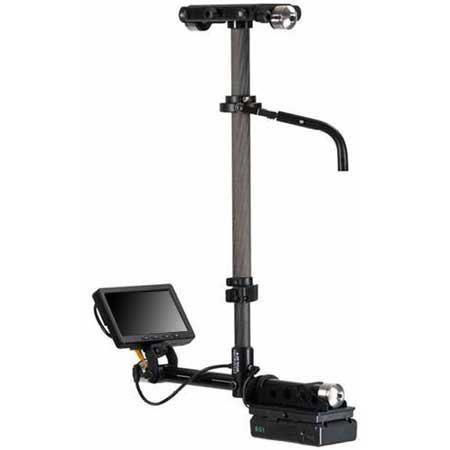
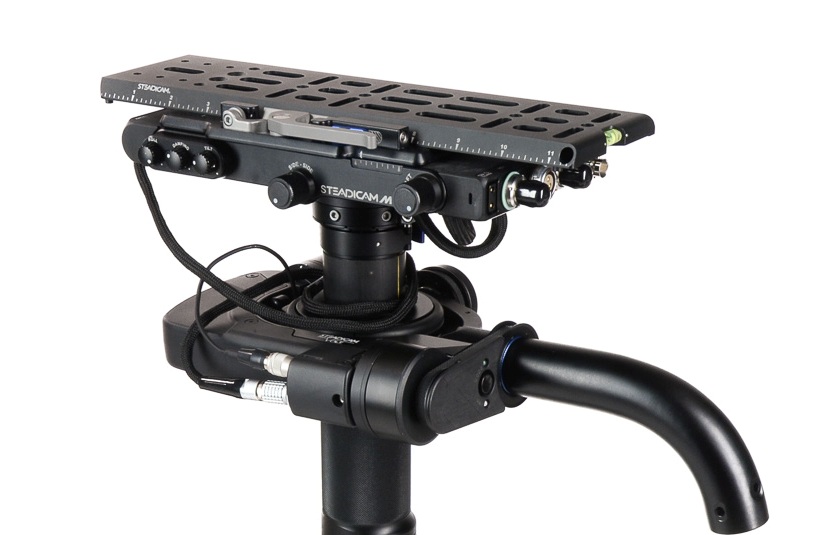
Pictured: The Arm, Sled, Docking Station and Vest of a M2 model Steadicam.

A Steadicam is a tool used to create fluid dynamic shots unlike any other camera movement apparatus. It consists of a vest worn by the operator connected to an articulating arm and a post that holds the camera and electronic components. The arm does the job of evening out the natural bounce of a body walking, smoothing out the shot. If you were to attempt the same with handheld, it couldn’t be as smooth. Even if I breathe with a camera on my shoulder, the movement translates to the image.

Examples

Popular Steadicam examples include the stairs run from Rocky, the hallway shot in The Shining, and the Copacabana scene in Goodfellas. If you haven’t seen those, by all means click the links and watch the clips. Since those are the most commonly used examples, I wanted to show some fresh ones. Kurush and I put together a video of examples of a handful of other movies that have inspired us.

What we can learn from these examples:

Point Break: The camera expertly follows a high energy scene in a police station, whipping between characters and moments to carry the scene forward. This is a more interesting take on the typical police station scene without being static and stoic. This clip gives a real sense of space in the station, from the character’s entrance to how he moves around the bullpen. This shot switches between framing the main two characters from behind, getting a wide shot of the entire place, and returning to frame the main characters from the front. There’s a nice variety of shots without ever needing to break away for coverage.

Snake Eyes: In this example, we see how perspective changes as the Steadicam moves around the scene. At one point, the Steadicam becomes the point of view for one character, the boxer. When we reveal who it is, the Steadicam backs up to include him physically in the scene.

Birdman: The movie is depicted as if it is a single camera following characters around for a continuous shot. Since that is the technique, shots are constructed by the camera moving closer or farther away from speaking characters, moving around the stage to reveal things and traveling between locations around the theater by following one character at a time.

Baby Driver: This is near the beginning of the film, introducing Baby and his connection to music in the film. This is a well choreographed and timed performance between the camera operator and actor. See how things are revealed as Baby walks how each element of the scene adds to the soundtrack (honking cars, a trumpet player on the street, pedestrians). Pay attention to the background on a second watch of the scene.

Last Night in Soho: In this thriller, Eloise is experiencing flashbacks to the 60s to a vivacious woman named Sandie and a connection to a series of murders. Eloise sees herself in Sandie’s perspective, sometimes in the mirror, and sometimes replacing her in the scene. This is another well choreographed number. In the video I included the behind the scenes clip showing the Steadicam operator. Note how Eloise waits for her turn to cut in to the dance, and how moments are revealed as the Steadicam travels around the main characters. You can also see a spotter helping the Steadicam out. There’s a lot of moving parts and nobody wants to have a camera run into them!

In Part 2, we’ll talk about the components of the Steadicam and why balance is so important.

Why Aren’t There More Women Directors?

Women have got to realize something:

We’re not funny…

We can’t do action…

We certainly can’t direct…

Maybe we should go truly old school and just have castrated men play all the parts? Worked in Shakespeare’s day, didn’t it?

Obviously the above is satire from my part, but it’s not satire on some corners of the Internet. When a movie does well, suddenly it’s “Oh my gosh, women can be funny!? What a good director! Amazing!” but when a movie goes bad, suddenly it’s “This is what happens when you cater to women. This was a bad female director, actor, writer, etc.” We’ve all heard the Madame Web jokes at this point.

I personally love the part where she says, “It’s Madame Webbin’ time.”

I too did not see that movie. But I probably will because I’m a glutton for punishment.

A 2024 Guardian article pointed out the discrepancy of proposed diversity and inclusion promises and what actually happened.

USC’s Annenberg Inclusion Initiative called out the major studies who claimed they would promote more diversity in their hiring practices after 2020 as “performative.” The study didn’t show any actual progress towards pushing for that change.

Women comprised 16% of directors on the 250 top grossing films in 2023, according to the study conducted by the Center for the Study of Women in Television and Film at San Diego State University. That’s down from 18% the year before.

I’m sorry, down?! Aren’t we more inclusive, more diverse than ever? Nope.

Of the 116 directors attached to the 100 top grossing films of 2026, only 14 were women. Look at those numbers again. That’s 12%.

These numbers are in direct contrast to the women dominated juggernaut of 2023, Greta Gerwig’s Barbie which was a $1 billion success.

By the way, only 4 of those directors were women of color.

Diversity and inclusion are — spoiler alert — not a bad thing. I work in the Atlanta film industry. I work with some of the most diverse crews you’ll see, and yet I still see so many sets that are primarily white and/or male.

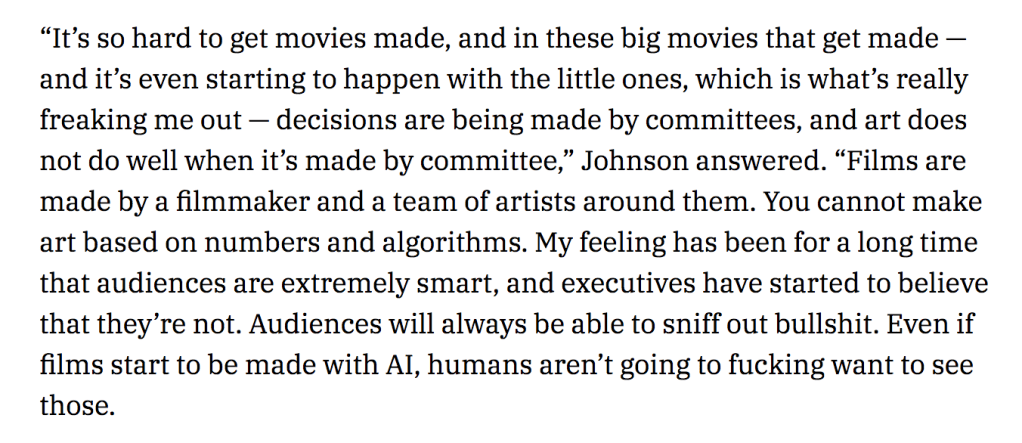
As people complain about superhero fatigue or girly movies just not appealing to mass audiences (The Marvels, Madame Webb) I want to share this piece of a statement from Dakota Johnson, the titular Madame Webb herself:

Dakota Johnson survived everything about Fifty Shades of Gray, she can surely shake this off too.

“Decisions are made by committees….art based on numbers and algorithms.” This hits hard because the shadier businessmen of Hollywood are surely looking to A.I. to pump out algorithm-satisfying garbage in order to save a buck. But for years it’s people sticking their fingers in where they probably don’t belong.

Film is a collaborative medium, and that’s a beautiful thing. I’ve seen my work in a whole new light after an editor or colorist has done their job, and I’ve seen scripts blossom through the work of careful critique and notes. Where it falls apart is when execs or producers or whoever start trying to make their mark and just doing arbitrary things they think the audience will want. Or they want. Like a giant mechanical spider in Wild, Wild West, which was originally pitched for the unproduced Superman Lives script. I don’t even have time to get into that one. Read about it here.

One of those arbitrary things is hiring someone like themselves to direct a film. Men in power tend to hire men that remind them of themselves.

This Variety article references a study about how first time directors get fewer offers, but even experienced directors are more likely to be hired if they are white and male. The stat speaks for itself:

  • 4.8% of experienced directors are female. 95.2% of experienced directors are male.
  • 16.3% of experienced directors are BIPOC, the rest are white.

“The results of this study are eye-opening. For underrepresented groups, there remain obstacles, structures and processes that stand in the way of getting that critical first shot. I’m encouraged that first-time directors get equal results, but they just need to be given equal opportunities,” said Dr. Yalda T. Uhls, founder of the Center for Scholars & Storytellers at UCLA.

It’s 2024. The time for arguing about more inclusivity seems to be falling on deaf ears. So let’s shout it a little louder. And in the meantime, keep your mind open about who to hire on your next film. You may be surprised by the incredible artists you connect with.

Sources:

Study shows ‘catastrophic’ 10-year low for female representation in film

First-Time Directors Still Have Limited Opportunities in Hollywood, New UCLA Study Reports (EXCLUSIVE)

Giant Spiders, Giant Flops: The Enduring Awfulness of ‘Wild Wild West’

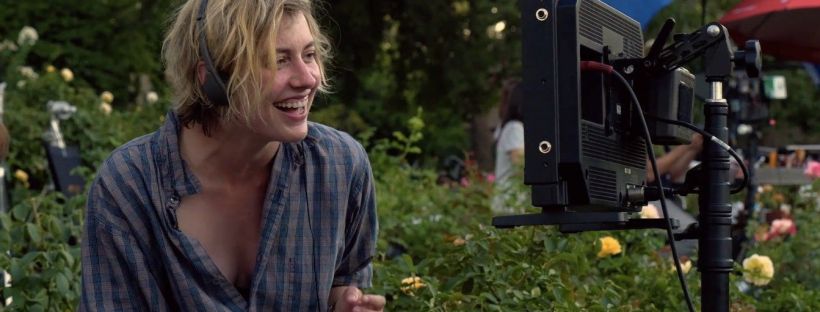
Featured Image: Greta Gerwig directing Ladybird.

How to Avoid Film Job Scams – Take Five

It would be a full time job for me to update this blog everytime I find a scam posted or someone I know shares a scam they found with me. There’s no way to keep up. My overall goal is to equip you with the know-how to see the red flags and avoid being scammed at all costs.

Sometimes I can’t name names. There’s a few reasons for this:

  • scammers can also be identity thieves who stole someone’s picture and name. You don’t want the real person to get in trouble.
  • It’s just a fake made-up name that will evaporate anyway. Like one I covered, Jake Smith became Jeffery Cooper became Ethan Snith.
  • Maybe I’m wrong. Or maybe the poster is just inexperienced and went about things the wrong way.

I do however want to bring the following items to light, and also reinforce the red flags you should look out for when vetting a scam job post.

Red flags to look out for when vetting a scam:

  • bad grammar/spelling
  • incorrect film terminology. (I.E. Production Assistance instead of Assistant.)
  • unusually high rate or weird weekly rates/hourly rates for usually a day rate job
  • Job poster turned off commenting on the post. That’s usually because people started getting suspicious and asking the right questions.
  • large blocks of text that ramble on about the proposed job.

You can also do your due diligence by briefly looking into the job poster. Do they have no Facebook friends? Did they recently make an account, or change their name and profile pic? Did they post a very similar job in multiple groups with different dates?

Now these things don’t guarantee a scammer, but if you checked a few of them off a list, that’s a real good indicator.

Kevin – But Not Really

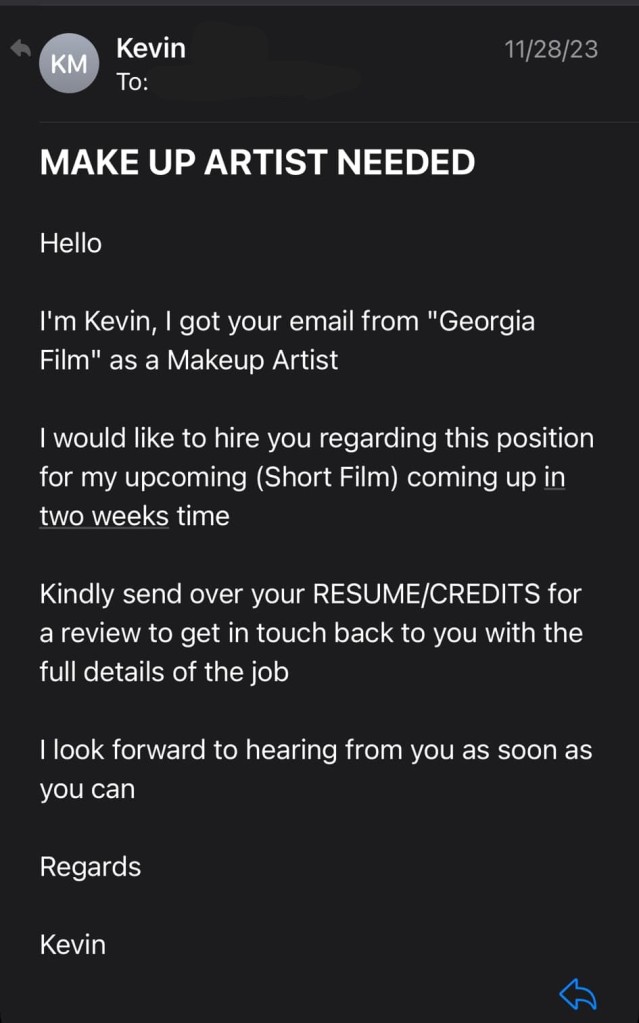
An Atlanta makeup artist was contact by a legit enough sounding job poster. They used a real person’s name who is in no way connected to the resulting attempted scam, so I deleted the last name.

It uses a familiar format: Fake Kev contacted the makeup artist saying they found their info on “Georgia Production website.” Sometimes it’s called a film directory or similar, but a lot of scams used this “I found you on (something that doesn’t exist).”

They also said “Kindly,” “regards,” and “send over your resume/credits.” which are all things I’ve seen a hundred times in these scam emails.

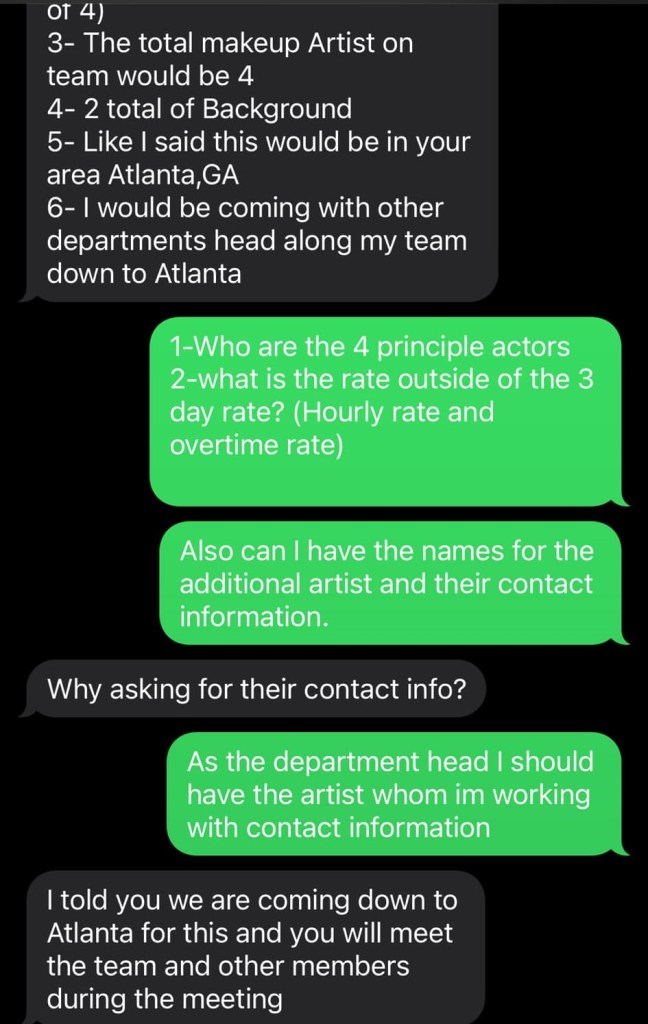
Although our makeup artist was excited at the opportunity to department head on a project, they kept a cool head and did their due diligence. They asked for a deal memo, tax docs and contact info for the additional makeup artist. This is all normal, good stuff to check on if you’re offered a job.

Then this mystery job poster sent a $3000 check to the makeup artist’s home….from an electrical company.

Folks, never, ever receive payment before a job. It is a check phishing scam. After that check goes in your bank and you immediately withdraw the funds for some equipment they ask you to pay for or, in this case, hiring an additional makeup artist, the bank finds out a day or two later that the check is fake and now you’ve sent your own money right back to the scammer.

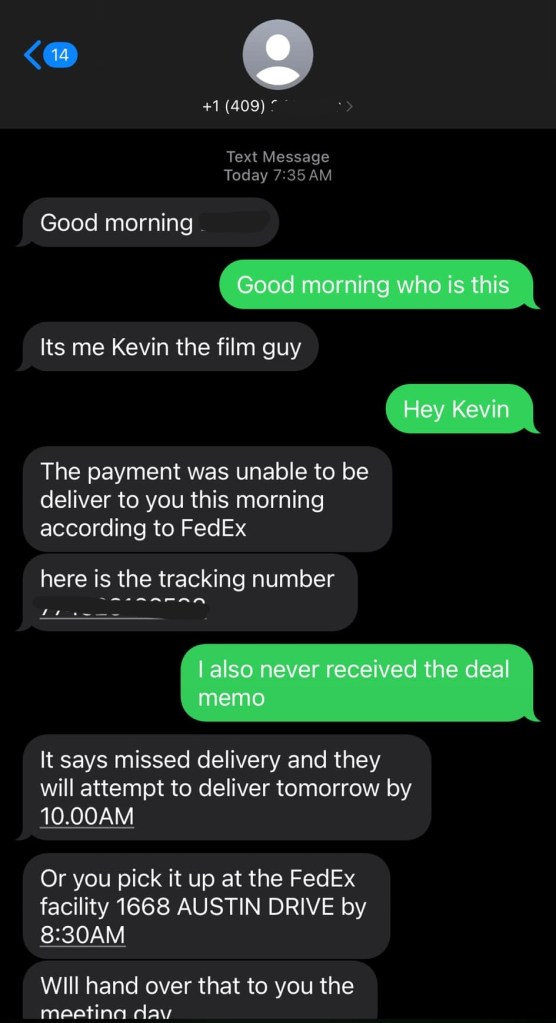
“It’s me Kevin the film guy” said the scammer

Our makeup artist did not get scammed because they knew when things weren’t adding up.

The scammer tries to guilt the makeup artist by saying they already confirmed (they didn’t) and trying to place blame on them for not stipulating a lack of deal memo was a deal breaker. And the scammer clearly didn’t know what a deal memo was because they proceed to call it a “demo” a couple times.

Sometimes these scammers know just enough about film to get by, but their story falls apart very quickly when a professional digs in.

Also note the poor grammar that indicates a non-native English speaker. “The payment was unable to be deliver,” “I will hand over to you meeting,” “You should have tell me this.” Look, I get it scammer, using past tense is hard. But if you want to make the Duolingo owl happy, you have to at least try.

Cinebyte

This one is posting a lot so I wanted to bring it to everyone’s attention.

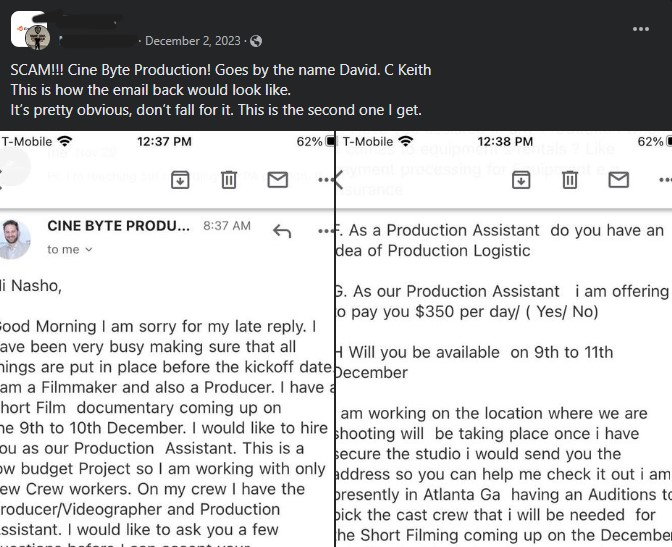
Another crew member in a Facebook group called out Cinebyte Productions as a scam, even posting the highly suspect email he received from the company.

The email is full of bad grammar and is just a huge block of text. I’ll reiterate what I’ve said in the past. When you are a professional in the film industry and someone offers you a job, it usually starts. “Hey, so-and-so recommended you. Are you available to cam op a scripted series in May?” And then you proceed to get more details on further communication.
The Cinebyte job postings are posted by several different people (or the same person using different names, isn’t this fun?). They also use multiple emails. So far I’ve seen: cbytefilm@gmail, lanawilson496@gmail, cinebyteproduction3, etc.

The postings are fake but the company is real. Someone stole David’s name and pic and the company name to seem legit.

I wanted this entry to end here. Guys, I’m tired of chasing these scams. I just want to catch non-Pokemon branded creatures in Palworld and relax for once. But there’s one more I’ve got to cover.

The Music Video Scammer

I’ve covered another shapeshifter before. He went by Jake Smith, Ethan Smith, Jeffery Cooper and every version of those names. Now we’ve got this guy.

Someone named “Eric” (but not really, follow along) posted this job for a PA on a music video. Responsibilities included driving talent and “on-set assistance” (groan).

A number of PA’s hungry for work fell into this supposed job. I learned they did do some driving around, but it became apparent that things were not on the up-and-up. PA’s were expected to pay for lunch, pay for an iPhone SE and headphones. They picked up Ken, a man who was supposedly in a car accident and couldn’t drive himself around. I suppose Ken, who claimed to be the rapper’s manager, the contact they were driving around, hair/makeup artist who, on closer inspection, might not have been an actual HMU. The driver/PA did three days of pickups/drop off’s to such places as a park in a seedy neighborhood, Cookout and, amazingly, Dave n Busters.

Every PA who responded to and did this job (it must have been more than the 3 days, as multiple people were scammed), did not get paid and were ghosted by Ken/Eric.

So Ken/Eric got called out on Facebook, and not long after he changed his name and profile picture to Chris, copying another real filmmaker’s profile pic and image, and posted this job:

I wasn’t ready to post the blog when this went up, so I immediately posted right after this that “Chris” was the same guy who scammed the music video PA’s. Within minutes, “Chris” deleted or changed his Facebook again. Whatever identity he picks next, I’m sure he and many others are out there ready to scam again.

A lot of our scammers are overseas, trying to steal your account information or get you to send them equipment and you’re out the money. But some scammers do this up close and personal. Let’s keep our community safe and keep each other informed.

Previous posts on this topic:

New Year, Same Old Film Job Scams

How to Avoid Film Job Scams – Take Four

SAG-AFTRA just threw their Voice Actors under the A.I. bus

2023, the year of the strikes.

The combined writer’s and actors strikes, WGA and SAG-AFTRA respectively, won workers more residuals and consulted the affected workers on issues of A.I. usage.

Then, yesterday, SAG-AFTRA dropped this bomb and acted like it was a good thing:

SAG-AFTRA and Replica Studios Introduce Groundbreaking AI Voice Agreement at CES

Replica Studios (Replica), an artificial intelligence (AI) voice technology company, and The Screen Actors Guild – American Federation of Television and Radio Artists (SAG-AFTRA) announced today the introduction of a groundbreaking AI voice agreement during an event at CES….

This new agreement paves the way for professional voice over artists to safely explore new employment opportunities for their digital voice replicas…

The agreement between the leading AI voice company and the world’s largest performers’ union will enable Replica to engage SAG-AFTRA members under a fair, ethical agreement to safely create and license a digital replica of their voice. Licensed voices can be used in video game development and other interactive media projects from pre-production to final release.

http://www.sagaftra.org

I like that they used the words “fair, ethical, safe” to describe how they were stabbing their membership in the back.

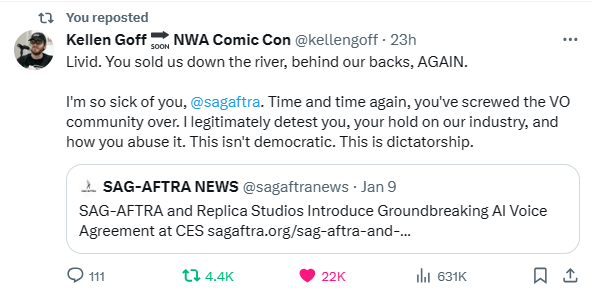
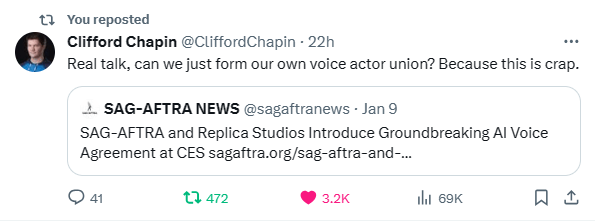
Why do I think that this went behind SAG-AFTRA membership’s backs? Simply because I found out about this because of how many voice over artists called it out, saying, “We didn’t vote OR hear about this. What the hell.” (paraphrasing)

Kellen Goff: Voice actor Five Night’s at Freddy’s (videogame), My Hero Academia, Attack on Titan, Black Clover

Elias Toufexis: Voice actor Starfield (videogame), Deus Ex: Mankind Divided (videogame), Blood of Zeus

Clifford Chapin: Voice actor in My Hero Academia, Attack on Titan, Spider-man 2 (videogame)

The technology already exists to sample someone’s voice and create a pretty convincing, if not soul-less replica of their voice. This isn’t only un-creative, it’s also completely un-ethical. This argument has also come up with the advent of deep fakes.

“Typically used maliciously or to spread false information.” Such as when someone made a deep fake of House Speaker Nancy Pelosi to act like she was impaired. Deep fakes can make it seem like anyone said anything, and that’s very damaging. And do I need to remind you how wrong it is?

Circling back to voice actors, what does this entail? Doesn’t the deal with Replica Studios just give voice actors the ability to sell a digital imprint of their voice? This could be interpreted as the actor’s choice.

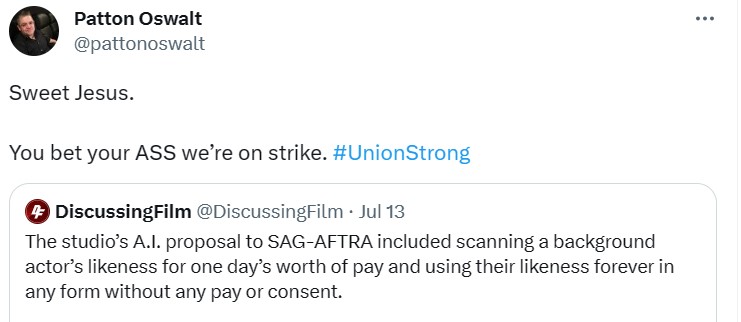
This issue was also brought up by SAG-AFTRA membership last year, when it became clear that production companies wanted to pay background actors a one time fee to digitally scan them, and then use that image in perpetuity. That’s forever, babe. That’s multiple thousands of dollars that person will never be able to make. That’s a likeness of them out there that could be made to do anything.

“But, I can’t afford to pay an artist/actor/voice actor/graphic artist for their work! I have to use A.I.!”

What did you do before the days of this technology? Several options: 1. Save up the money or fundraise so you could do your project. 2. Take the time to learn the skills yourself. 3. Reach some kind of deal with the artist you need, like bartering services in kind or deferred payment.

“But Bridget, you say. You don’t work in voice over or animation or videogames.”

I know, anonymous person in my head, but here’s the thing. When you attack one artist, one creative profession like this, you attack us all. And I like videogames and animation and artwork and writing, so I’m going to support the people affected and continue to fight for them.

Hey it’s not all bleak. Recently Wacom (a well known drawing tablet manufacturer) had to apologize for accidentally using AI imagery in their ad campaigns. This cute dragon image falls apart when you really look at it. A tail sprouts from the wrong direction, fur mushes into scales and other weird artifacts are present.

I’m just including the above example, not all 4 that artists uncovered because this post is already bloated.

Artists immediately threw backlash at Wacom. Simply, a company for artists should support them. They had to apologize.

“We want to assure you that using AI generated images in these assets was not our intent.

Here is what happened: Wacom purchased these images through a third-party vendor where it was indicated that they were not AI generated. We vetted the images through a few popular online tools that also indicated that they were not AI generated. However, given the community’s feedback, we are now not sure how the images were created. For this reason, we immediately discontinued their use.”

Wacom’s statement

This $750 Million dollar company can’t claim poverty. They could have commissioned a legion of artists for their marketing campaign.

If you’re like me, you’re going to continue to fight against companies replacing artists with soulless computer interpretations. The next job they take could be yours.

Sources:

SAG-AFTRA and Replica Studios Introduce Groundbreaking AI Voice Agreement at CES

The deal that ended the writers strike: A look at what the 3-year agreement says

Movie extras worry they’ll be replaced by AI. Hollywood is already doing body scans

Doctored Nancy Pelosi video highlights threat of “deepfake” tech

Artists are making creative companies apologize for using AI

A response to community questions concerning Wacom using AI-generated art in US marketing assets

The Case for Physical Media in an Increasingly Online World

Many PlayStation users were greeted with this legal notice recently:

PlayStation, due to “licensing changes” is deleting 1200 titles, including those that were purchased by users already, and not offering refunds.

The concept of ownership these days is tenuous. In the before-times, it was pretty clear. If you owned a record, a CD, a DVD…. that’s yours for however long you want it. You could sell it at a yard sale. You could Frisbee it at a neighbor you don’t like. That’s yours for all purposes with certain exceptions for illegal copying or pretending you’re a theater chain and trying to profit off the film yourself.

But as our technology changed, so did the way we consumed our media. Movie rental places were replaced by streaming services. Music aficionados actually pay for Spotify. You no longer have to go to a physical store and find the music you want. You could just yell in your house, “Alexa, play Running up that Hill by Kate Bush.”

Just yesterday I was reminded how things have changed. I was in a Discord with some friends. We were all playing separate games because the Eminem takeover killed Fortnite (don’t judge me) but meanwhile, we were using a bot called Jockie Music to play music for us while we talked. We went through some early 2000s emo, some pop 80s tracks, and on a whim one member played a soundtrack title from Final Fantasy. 800 miles apart, and we were all able to listen to the same music and request what we wanted from a personal digital DJ.

This topic also came to mind recently because I heard Best Buy was phasing out their DVD sales. Then I was in Target for Black Friday and their DVD section was one shelf. In Walmart the same, with the Entertainment section being taken over by tech.

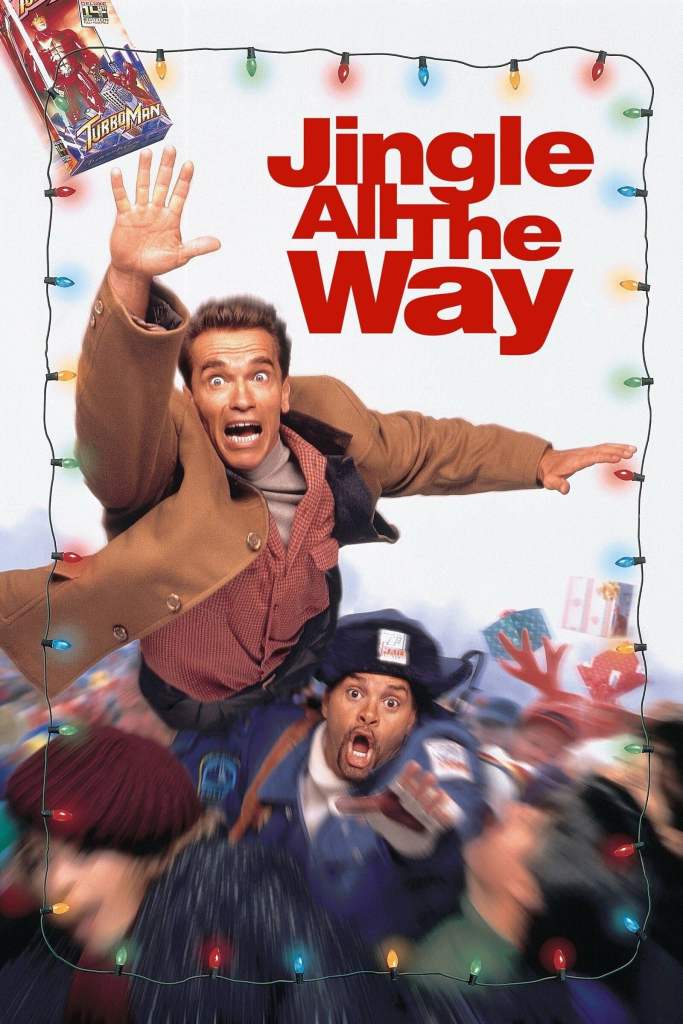
Have you ever tried to look up a movie that is 10, 20, 30 years old and can’t find it? Or better yet, you find it, but it’s not free. You have to rent a movie that’s been playing on regular TV for free for decades. Last year I had a hankering for a bumbling, heavily accented father trying to get his little Anakin Skywalker the hottest toy of the season. I speak of course of the 1996 classic Jingle All the Way.

Pictured here: Me, looking for outdated movies in bargain bins.

I. Couldn’t. Find. It.

I had 4 streaming services to choose from. It was nowhere without having to rent a nearly 30-year-old movie. This year Disney+ has custody, so…cool I guess.

That’s the thing. These streaming services all buy and essentially “borrow” a lot of their content through licensing. They compete against each other. You want to watch all the Spider-mans? And I mean all of them? Good luck finding them all on one service. You can’t even watch the Andrew Garfield movies (all 2 of them) on one service.

Besides the streamers flipping through content like cards in a deck of Uno, you also have the very real possibility that a company will just arbitrarily decide “You know what? We need a tax break.” And they delete their own movie off their service with no physical media to back it up. Gone. That content that cost hundreds of thousands of dollars, and so many people’s time and energy to create… is gone forever.

HBO Max reportedly cut costs last year by deleting 20 shows and movies including those that belonged just to them. That’s content that exists nowhere else.

Surely you’ve also booted up a service like Netflix and started the endless scroll to find something to watch. That’s apparently something these companies are very concerned about. From the previously linked MSNBC article:

“With the coming addition of Discovery+ content, Warner Bros. Discovery executives are concerned HBO Max may get bogged down with little-watched films and shows. That could cause viewers to associate the service with having a lot of stuff they don’t want to watch — the “Netflix problem,” said one HBO Max executive, who asked not to be named because the decision was private.”

Digital content isn’t, necessarily, forever. I feel like the NFT bros have also come to this conclusion.

The case could be made for physical media to experience a resurgence. Heck, record sales are doing well. Yes, vinyl! Vinyl sales were up for the 17th year in a row, though the article I reference did mark a slow in growth, probably due to price increases.

I get it. The way movies have been marketed has been diluted by so many avenues, and folks don’t necessarily have $22 to lay down on a movie to add to their collection. But your favorite movies, the ones you want to go back to time and again? They’re worth it.

Maybe I’ll end this by proposing this ridiculous idea: Physical media on demand. Sure, the vast rows of TV season box sets and various editions of Blu-Ray and DVDs might have to be phased out, but perhaps there should be a way to custom order the physical media you want so it’s only produced when someone orders a copy. Less waste is created. But at least there has to be a way to keep digital copies of movies that were acquired legally. Otherwise, I think the pirates will probably win, and that’ll be yet another struggle in the film industry to fight.

Sources:

PlayStation Store To Lose More Than 1,200 Purchasable Titles – With No Refunds

Where to Watch Every Spider-Man Movie Online in 2023

Streaming services are removing tons of movies and shows — it’s not personal, it’s strictly business

Here’s why HBO Max is pulling dozens of films and TV series from the streaming platform

U.S. Vinyl Album Sales Rise for 17th Straight Year — But Growth Is Slowing

Header image: Photo 26195729 | Dvd © Tonny Anwar | Dreamstime.com

Why Residuals Are a Big Factor in the SAG-AFTRA and WGA Strikes

The WGA and SAG-AFTRA are both on strike against the Alliance of Motion Picture and Television Producers (AMPTP) halting TV and film productions and leading to a very sparse year financially for many film workers. They’re just asking for more money, right? Yes and no. This is certainly not a case of greed from the average film worker, but from corporate CEOs who make hundreds of millions of dollars a year while balking at a small percentage that writers are asking for. To put it in perspective, since 2018 writers have seen an inflation-adjusted fall in revenue of 14%. For writer-producers it’s worse at 23%. In recent years, the numbers of writers working at a WGA minimum went from a third to half of all writers. Meanwhile SAG-AFTRA actors report paltry residuals and popular TV shows that didn’t properly compensate them either, and a big culprit is streaming.

The WGA Strike Began May 2, 2023

The WGA went on strike in May when negotiations broke down. How far apart was the WGA’s proposal from the AMPTP counter offer? The WGA asked for a pay increase for members totaling $429 million per year (that’s only about 5% on WGA minimums). The AMPTP countered at $86 million per year, an amount they called “generous.”

You can consult this page to see the WGA’s terms and the AMPTP counter offers.

The WGA has gone on strike for several reasons, one of them being paltry residuals for streaming shows. Residuals are compensation for a performer when their work is re-run, syndicated to another network, or sold as a physical media such as a DVD box set to name a few. Streaming obviously complicates this because programs are not broadcast in the same fashion as on traditional TV.

“Over the past decade, while our employers have increased their profits by tens of billions, they have embraced business practices that have slashed our compensation and residuals and undermined our working conditions,” said the WGA Negotiation committee to its members prior to the strike beginning.

Surprisingly, WGA West’s fiscal report in March 31, 2022 reported an “all time high” in guild collected residuals. How does that make sense when writers claim they’re making less?

Because they are making less!

The total residuals may appear higher, but that is due to the volume of extra projects being made. It’s no longer just theatrical releases and network TV. There is a cornucopia of different streaming platforms all vying for a catalogue of material to get you to sign up for another subscription service.

Charles Slocum, assistant executive director at the WGA West, indicated that residuals slashing was taking place on a per-program basis, and the major culprit was streaming services.

And so, when WGA contracts were coming to an end this year, residuals were one of the main points they would negotiate for — as well as not having writers replaced by the likes of ChatGPT.

Slocum also made the point that companies have not agreed to pay residuals at broadcast levels for streaming programs. “If you write for a streamer, you get two residuals payments – one for domestic streaming and one for foreign streaming. It’s a set amount of money. If it’s a big hit, you do not get paid more residuals in streaming, whereas in the broadcast model, you do because of its success. That’s the sense that residuals were slashed – they have not agreed to a success factor when a program is made for streaming.”

Many writers, actors, and other film industry professionals have taken to social media to explain what position they are in. Screenwriter Daniel Kwan, Oscar-winner for Everything Everywhere All at Once, said on Twitter, “It’s about maintaining a healthy middle/working class of writers in our industry. It’s about showing our collective strength as new tech threatens to take away our leverage.”

The average person may assume that screenwriters (and actors!) are making so much money already that this argument is unnecessary. But the truth is, the majority fall into middle class status or lower. Only a small percentage make the insane bucks that make headlines.

Shrinking writer’s rooms has also been a factor that has plagued modern writers. In traditional TV, you’d have a group of people hammering out episode ideas, sharing script writing duties for 20+ episode seasons. Now, with streaming’s angle towards shorter seasons (8 episodes seems the norm these days) and fewer writers, the entire process has shifted. Shorter seasons and smaller rooms equals fewers weeks of pay and more gaps in work for writers and actors alike

SAG-AFTRA Strike Began July 14, 2023

Actors too, are striking for better conditions. They decry similar concerns such as waning residuals from streaming to A.I. creating virtual versions of actors and replacing them, the actors were ready to put their foot down and join the WGA on the picket line.

“There has been a sea change in the entertainment industry, from the proliferation of streaming platforms to the recent explosion of generative AI, and at stake is the ability of our members to make a living,” said SAG-AFTRA Chief Negotiator Duncan Crabtree-Ireland. “We must ensure that new developments in the entertainment industry are not used to devalue or disrespect the performers who bring productions to life.”

The culture’s shift to streaming has led to shorter season runs, and therefore fewer episodes and less work for recurring performers on shows.

Most actors, like the writers, do not make the big bucks that make readers of Variety blush. Many are considered middle class or even struggling to get by. As the strike was authorized, numerous actors took to Twitter to provide anecdotes on why the strike was necessary.

The popularization of A.I. tech has made both writers and actors nervous about the reality of losing their jobs. This is a huge topic, and difficult for me to cover without this post ballooning into a novel’s length, but suffice to say that AMPTP has unironically looked at A.I. as a cost-cutting maneuver to replace people.

This post went around recently by Justine Bateman, A.I. consultant to SAG-AFTRA during the negotiations.:

All indicators are showing that we’re going to be in this for the long haul.

Sources:

Deadline: Are Streaming Residuals Being Slashed? As WGA’s Own Data Shows, It’s Complicated

YouTube Video: Steve Schmidt explains how the SAG-AFTRA & WGA strike impacts the American middle class |The Warning

Tensions from the last writers’ strike cast a shadow over current labor fight

Why Actors Are Going on Strike

Mini Rooms Drive Major Controversy as Creative Community Feels Strain of TV’s Vast Expansion

SAG actors strike, joining Hollywood writers. What are we supposed to do now? Read?

Feast or Famine: Looking at the Stats

It’s the end of February, and all I’ve heard from various film friends is “I’m not working right now, are you?” A winter slump is normal, especially December into January. I just go into these months expecting the slowdown, and for things to pick up in March.

But another kind of work anxiety hits. How much do I need to reach out to jobs before I work regularly? It’s not an easy answer, but looking at my own data, I can see some patterns.

Since 2018 I’ve been keeping track of how many jobs I’ve applied to or been recommended for, and how many jobs I actually got. I meant well, but as times got busy, I eventually lost track or didn’t keep the best data. But I decided, you know what? There’s still something here to see. At least from 2018-2021.

I’m looking at two main things. Gigs applied to, referred to, or inquired about vs Gigs actually worked.

A Handy Dandy Chart

YearGigs AppliedGigs WorkedHow many applications until a job
20181231210
2019164266.3
2020105205.25
202160351.7

Within 4 years, you can see that I went from sending out 10 applications to get to one job, to sending out about 2. Now, I went to art school so I can’t Math all that well, but that looks like a good trend to me.

If I just don’t think too hard about it, the math checks out

I didn’t bother showing info from 2022 because I had several long running gigs and decided not to be Type A about showing what jobs I applied to anymore.

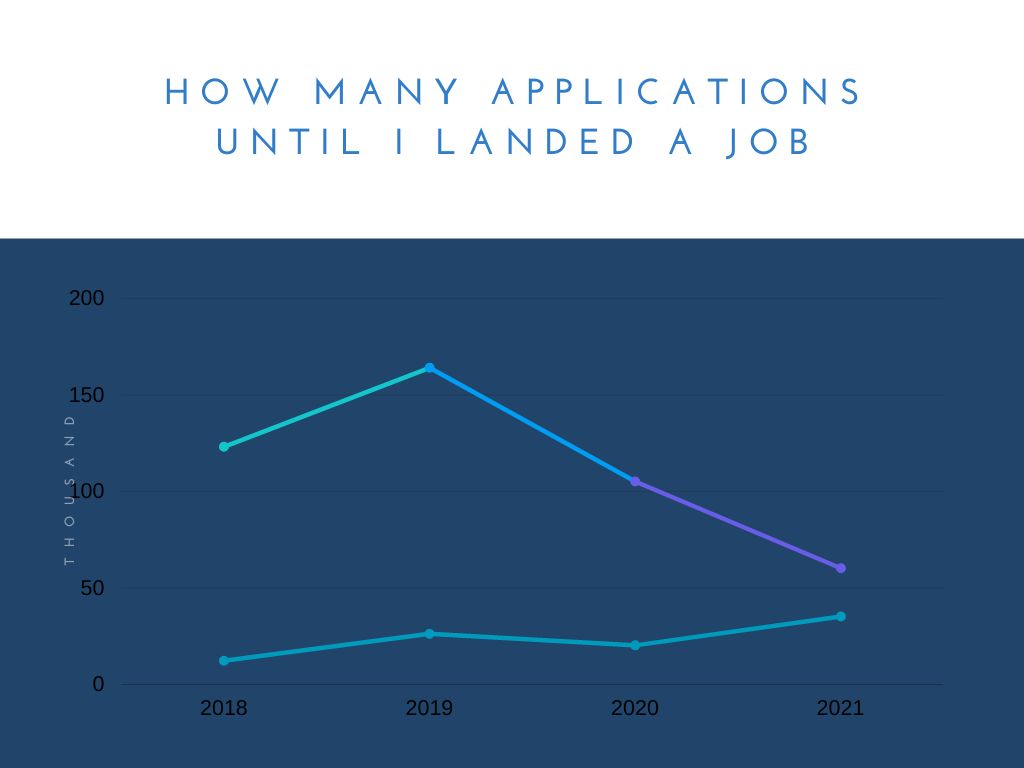
Represented as a hastily thrown together graph on Canva, that looks like:

Top line = Number of applications

Bottom line = Number of jobs landed

Closing the gap is a good thing.

There’s a few things I want you to know about this data.

  1. It takes a lot of effort to establish yourself in a new market. When I arrived in Georgia, I had to do a lot of legwork to start getting jobs.
  2. As time went on, a lot of my applications were actually just recommendations — people recommending me for gigs. When you become known, the work starts coming to you.
  3. I didn’t bother keeping track in 2022 because I was almost 100% working based off recommendations and had several longer runs on shows, whereas previous years I had more day-play opportunities.

If I look at my Google calendar from those years, I see wide swathes of nothing going on for days or weeks during the same slow months. Film is a marathon, not a sprint, and you’ve got to plan accordingly for the slow times. And those slow times can make you feel like you’re beating your head against the wall.

And it’s not just as simple as applying to jobs you see posted on job boards or Facebook groups or throwing your name in the ring for open crew calls.

A lot of the work I did alongside all this was networking, meeting people for coffee, doing casual fun things with fellow filmmakers, helping out on friend’s sets, speaking to students and film clubs, and even writing this blog. Self-promotion is a big deal in addition to applying for jobs. Networking is the glue that holds it all together.

I also applied to a lot of jobs in the slow months of January and February each year. There’s a lot more competition then, because less people are actively working.

This is my way of saying, if it’s slow right now, it’s not just you. It’s a lot of us, and there’s a lot of folks scrambling for the next job.

Keep in mind we’re also on the brink of a possible union strike down the line, and theories have been floating around about productions holding back from starting. I don’t know for sure. All I can say is to hold tight and know that you’re not the only one not actively working right now, and if you’re new — it’s going to take a lot to get yourself established.

This is not an easy industry to get into, but those who have the fortitude to stick through the hard times end up successful.

Sources:

Hollywood Braces for a Possible Writers Strike: Why the WGA and Studios Are on a Collision Course

What’s Your Rate? (What’s Your Budget?)

A classic standoff worthy of any gunslinger this side of the Alamo.

One of the most hardest parts about working in film production is not what you’d expect. Sure there are challenges in regards to getting on set in the first place, gaining knowledge in different fields and just surviving your first long day as you question your sanity in regards to the freelance life, but there’s even more to consider.

I’m talking about rates.

In this business we set rates for ourselves to work on a production per day. This is usually on a 12 hour regimen, however there can be rates for specifically 10 or 14 hour spans as well. It depends on the production and the nature of the job position. Steadicam Ops, for instance, may charge a day rate for 10 hours or less due to the physical nature of the job.

Some jobs set the rates they are willing to pay for the various positions on their set. For example, a short film production may call you up, looking for a 1st AC, saying they are willing to pay $350 per day max. It is then up to you and your calendar whether you’re willing to take that rate for that day.

However the opposite could be true. An indie feature producer may call you, asking what your rate is.

So, why is the budget/rate stalemate so tricky?

You may have different rates depending on the scope of the job and the type of project. For example, I may not charge the same for a small short film shoot than I will for a corporate or feature film. It is also up to me if I’m willing to take a job, available or not, for any number or set of conditions.

Asking a production what their budget is proves a valuable way of gauging what the project really is. A Tier 1 feature is going to have a different budget reserve than does a small weekend shoot. A production not willing to share basic information can sometimes be a red flag. But having a basic understanding of budget will determine if you’re asking for your full rate, or a discounted rate. Either way is totally up to you. Ask for your full rate every single time if you’ll only work for that. It’s your skills on the table, after all.

Of course, setting your rate can be a hard decision. Are you new in the industry? Have many years of experience and special skills to bring to the table? That can change those numbers.

An important thing to remember about setting a rate is how many variables it contains. What are the expected rates for the job? How many days is the job? What are your expenses? How often will you get work?

There’s no one right rate. You can find out what union rates or commercial rates are and go from there, but a good rule of thumb is to ask. Normalize asking other people in your department what their rate is. Money is awkward to talk about but an important part of being a freelancer.

Oh! I didn’t even mention kit rentals and deferred pay.

A Kit rental is what you charge to bring your gear to a production. This is for specialized gear, like a camera, a Steadicam, a camera cart, a drone. You charge your rate PLUS the kit rental on that gear. To get an idea of what that rental should be, look at rental prices on something like Sharegrid or Adorama or local rental house. Kit rentals are important because that money goes towards paying that expensive gear off — and buying more.

If you see a job post somewhere indicating there’s deferred pay, I’ll give you two definitions: Deferred means “paid later” and also “you will never get paid.” If someone wants you to work a job for deferred pay, they are claiming they will pay you later. Films are expensive to make and likely the movie that doesn’t have a budget to pay it’s crew won’t be making a ton of money and then funneling any of it back to you. Financially, movie making is a risky business, especially in the independent world. Only do a deferred project gig if you want the experience and don’t mind if you never see a dime.

RE: Hollywood Scandals. Should we separate artist from art?

The floodgates have opened to scandals about sexual abuse from high level people in Hollywood.

We shouldn’t be surprised at the numbers, right? The “Casting Couch” is a dirty joke for a reason. This ousting of abusive, harassing jerks has been long awaited.

But now with this news comes the moral dilemma — can we continue to consume content knowing someone who made the film is a creep? Series have been cancelled, movies have halted production, and companies no longer want to work with those who’ve been named, but what happens when the choice is left to us?

I’ve written before on a moral dilemma surrounding the creation of a film and the final product.

I’ve also had this internal crisis with an author I once admired — Orson Scott Card. I had already read and enjoyed several of the Ender’s Game books before I found out how much a bigot the author was. It was hard to fathom how he could promote empathy and understanding in his writing, but not in real life.

Prime examples of abuse fill the shadowy corners of Hollywood classics.

shelley duvall

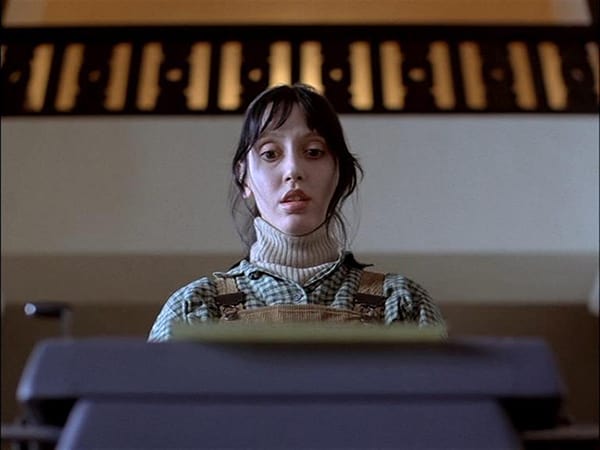
Shelley Duvall was forced to do 127 takes during that baseball bat scene in Stanley Kubrick’s The Shining. Several documentaries, including one by Kubrick’s own daughter, showed Duvall intentionally bullied. Kubrick told crew members not to sympathize with her, and she skirted illness constantly due to the stress.

Duvall did not have many acting credits after her 13 month stint on The Shining, and is reportedly not in good mental health these days.

Tippi Hedren dealt with Alfred Hitchcock’s obsession and sexual abuse on The Birds and Marnie. She said he would suddenly grab her, put his hands on her and become “petulant” whenever she talked to another man. He even jumped on top of her and tried to kiss her in a limo. He tortured Hedren on set with live birds when he was supposed to use fake ones. She described the scene as brutal and relentless.

tippihedrenbirds_large

Hitchcock threatened to ruin Hedren’s career when she wouldn’t cave to his advances.

In an interview with Variety in 2016, she explained why she opened up about the abuse in her memoir:

I wanted to let women, especially young women, know never to allow that kind of approach and to be forceful in telling people you’re not interested in having that kind of a relationship. It’s not a bad thing to say no.

Full article here

This abuse doesn’t live solely in the past. Finally, women and men are taking on their abusers in order to create change in a problematic industry.

Then there’s us. The consumers. Articles like the one below are popping up everywhere, everyone wondering: What should we do now?


It’s all down to personal choice at this point. If Netflix didn’t cancel House of Cards, could you still watch it? Will movies from the Weinstein Company leave a bad taste in your conscience?

What to do

Yes, it’s problematic when things we like are made by people we don’t agree with on a fundamental level. There are several things we can do, though.

  1. Talk about it.

    Don’t internalize this struggle. We have numerous forms of social media in which to share an opinion. Tag the production company. You’d be surprised who is paying attention. Also, consider writing an opinion piece for your local newspaper on the subject. Local newspapers enjoy getting public input and people will be interested in reading those words, and maybe someone can be swayed.

  2. Don’t consume the art.*

    This one can be more difficult if you are already a fan of the work. Your spending power says something. If enough people don’t pay for a movie, the box office will reflect it and production companies will take note. They will not want to work with an actor or director that the public is no longer willing to support. They like predictable cash flow.

    * a necessary side note: for the love of all that is art, do not pirate a film. If you want to see it, you pay to see it. It’s as simple as that. Use Redbox instead of going to the theater, or watch it at a friends house. I don’t care. Just don’t pirate. Thousands of people’s livelihoods depend on box office receipts, mostly people who make significantly less money than the person you have an issue with. Don’t steal their work.

  3. Consume art by artists you DO believe in.

    Use your purchasing power to support indie films, films by women and LGBT filmmakers or other poorly represented minorities. Kickstart someone’s passion project. Get voices out into the light who need to be heard. Your $10 here will make a bigger difference than your $10 on a blockbuster summer tentpole.

Your opinion matters. Keep the discussion going. It’s the best way to turn things around so future generations don’t have these stories anymore.

Sources

Tippi Hedren on Why She Went Public About Being Sexually Abused

Tippi Hedren says Hitchcock sexually assaulted her – USA Today

Orson Scott Card: Mentor, Friend, Bigot

An Ethical Guide To Consuming Content Created By Awful People Like Orson Scott Card

He’s a Creep, but Wow, What an Artist!

The Real Horror of ‘The Shining’: The Story of Shelley Duvall