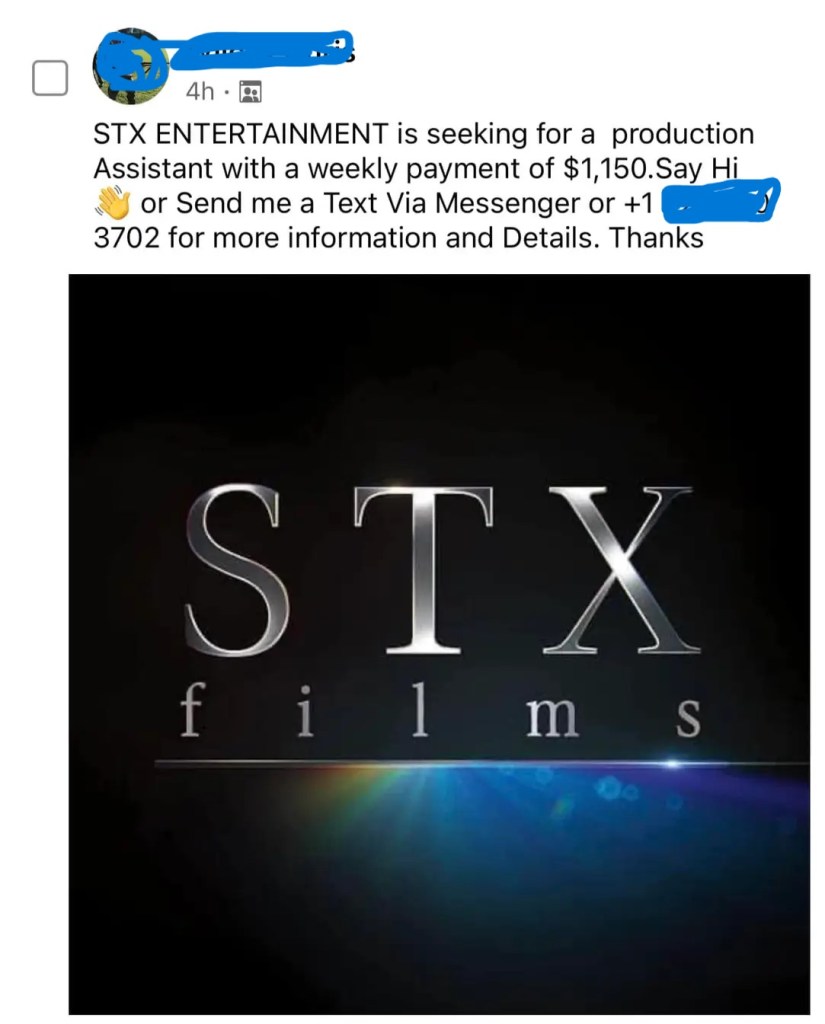
Does the Art Directors Guild Suspending their Training Program Signal a Massive Change?

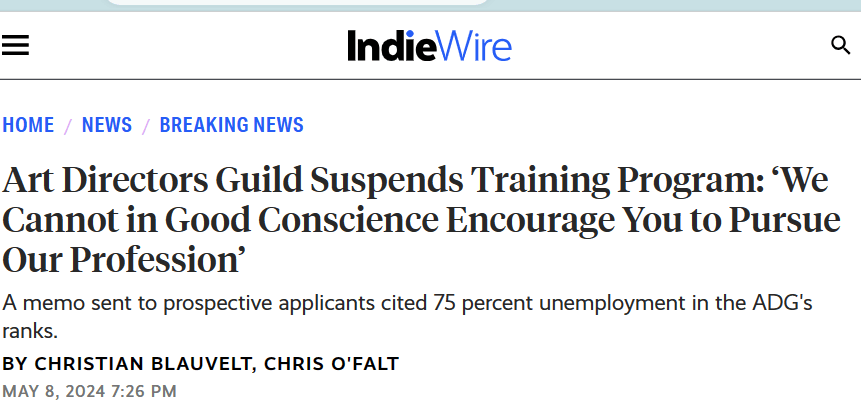
Recently, this article made the rounds:

Read more on IndieWire.

The Art Directors Guild, IATSE 800, is a union representing over 3,000 Art Directors, Illustrators, Scenic Artists, Graphic Artists and Set Designers in the film industry. In the article, we learn that the Art Directors Guild sent an email out announcing they will suspend their training program due to the 75% unemployment rate among its union member’s ranks. This decision is entirely reflective of the ripple effect of the SAG-AFTRA and WGA strikes last year.

“The industry has not resumed a full, pre-strikes level of productions, and it remains unclear if a return to that status quo is possible in a Hollywood gripped by ever-higher costs, ever-lower revenue, and increased production abroad.”

-IndieWire

This also brings to mind how many people I see announcing they are moving to Atlanta and looking for connections in the local film industry. That’s fine but, I hope everyone and anyone who is thinking about going into film for the first time or moving to continue their film career does a bit of research first. We clearly haven’t recovered from the two strikes last year (necessary though they were, they also hurt financially). I also question if we ever fully recovered from 2020, when the pandemic shuttered production across the world.

But with a pandemic that encouraged people to stay inside, there ended up being a lot of TV being consumed. The streaming companies — Netflix, Hulu, Disney+, Paramount, etc — got excited.

In 2021, Netflix boosted their budget almost 30%, putting $13.6 billion into content spending. This article from 2021 predicted their budget would balloon to $18 billion by 2025. An sharp upward trend seemed likely.

In 2023, Netflix content spending was around $17 billion. And before you point out “but 17 is so close to 18!” I need you to realize how vast a number 1 billion represents. If we were to use time as an example: 1 million seconds = 11 days . 1 billion seconds = 31 years.
Streamers are focusing on more original content in order to keep customers interested. There’s also a noted shift into reality style television, as shows like Netflix’s Nailed It cooking competition series are still popular and much cheaper to produce than narrative content. I’ve also talked before about these companies not greenlighting projects and just outright cancelling them to save a buck.

The streaming companies blew their budget on a dream, and now the bill has come due. They over estimated their profitability while fighting each other for market dominance. Instead of one triumphing over the others, we have a consumer base watered down and split amongst many services, if they even have streaming at all. Who misses cable now?

There is also likely a slow up because of this year’s negotiations between the AMPTP and IATSE, Teamsters and Hollywood Basic Crafts. The current 3 year contract expires July 31st. These unions are negotiating for proposals on Pension and & Health Plans, wage increases, residuals and concerns over artificial intelligence.

A strike doesn’t seem as likely this year. For one, the negotiations appear to be making some headway. Several unions such as Local 892 Costume Designers and Local 728 Lighting technicians have reached tentative deals.

But, the reality is that most folks can’t afford to have another strike. That’s concerning because of what’s on the docket but also…totally understandable. Those of us in this position are trying to recoup from last year. Some folks haven’t worked at all this year. That’s unheard of in most other professions.

The fact that the Art Directors Guild suspended their training program is genuinely sad to hear, but it seems to have been done with the very real concern about not putting more pressure on folks who need work right now. As hard as it is to see, not adding trainees in the guild for a time is a kindness. And surely, when things pick up, they can reassess and reopen their ranks to new people.

Will things ever go back or is this a hint at lasting change? The answer is far more complicated than we can surmise right now.

Sources:

Art Directors Guild Suspends Training Program: ‘We Cannot in Good Conscience Encourage You to Pursue Our Profession’

Netflix’s Amortized Content Spending to Rise 26% to $13.6 Billion in 2021, Analysts Project

Analysis: Content Spending Will Slow in 2023 as Streamers Pivot to Profitability; Disney, Netflix to Lead Way

IATSE Lays Out Contract Proposals, Including “Substantial” Health & Pension Plan Increases, As General Negotiations Begin

Georgia film industry sets another economic impact record

How to Avoid Film Job Scams – Take Six

Okay, first thing — Thank you to everyone who shared the blog and reached out to tell me that they used my blogs on scams as a resource to keep themselves and their friends safe. It really warms my heart to see a difference being made.

I don’t only write about scams but since getting the word out has been useful, I’ll keep up the occasional update post on the topic.

Recently I spoke at another Atlanta Film Production Mixer about my career and what red flags to look out for. Again I had multiple people telling me about scams they encountered.

Lovely photo shot on actual film by one Marco Gutiérrez.

It’s time for an update. Here are a few more scams to look out for. Now, keep in mind how they are done, not necessarily the individual job itself. Most of these posts have dates that have passed now. It’s literally impossible for me to keep up with them. But if you note why these posts are scams and arm yourself with that in the future, you are less likely to become a victim.

The Math isn’t Math-ing.

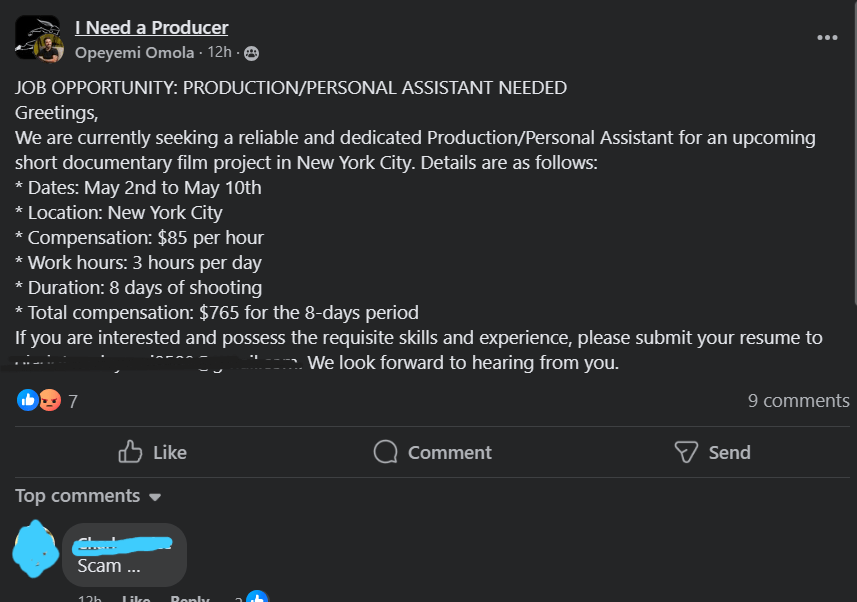
How can you tell this one is not a real job?

For one, some quick simple math will tell you something is up. They claim the job pays $85/hr. It’s 3 hours a day for 8 days. $85×3= $255/day. $255/day x 8 days = $2,040. The post claims the Personal Assistant PA is getting $765 for the entire job. Wow.

Also, a “personal assistant/production assistant”? Those are two different jobs.

For some reason I’m also seeing this “3 hours a day” grift a lot lately. Maybe it’s to entice people for a seemingly large reward for minimal work.

Another thing to do when considering if a job is a scam or not is to check the likes and comments. Here you can see one person who is familiar with this particular scammer and calls them out.

That’s…Not How This Works

This can be a scam or just a person who doesn’t know much about the film industry. Sometimes that’s the same person.

I’ve seen multiple jobs asking for “two DPs” or a media manager who is actually acting as an editor assistant.

The two DP’s thing I want to elaborate on quickly: a project typically has one Director of Photography. That’s the lead guy or gal in charge of the camera department. You don’t want too many cooks in the kitchen. You may find multiple DPs on very large Hollywood style projects or big features, because you might have a second unit DP in charge of stunts and other scenes. You would also have multiple DPs for different episodes of TV shows.

But if you see a post for a small project looking for multiple DP’s, they are either misunderstanding what a camera operator is or …

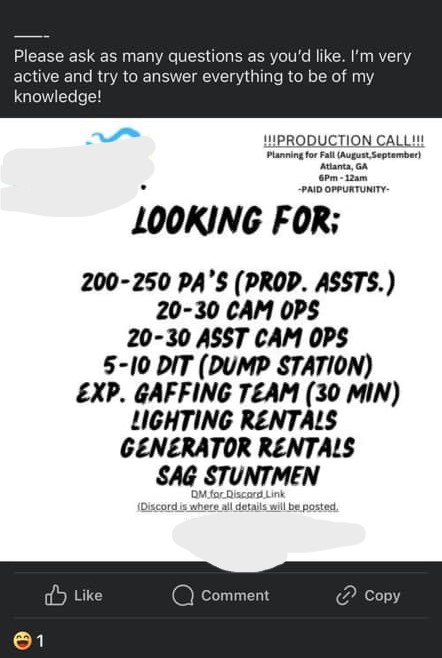
200 PA’s and 20+ camera operators and assistants? Either this is a huge show or…

Maybe just see that they want you to join a Discord for more information and realize what the problem is.

“No Experience Necessary!”

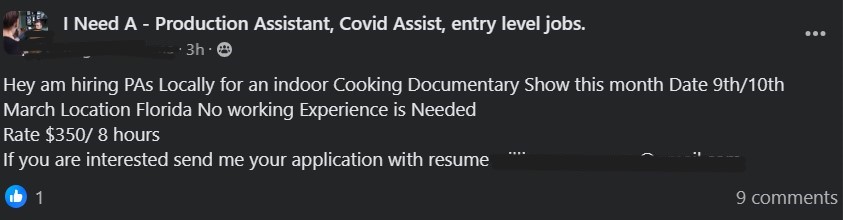
Be very wary of any film job that says “no experience necessary.” I’ve seen that on a lot of scams too.

Truth be told, production assistant is an entry level position. A job can ask for a more experienced PA or one who has worked on certain shows, but the understand is that sometimes this is a PA’s first job.

But how about a job offering a suspiciously high rate for a first time PA?

Yeah, stay away from these.

Steadicam 101: Balancing and Operating

We’ve learned why we use a Steadicam…

We’ve covered what pieces make up the Steadicam…

Now it’s time to balance and actually use the thing!

Balance

A Steadicam cannot work properly if the rig is not balanced.

Again, this is a simplified version of balancing. To really learn, you gotta get your hands on a rig, or at least observe a Steadicam operator as they prep.

First of all, you need to find the center of gravity, or cg, of the camera. After the camera is built (i.e. it has all the accessories and lens you’re going to use for the shot) you can find the cg by rolling the camera body on a rail. Where the camera is balanced on that rail, mark with a piece of tape or just remember where it is.

  • The camera is placed on the sled via the cheeseplate on top.
  • The post is lengthened to the appropriate length. This is in relation to how much weight is on the camera at the top.
  • On the top stage are the adjustment knobs to move the camera right and left or front and back. This is the fine adjustment.
  • If the rig is perfectly balanced while stationary, you’ve achieved “Static balance.” If there’s time, proceed to:
  • Dynamic Balance.” Spin the post on the balancing peg and see if the camera tilts any direction. You then make corrective adjustments with the fine adjustment knobs, moving the monitor in/out and moving the battery in/out.
  • adjust the tension on the arm so the camera floats where you want it.
  • the vest is adjusted to the operator’s body so it doesn’t slip and pressure is exerted evenly across it.

Operating

Actually operating the Steadicam requires a lot of physical and internal adjustments.

The operator has to have good posture. They walk forward, smoothly, making minor adjustments as needed. They avoid accidentally cross stepping, so they don’t trip.

While the operator’s feet carry them where they need to go, their hands are busy making sure the camera is where it needs to be pointed. The left hand is on the gimbal, in charge of panning, while the right hand lives on the handle that connects to the arm, moving the rig up and down as needed.

For more in depth information about Steadicam operating, check out the Steadicam Operator’s Handbook by Jerry Holway and Laurie Hayball.

Steadicam 101: What Components Make a Steadicam

When the Steadicam operator walks on set and starts setting up their gear, it can look pretty impressive. Here’s this guy or gal with cases of specialized equipment that looks like it belongs to Robocop.

Or maybe Alien.

Contrary to this picture, Steadicams are not all that great at eradicating alien threats.

So what part is the Steadicam?

Ah, not an easy answer actually.

I’ve worked with a number of newer directors, and there’s a bit of a learning curve I often have to help with there. Sometimes I’m asked “So you have a Steadicam? What camera is on there?” And I answer, cautiously, “Whatever camera you want within the weight limit.” But then I figured out…some folks don’t know the camera is actually not part of the Steadicam. The Steadicam is the device that moves the camera around. It’s a dolly if it had feet and shock absorbers instead of wheels and rails. It’s a tripod with an ego. And it’s also not those things.

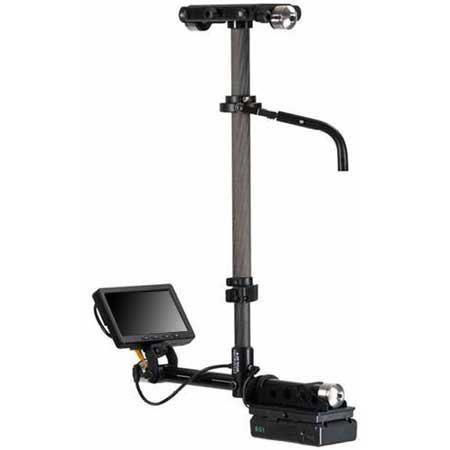
The Steadicam mainly consists of 3 major components: The Sled, The Vest and the Arm.

Pictured are parts of the Steadicam M-2.

Sled

Pictured is a Steadicam Pilot, a smaller rig for DSLR sized cameras.

The Sled is the post you see here. The camera is mounted on top, there’s a monitor at the bottom, and batteries power everything from the bottom. This is where the electronics live. There’s wires inside that travel from the top of the top stage to the very bottom where the batteries and monitor reside.

Arm

Pictured is a G-70x arm. This arm can handle 13-70lbs of weight.

The arm is really where a lot of the magic happens. The arm has sections and springs that compress or expand to lift or lower the rig with ease. The arm also isolates movement, taking away the natural bounce of a human’s walk and translating it into smooth moving video.

Vest

Two types of vests pictured above: A Fawcett Exovest and a GPI Pro vest. There are several varieties.

The Vest is where this contraption connects to a human body. The vest takes the weight and distributes it across the body. They are quite adjustable. Only in certain cases will an operator need to get a specific type of vest, due to small size or even just preference.

Let’s take a look at the top of the sled

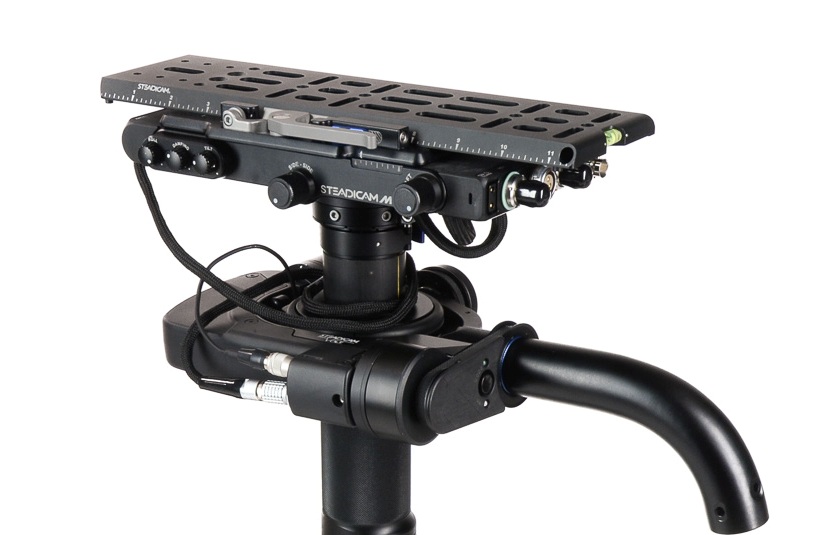
Here’s an example of the top stage (top platform where the camera ends up being mounted). There’s a plate that goes on the very top that you screw the camera into. Adjustment knobs on the sides move that plate either left and right or front and back. This will serve in helping balance the camera.

Also on the top stage are all sorts of places to plug in wires! Several of these inputs are to get power from the battery at the bottom into the camera or to power the accessories. Why not just leave a battery on the camera when you put it up there? Well, you can, but anything you put on the Steadicam will add more weight. Sometimes, you gotta remove as much weight as possible.

You can also see the SDI inputs (pictured right, at the short end of that top stage). This is how you get the video feed from the camera to the monitor at the bottom of the sled.

The Gimbal

This is the handle that sticks out from the sled post and connects to the arm.

The gimbal is 3-axis, meaning it moves freely in three directions for pans, tilts and roll. The gimbal handle that connects to the arm is where the right hand goes, and the handgrip below on the post itself is where the left hand goes. This can be reversed for left-handed users who operate “goofy footed.”

Other Accessories

Plenty of other accessories and mounting devices enable the Steadicam operator to work in different conditions. There are mounts so they can operate from a car, more advanced gimbal technology in the form of the Volt, and things like rickshaws and the Trinity to change the possibilities of what operating can offer.

But this is an intro series and you’ll have to dig into all that when you decide you want to learn more.

Part 3: Balancing and Operating, is coming next.

Steadicam 101: Why Use a Steadicam?

I had the honor of co-hosting a Steadicam workshop for the Women in Focus Summit alongside fellow operator Kurush Bakhtiari. The event run by Ladibug Studios and ColourCo Rentals had several informational panels on camera, lighting and directing with a focus on getting more women and non-binary folks into production.

Kurush with his Archer and Klassen vest, me with a Zephyr kit.

I didn’t expect all of our attendees to take up the mantle of Steadicam. Sure, maybe we inspired a person or two who was curious or knew nothing about the skill, but learning about Steadicam is not just for the people who will wear the vest.

Plenty of crew members interact with the Steadicam operator: The AC who builds the camera to go on the rig, the grip who takes the rig off the operator when they need a break, the other grip who acts as a spotter for safety. Widen your parameters also to the 1st AD who is trying to keep a schedule and time transitions between sticks and camera accordingly, and to the director and DP who will be asking the Steadicam operator to bring their vision to life.

Understanding the roles, responsibilities and limitations of other positions on set just makes you better at your own job.

This will be a 3 part series to go over the basics.

What is a Steadicam?

Pictured: The Arm, Sled, Docking Station and Vest of a M2 model Steadicam.

A Steadicam is a tool used to create fluid dynamic shots unlike any other camera movement apparatus. It consists of a vest worn by the operator connected to an articulating arm and a post that holds the camera and electronic components. The arm does the job of evening out the natural bounce of a body walking, smoothing out the shot. If you were to attempt the same with handheld, it couldn’t be as smooth. Even if I breathe with a camera on my shoulder, the movement translates to the image.

Examples

Popular Steadicam examples include the stairs run from Rocky, the hallway shot in The Shining, and the Copacabana scene in Goodfellas. If you haven’t seen those, by all means click the links and watch the clips. Since those are the most commonly used examples, I wanted to show some fresh ones. Kurush and I put together a video of examples of a handful of other movies that have inspired us.

What we can learn from these examples:

Point Break: The camera expertly follows a high energy scene in a police station, whipping between characters and moments to carry the scene forward. This is a more interesting take on the typical police station scene without being static and stoic. This clip gives a real sense of space in the station, from the character’s entrance to how he moves around the bullpen. This shot switches between framing the main two characters from behind, getting a wide shot of the entire place, and returning to frame the main characters from the front. There’s a nice variety of shots without ever needing to break away for coverage.

Snake Eyes: In this example, we see how perspective changes as the Steadicam moves around the scene. At one point, the Steadicam becomes the point of view for one character, the boxer. When we reveal who it is, the Steadicam backs up to include him physically in the scene.

Birdman: The movie is depicted as if it is a single camera following characters around for a continuous shot. Since that is the technique, shots are constructed by the camera moving closer or farther away from speaking characters, moving around the stage to reveal things and traveling between locations around the theater by following one character at a time.

Baby Driver: This is near the beginning of the film, introducing Baby and his connection to music in the film. This is a well choreographed and timed performance between the camera operator and actor. See how things are revealed as Baby walks how each element of the scene adds to the soundtrack (honking cars, a trumpet player on the street, pedestrians). Pay attention to the background on a second watch of the scene.

Last Night in Soho: In this thriller, Eloise is experiencing flashbacks to the 60s to a vivacious woman named Sandie and a connection to a series of murders. Eloise sees herself in Sandie’s perspective, sometimes in the mirror, and sometimes replacing her in the scene. This is another well choreographed number. In the video I included the behind the scenes clip showing the Steadicam operator. Note how Eloise waits for her turn to cut in to the dance, and how moments are revealed as the Steadicam travels around the main characters. You can also see a spotter helping the Steadicam out. There’s a lot of moving parts and nobody wants to have a camera run into them!

In Part 2, we’ll talk about the components of the Steadicam and why balance is so important.

Why Aren’t There More Women Directors?

Women have got to realize something:

We’re not funny…

We can’t do action…

We certainly can’t direct…

Maybe we should go truly old school and just have castrated men play all the parts? Worked in Shakespeare’s day, didn’t it?

Obviously the above is satire from my part, but it’s not satire on some corners of the Internet. When a movie does well, suddenly it’s “Oh my gosh, women can be funny!? What a good director! Amazing!” but when a movie goes bad, suddenly it’s “This is what happens when you cater to women. This was a bad female director, actor, writer, etc.” We’ve all heard the Madame Web jokes at this point.

I personally love the part where she says, “It’s Madame Webbin’ time.”

I too did not see that movie. But I probably will because I’m a glutton for punishment.

A 2024 Guardian article pointed out the discrepancy of proposed diversity and inclusion promises and what actually happened.

USC’s Annenberg Inclusion Initiative called out the major studies who claimed they would promote more diversity in their hiring practices after 2020 as “performative.” The study didn’t show any actual progress towards pushing for that change.

Women comprised 16% of directors on the 250 top grossing films in 2023, according to the study conducted by the Center for the Study of Women in Television and Film at San Diego State University. That’s down from 18% the year before.

I’m sorry, down?! Aren’t we more inclusive, more diverse than ever? Nope.

Of the 116 directors attached to the 100 top grossing films of 2026, only 14 were women. Look at those numbers again. That’s 12%.

These numbers are in direct contrast to the women dominated juggernaut of 2023, Greta Gerwig’s Barbie which was a $1 billion success.

By the way, only 4 of those directors were women of color.

Diversity and inclusion are — spoiler alert — not a bad thing. I work in the Atlanta film industry. I work with some of the most diverse crews you’ll see, and yet I still see so many sets that are primarily white and/or male.

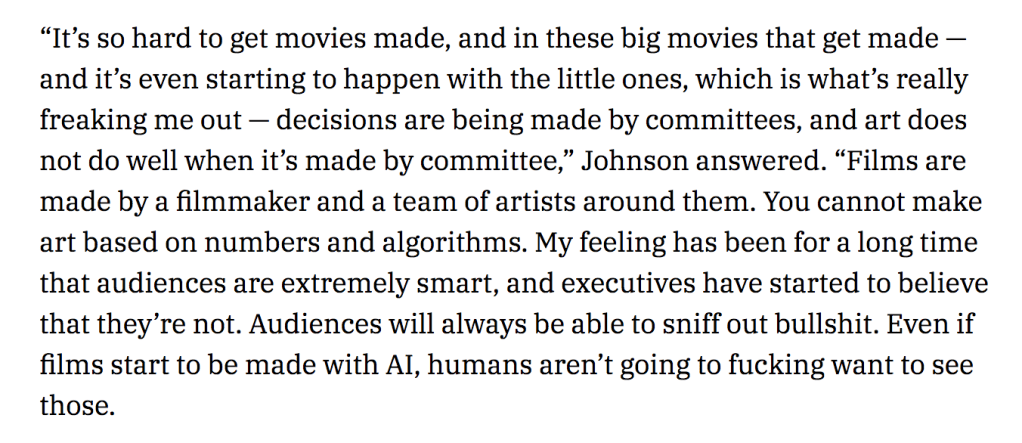
As people complain about superhero fatigue or girly movies just not appealing to mass audiences (The Marvels, Madame Webb) I want to share this piece of a statement from Dakota Johnson, the titular Madame Webb herself:

Dakota Johnson survived everything about Fifty Shades of Gray, she can surely shake this off too.

“Decisions are made by committees….art based on numbers and algorithms.” This hits hard because the shadier businessmen of Hollywood are surely looking to A.I. to pump out algorithm-satisfying garbage in order to save a buck. But for years it’s people sticking their fingers in where they probably don’t belong.

Film is a collaborative medium, and that’s a beautiful thing. I’ve seen my work in a whole new light after an editor or colorist has done their job, and I’ve seen scripts blossom through the work of careful critique and notes. Where it falls apart is when execs or producers or whoever start trying to make their mark and just doing arbitrary things they think the audience will want. Or they want. Like a giant mechanical spider in Wild, Wild West, which was originally pitched for the unproduced Superman Lives script. I don’t even have time to get into that one. Read about it here.

One of those arbitrary things is hiring someone like themselves to direct a film. Men in power tend to hire men that remind them of themselves.

This Variety article references a study about how first time directors get fewer offers, but even experienced directors are more likely to be hired if they are white and male. The stat speaks for itself:

  • 4.8% of experienced directors are female. 95.2% of experienced directors are male.
  • 16.3% of experienced directors are BIPOC, the rest are white.

“The results of this study are eye-opening. For underrepresented groups, there remain obstacles, structures and processes that stand in the way of getting that critical first shot. I’m encouraged that first-time directors get equal results, but they just need to be given equal opportunities,” said Dr. Yalda T. Uhls, founder of the Center for Scholars & Storytellers at UCLA.

It’s 2024. The time for arguing about more inclusivity seems to be falling on deaf ears. So let’s shout it a little louder. And in the meantime, keep your mind open about who to hire on your next film. You may be surprised by the incredible artists you connect with.

Sources:

Study shows ‘catastrophic’ 10-year low for female representation in film

First-Time Directors Still Have Limited Opportunities in Hollywood, New UCLA Study Reports (EXCLUSIVE)

Giant Spiders, Giant Flops: The Enduring Awfulness of ‘Wild Wild West’

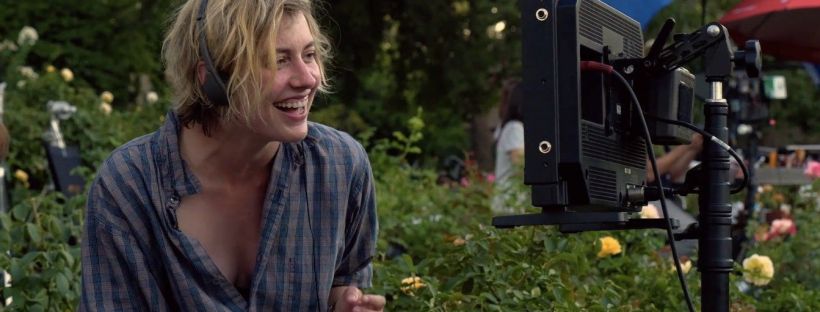
Featured Image: Greta Gerwig directing Ladybird.

How to Avoid Film Job Scams – Take Five

It would be a full time job for me to update this blog everytime I find a scam posted or someone I know shares a scam they found with me. There’s no way to keep up. My overall goal is to equip you with the know-how to see the red flags and avoid being scammed at all costs.

Sometimes I can’t name names. There’s a few reasons for this:

  • scammers can also be identity thieves who stole someone’s picture and name. You don’t want the real person to get in trouble.
  • It’s just a fake made-up name that will evaporate anyway. Like one I covered, Jake Smith became Jeffery Cooper became Ethan Snith.
  • Maybe I’m wrong. Or maybe the poster is just inexperienced and went about things the wrong way.

I do however want to bring the following items to light, and also reinforce the red flags you should look out for when vetting a scam job post.

Red flags to look out for when vetting a scam:

  • bad grammar/spelling
  • incorrect film terminology. (I.E. Production Assistance instead of Assistant.)
  • unusually high rate or weird weekly rates/hourly rates for usually a day rate job
  • Job poster turned off commenting on the post. That’s usually because people started getting suspicious and asking the right questions.
  • large blocks of text that ramble on about the proposed job.

You can also do your due diligence by briefly looking into the job poster. Do they have no Facebook friends? Did they recently make an account, or change their name and profile pic? Did they post a very similar job in multiple groups with different dates?

Now these things don’t guarantee a scammer, but if you checked a few of them off a list, that’s a real good indicator.

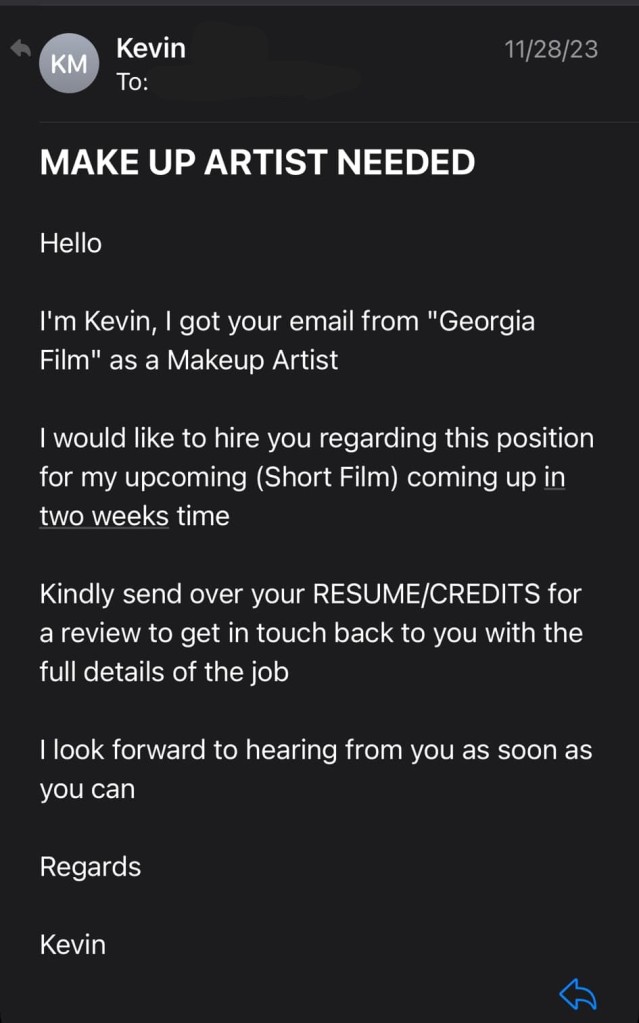
Kevin – But Not Really

An Atlanta makeup artist was contact by a legit enough sounding job poster. They used a real person’s name who is in no way connected to the resulting attempted scam, so I deleted the last name.

It uses a familiar format: Fake Kev contacted the makeup artist saying they found their info on “Georgia Production website.” Sometimes it’s called a film directory or similar, but a lot of scams used this “I found you on (something that doesn’t exist).”

They also said “Kindly,” “regards,” and “send over your resume/credits.” which are all things I’ve seen a hundred times in these scam emails.

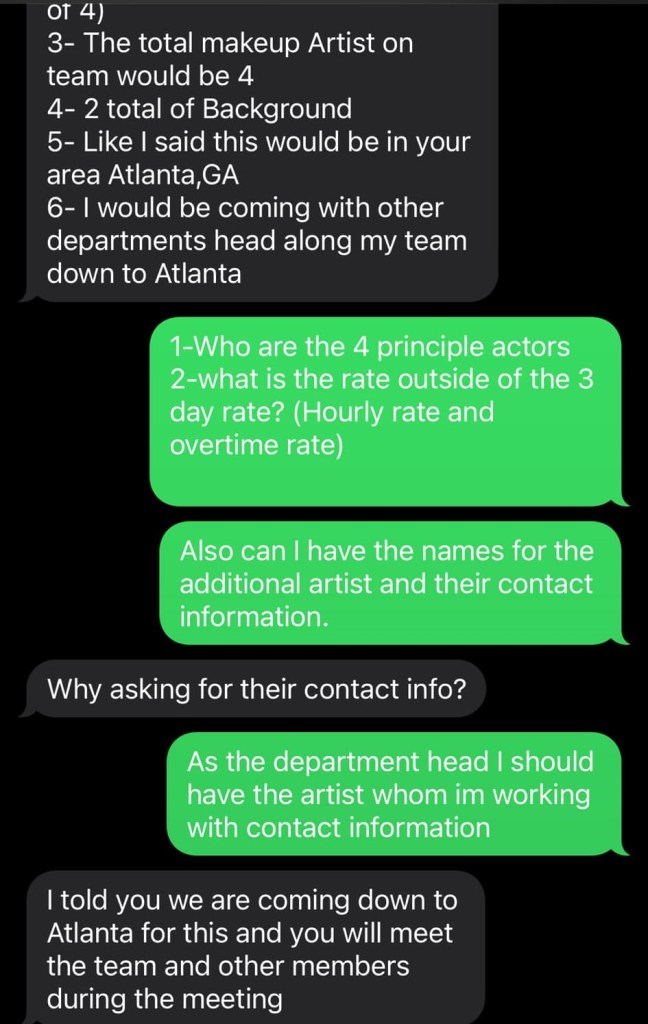
Although our makeup artist was excited at the opportunity to department head on a project, they kept a cool head and did their due diligence. They asked for a deal memo, tax docs and contact info for the additional makeup artist. This is all normal, good stuff to check on if you’re offered a job.

Then this mystery job poster sent a $3000 check to the makeup artist’s home….from an electrical company.

Folks, never, ever receive payment before a job. It is a check phishing scam. After that check goes in your bank and you immediately withdraw the funds for some equipment they ask you to pay for or, in this case, hiring an additional makeup artist, the bank finds out a day or two later that the check is fake and now you’ve sent your own money right back to the scammer.

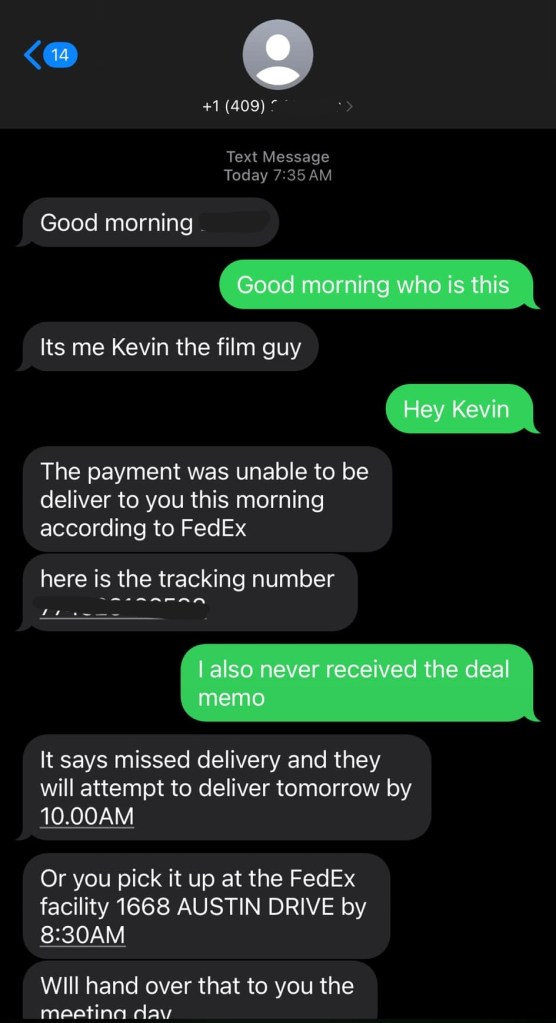
“It’s me Kevin the film guy” said the scammer

Our makeup artist did not get scammed because they knew when things weren’t adding up.

The scammer tries to guilt the makeup artist by saying they already confirmed (they didn’t) and trying to place blame on them for not stipulating a lack of deal memo was a deal breaker. And the scammer clearly didn’t know what a deal memo was because they proceed to call it a “demo” a couple times.

Sometimes these scammers know just enough about film to get by, but their story falls apart very quickly when a professional digs in.

Also note the poor grammar that indicates a non-native English speaker. “The payment was unable to be deliver,” “I will hand over to you meeting,” “You should have tell me this.” Look, I get it scammer, using past tense is hard. But if you want to make the Duolingo owl happy, you have to at least try.

Cinebyte

This one is posting a lot so I wanted to bring it to everyone’s attention.

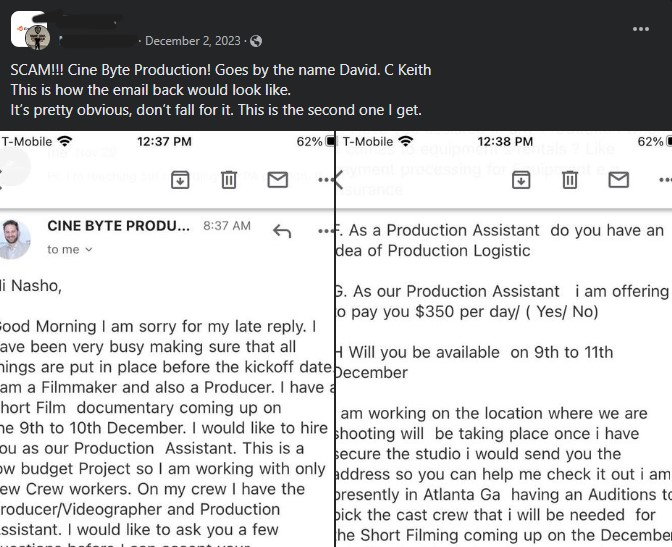
Another crew member in a Facebook group called out Cinebyte Productions as a scam, even posting the highly suspect email he received from the company.

The email is full of bad grammar and is just a huge block of text. I’ll reiterate what I’ve said in the past. When you are a professional in the film industry and someone offers you a job, it usually starts. “Hey, so-and-so recommended you. Are you available to cam op a scripted series in May?” And then you proceed to get more details on further communication.

The Cinebyte job postings are posted by several different people (or the same person using different names, isn’t this fun?). They also use multiple emails. So far I’ve seen: cbytefilm@gmail, lanawilson496@gmail, cinebyteproduction3, etc.

The postings are fake but the company is real. Someone stole David’s name and pic and the company name to seem legit.

I wanted this entry to end here. Guys, I’m tired of chasing these scams. I just want to catch non-Pokemon branded creatures in Palworld and relax for once. But there’s one more I’ve got to cover.

The Music Video Scammer

I’ve covered another shapeshifter before. He went by Jake Smith, Ethan Smith, Jeffery Cooper and every version of those names. Now we’ve got this guy.

Someone named “Eric” (but not really, follow along) posted this job for a PA on a music video. Responsibilities included driving talent and “on-set assistance” (groan).

A number of PA’s hungry for work fell into this supposed job. I learned they did do some driving around, but it became apparent that things were not on the up-and-up. PA’s were expected to pay for lunch, pay for an iPhone SE and headphones. They picked up Ken, a man who was supposedly in a car accident and couldn’t drive himself around. I suppose Ken, who claimed to be the rapper’s manager, the contact they were driving around, hair/makeup artist who, on closer inspection, might not have been an actual HMU. The driver/PA did three days of pickups/drop off’s to such places as a park in a seedy neighborhood, Cookout and, amazingly, Dave n Busters.

Every PA who responded to and did this job (it must have been more than the 3 days, as multiple people were scammed), did not get paid and were ghosted by Ken/Eric.

So Ken/Eric got called out on Facebook, and not long after he changed his name and profile picture to Chris, copying another real filmmaker’s profile pic and image, and posted this job:

I wasn’t ready to post the blog when this went up, so I immediately posted right after this that “Chris” was the same guy who scammed the music video PA’s. Within minutes, “Chris” deleted or changed his Facebook again. Whatever identity he picks next, I’m sure he and many others are out there ready to scam again.

A lot of our scammers are overseas, trying to steal your account information or get you to send them equipment and you’re out the money. But some scammers do this up close and personal. Let’s keep our community safe and keep each other informed.

Previous posts on this topic:

New Year, Same Old Film Job Scams

How to Avoid Film Job Scams – Take Four

Unusual Shot Design to Evoke a Tone: Knock at the Cabin

My film professor Bear Brown would always say “Never stop learning.” We do this by practicing the craft of cinematography, reading about it, learning new technologies, and dissecting movies and TV to understand what was achieved.

Let’s look at the shot design of M Night Shyamalan’s Knock at the Cabin together!

While vacationing at a remote cabin, a young girl and her parents are taken hostage by four armed strangers who demand that the family make an unthinkable choice to avert the apocalypse. With limited access to the outside world, the family must decide what they believe before all is lost.

Anamorphic Lenses

Let’s dig into how I knew this film was shot on anamorphic lenses even though I can’t find any solid info on which camera or lenses were used.

All I could find was that Shyamalan wanted a 90s horror-thriller vibe and filmed with lenses from the 90s. These were used in flashbacks primarily. We could have had a mix of lenses and cameras for different scenes. That’s something the Directors of Photography (2 in this case) and the director would hash out. Ultimately it boils down to what the right tool is to tell your story. Given the unsettling feeling of the narrative, using anamorphics does make sense.

Anamorphic lenses capture twice the amount of horizontal image as a traditional spherical lens. that image is then de-squeezed in post production editing to get the final image. I’ve done a couple Steadicam gigs on anamorphic lenses now and it’s always a weird feeling seeing that strangely square image squished onto your monitor. (You then of course go through the monitor settings and get it de-squeezed so you can see what the final image would be).

Anamorphic lenses have unique properties. You can get fun J. J. Abrams style lens flare, oval-shaped bokeh (instead of the usual circular bokeh). They also feature reduced sharpness (focus is not always perfect!) and increased distortion of the image around the edges.

I mention all this not just because of the beautiful bokeh I witness in the background of certain shots….

look at those pretty bokeh ovals

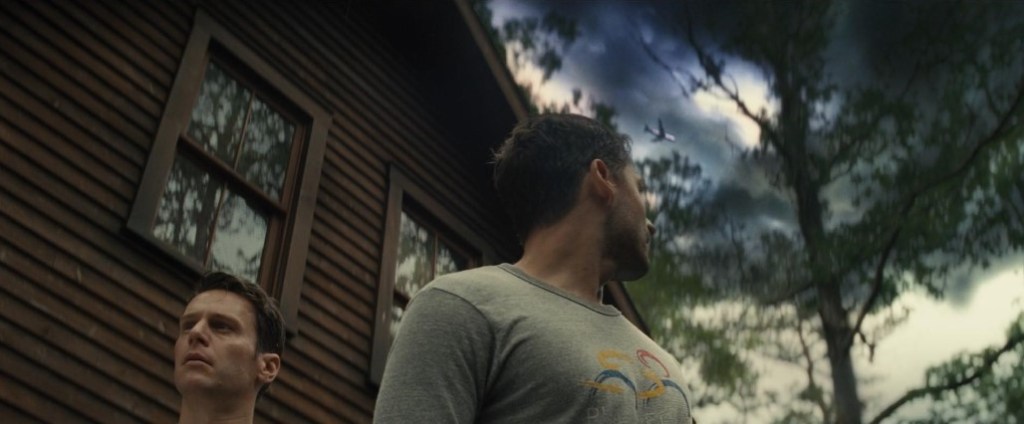
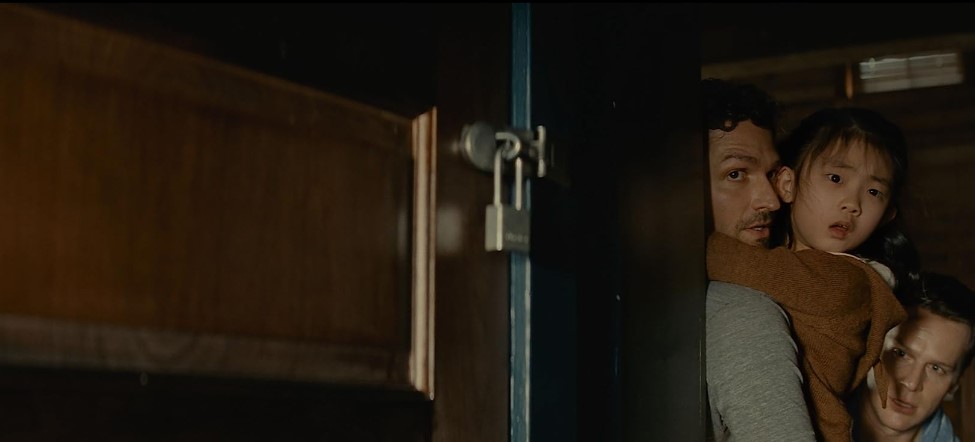
… I also say that because it motivates the characters to be up front and center-framed more often than on the sides. There are a lot of shots where characters are center framed. The viewer’s focus goes to the center and everything else is set dressing for whatever the center of attention is.

You also notice distortion if you look at any straight lines, such as doorways, bookshelves, etc. The lenses make them bend away at an unnatural angle. As you’re watching a film with this lens, you don’t typically notice this if you’re not looking for it. Your mind is focused on the story and characters and subtly translating this background information to be a little unsettling or off-putting.

A lot of other shots, however, were framed predominantly on the right. This is interesting because assuming you read left to right, you would look at the image from left to right, even if it happens in an instant. Often times, an important character will be on the left of the screen. Or you may have an equal distribution of shots that are framed left, right, and center. What made these right framed shots stand out was the sheer number of them. When things weren’t centered, they were right of frame.

I believe this was to keep things off-balance and to give the viewer time to scan the image before settling on the subject in frame.

Camera Movement

The use of camera movement was very intentional in this film. Most of the time, it felt like the camera was attached to whatever it was following, like Leonard’s low shot of his feet walking in the woods.

You can see that walking shot in the beginning of this clip: https://www.youtube.com/watch?v=Pgk1VGlWiDI

Another great shot, which I can’t find a clip of, is when the parents are confronting the people who invaded the cabin. the camera is basically stuck to a close-up on the parent’s face as he circles in the cabin. It was probably accomplished using a snorricam technique. A snorricam is a device that mounts a camera directly to an actor. Think “way too much effort for a selfie.”

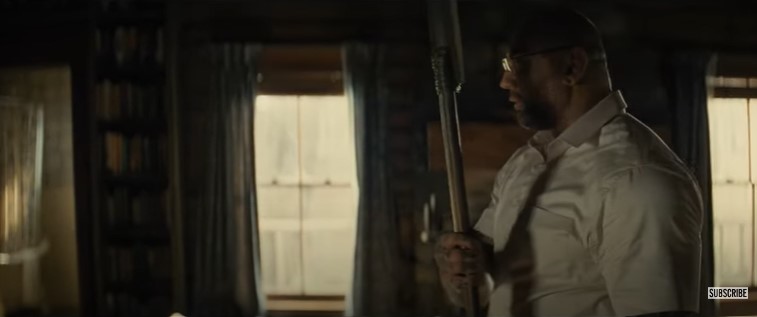
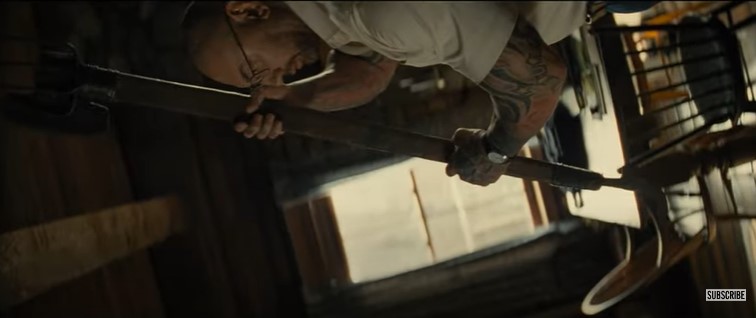
Even better was this really cool shot of Leonard swinging his weapon. The camera movement is perfectly timed and matching the angle of the axe coming down.

Big spoiler if you see the video of this scene, but here’s Leonard swinging that axe: https://youtu.be/p3Zth0YEn5A?si=07_S3tmxakWRlmrF&t=147

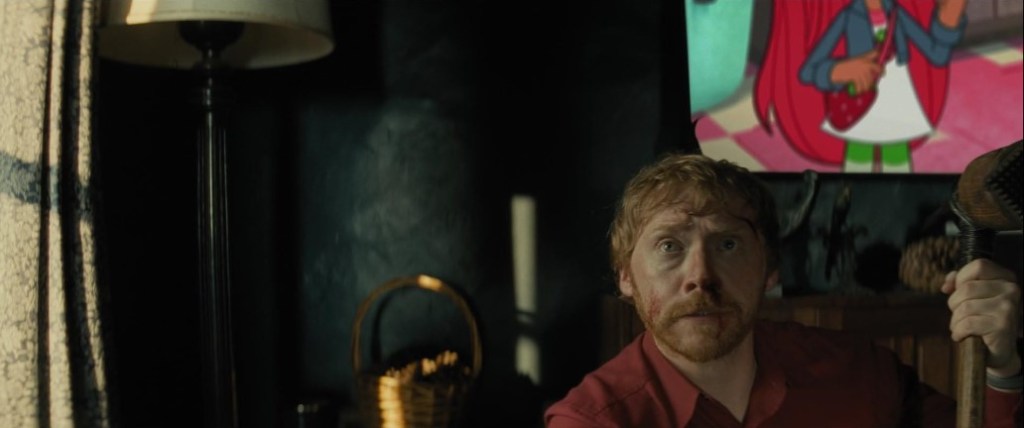
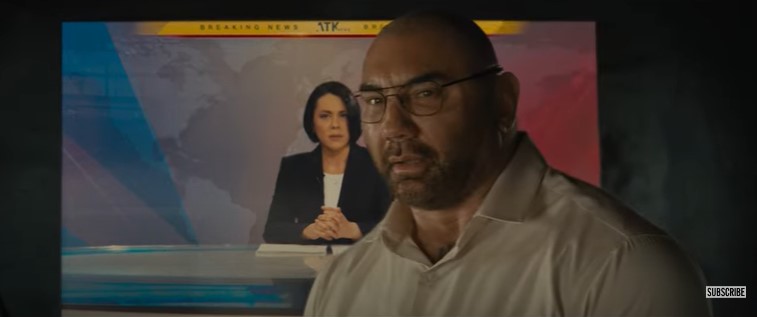
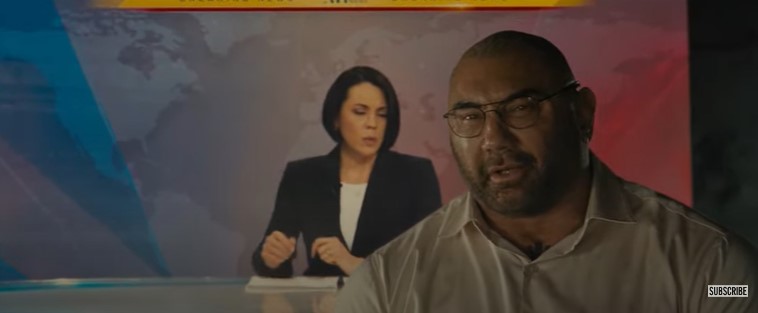
The DP’s also used a famous technique of a zoom-dolly (ala the famous beach scene in Jaws) to underscore when Leonard is proving that his doomsday story is real. The technique is achieved by utilizing a zoom and pushing in or away from an actor at the same time. The resulting distortion creates an uncomfortable feel that warps reality around the character. Pretty cool!

Look at how the perspective of the TV behind him changes over the course of this shot.

See that zoom-dolly in action here: https://youtu.be/xf8ILZnoSr4?si=wDYOefTrl0ymYX_n&t=74

Details hidden in the background

There’s a flashback to when Andrew and Eric adopt Wen from China. I used Google Lens to translate this text: “Children, when we love others, we should not only love them with words and tongues, but also show them in actions and sincerity.” It directly ties into what Leonard says about this couple having to choose who should die in order to save the world.

The blackboard in the cabin had a few questions on it. I started looking at it but didn’t really think about them until I came across this screenshot.

The questions are:

  1. Who invented chess?
  2. The first color named?
  3. Why school buses don’t have seatbelts?

The answers to those questions, when searched are:

  1. Uncertain. The origin is unknown though it likely originated from the Indian game of chaturanga.
  2. Light and Dark (White and Black). In almost all languages this is the case.
  3. They are bigger, heavier, and sit off the ground. Buses protect kids through compartmentalization.

In this small detail, we see nods to our Indian director (Shyamalan), the concept of light and dark (good and evil) and the safety of many. It directly speaks to the film’s themes and it’s just a thing in the background you might miss as you’re watching the action of the film take place.

Credit to the DP’s Jarin Blaschke and Lowell A Meyer for some really interesting work.

So is the movie worth watching?

Eh, well that’s up to you. For the purpose of seeing these shots in action? Sure. I like the unique way this film was shot, obviously enough to write about. But upon finishing the movie with a friend, we were both left with a bunch of questions and a puzzling sense of “was this movie good or not?” The movie both under- and over-explains the premise. I don’t get answers I want. I’m left wondering if certain actions were necessary. I think the bones of a good story are there, probably present from its beginning as the 2018 novel Cabin at the End of the World by Paul G. Tremblay. Shyamalan’s script version is reminiscent of the awkward dialogue I don’t like in his other movies. Maybe I’m biased. I’m still mad about The Last Airbender and annoyed that I wasted time watching trees blow gently in the breeze in The Happening.

Sources:

Knock at the Cabin – Prime

What are Anamorphic Lenses? – PhotographyLife.com

Anamorphic Lenses: The Key to Widescreen Cinematic Imagery – BHPhoto

Small Details You Missed in Knock at the Cabin – Looper

SAG-AFTRA just threw their Voice Actors under the A.I. bus

2023, the year of the strikes.

The combined writer’s and actors strikes, WGA and SAG-AFTRA respectively, won workers more residuals and consulted the affected workers on issues of A.I. usage.

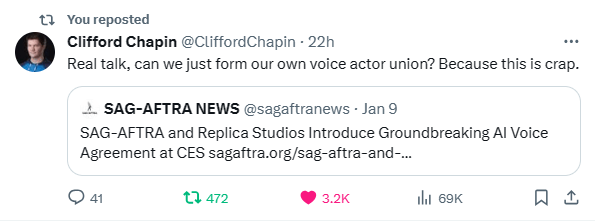
Then, yesterday, SAG-AFTRA dropped this bomb and acted like it was a good thing:

SAG-AFTRA and Replica Studios Introduce Groundbreaking AI Voice Agreement at CES

Replica Studios (Replica), an artificial intelligence (AI) voice technology company, and The Screen Actors Guild – American Federation of Television and Radio Artists (SAG-AFTRA) announced today the introduction of a groundbreaking AI voice agreement during an event at CES….

This new agreement paves the way for professional voice over artists to safely explore new employment opportunities for their digital voice replicas…

The agreement between the leading AI voice company and the world’s largest performers’ union will enable Replica to engage SAG-AFTRA members under a fair, ethical agreement to safely create and license a digital replica of their voice. Licensed voices can be used in video game development and other interactive media projects from pre-production to final release.

http://www.sagaftra.org

I like that they used the words “fair, ethical, safe” to describe how they were stabbing their membership in the back.

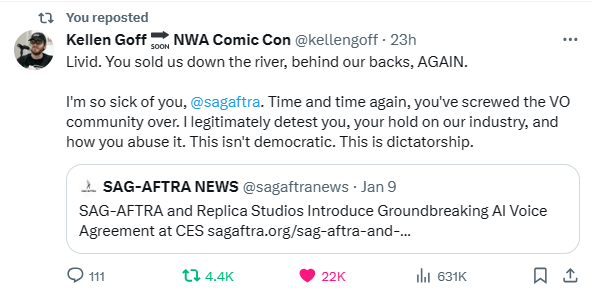
Why do I think that this went behind SAG-AFTRA membership’s backs? Simply because I found out about this because of how many voice over artists called it out, saying, “We didn’t vote OR hear about this. What the hell.” (paraphrasing)

Kellen Goff: Voice actor Five Night’s at Freddy’s (videogame), My Hero Academia, Attack on Titan, Black Clover

Elias Toufexis: Voice actor Starfield (videogame), Deus Ex: Mankind Divided (videogame), Blood of Zeus

Clifford Chapin: Voice actor in My Hero Academia, Attack on Titan, Spider-man 2 (videogame)

The technology already exists to sample someone’s voice and create a pretty convincing, if not soul-less replica of their voice. This isn’t only un-creative, it’s also completely un-ethical. This argument has also come up with the advent of deep fakes.

“Typically used maliciously or to spread false information.” Such as when someone made a deep fake of House Speaker Nancy Pelosi to act like she was impaired. Deep fakes can make it seem like anyone said anything, and that’s very damaging. And do I need to remind you how wrong it is?

Circling back to voice actors, what does this entail? Doesn’t the deal with Replica Studios just give voice actors the ability to sell a digital imprint of their voice? This could be interpreted as the actor’s choice.

This issue was also brought up by SAG-AFTRA membership last year, when it became clear that production companies wanted to pay background actors a one time fee to digitally scan them, and then use that image in perpetuity. That’s forever, babe. That’s multiple thousands of dollars that person will never be able to make. That’s a likeness of them out there that could be made to do anything.

“But, I can’t afford to pay an artist/actor/voice actor/graphic artist for their work! I have to use A.I.!”

What did you do before the days of this technology? Several options: 1. Save up the money or fundraise so you could do your project. 2. Take the time to learn the skills yourself. 3. Reach some kind of deal with the artist you need, like bartering services in kind or deferred payment.

“But Bridget, you say. You don’t work in voice over or animation or videogames.”

I know, anonymous person in my head, but here’s the thing. When you attack one artist, one creative profession like this, you attack us all. And I like videogames and animation and artwork and writing, so I’m going to support the people affected and continue to fight for them.

Hey it’s not all bleak. Recently Wacom (a well known drawing tablet manufacturer) had to apologize for accidentally using AI imagery in their ad campaigns. This cute dragon image falls apart when you really look at it. A tail sprouts from the wrong direction, fur mushes into scales and other weird artifacts are present.

I’m just including the above example, not all 4 that artists uncovered because this post is already bloated.

Artists immediately threw backlash at Wacom. Simply, a company for artists should support them. They had to apologize.

“We want to assure you that using AI generated images in these assets was not our intent.

Here is what happened: Wacom purchased these images through a third-party vendor where it was indicated that they were not AI generated. We vetted the images through a few popular online tools that also indicated that they were not AI generated. However, given the community’s feedback, we are now not sure how the images were created. For this reason, we immediately discontinued their use.”

Wacom’s statement

This $750 Million dollar company can’t claim poverty. They could have commissioned a legion of artists for their marketing campaign.

If you’re like me, you’re going to continue to fight against companies replacing artists with soulless computer interpretations. The next job they take could be yours.

Sources:

SAG-AFTRA and Replica Studios Introduce Groundbreaking AI Voice Agreement at CES

The deal that ended the writers strike: A look at what the 3-year agreement says

Movie extras worry they’ll be replaced by AI. Hollywood is already doing body scans

Doctored Nancy Pelosi video highlights threat of “deepfake” tech

Artists are making creative companies apologize for using AI

A response to community questions concerning Wacom using AI-generated art in US marketing assets

New Year, Same Old Film Job Scams

I use the blog on my website to teach what I know about the film industry. But one topic keeps coming up: Scams. It’s gotten so common that now people just associate my blog as “the scam blog.” My last scam related post was in August, but I’d have enough fodder to update the post weekly.

Here’s an example:

Love that comment.

I highlighted the red flags that should stand out for you:

  • Generally poor grammar: “The dates for a documentary-style TV show for Veles Productions (extra space added) this month are August 21-25.” Also the weirdness of hiring a Production Assistant/Personal assistant, two completely separate jobs.
  • Astronomically high rate for a PA $1500 for 12 hours (and weird added “4 hours per day.”) Day rates for PA’s range around $175-250ish per day (12 hours) depending on the market and type of gig.
  • Must have “terminology knowledge.” What!?
  • Using the word “staff” instead of “crew.”
  • The PA is helping set up “lights, props and tools.” PA is an entry level job and typically shouldn’t be doing any of these things, but as budgets get tight (read: stingy) a lot of places are making PA’s take on extra responsibilities. It’s not great but… I’ve seen it done.

That’s your typical example of a film job scam that’s posted to social media. It could be Facebook, Instagram…heck I’ve even seen scams posted to StaffMeUp and LinkedIn. Nowhere is safe, so always keep your guard up.

I wanted to shift gears for the new year and arm you with two other types of scammy jobs to look out for: Illegal internships and opportunity scams.

Illegal Internships

I’ve worked on a number of movies, tv shows and other projects where we’ve got some newbies working as PA’s who are billed as interns.

Internships have been under fire before in the entertainment industry. A famous case occurred during the production of Darren Aronofsky’s Black Swan. Two interns sued on behalf of 100 Fox Searchlight interns for backpay as they did work as employees, not interns. The class action lawsuit was resolved in the interns’ favor.

But I’ve also run into it on several low budget features and other projects where someone eager to enter the film industry comes in as an intern. Read between the lines — unpaid labor.

Sometimes I make a point to ask the intern “Are you in college right now? Are you getting college credit?” If not, then it gets sketchy. A legal internship benefits the intern alone, through work experience and/or college credit. Typically an employer is helping the intern but not benefitting themselves — well, in theory. But if that intern is doing the work that a full time employee would do? That’s a problem.

If you want to volunteer on someone’s project, that’s up to you. But I wouldn’t ask you to take the title of intern if you’re doing an actual job for someone. I even wrote about deciding whether or not to volunteer on a film set before:

“This is your opportunity!”

The real reason I was inspired to do an update on scams is because I came across this on Eventbrite.

This “event” someone posting that you could work on a faith based film — for the low, low price of $199! That you pay them.

Oh jeez, where do I start with this one?

You should never pay to work on a movie.

I’ve seen this scam before in another form, someone advertising they needed crew for a movie and asking the crew to pay to work on the film. The audacity of this.

Oh also, “star” in a movie? With no acting experience? That’s fishy enough. At best you’d be an extra. Someone sitting on a park bench in the background or filling tables in a restaurant. Not a main character with lines.

Sign up from our website and receive a 25% discount!

Star in a Faith-Based Christmas Movie! No Acting Experience Required. Now available in over 50 major US cities. Bring the whole family!

If it wasn’t clear this was a scam before, I clicked on the website link and saw that the “admission fee” was now $50 (how generous! And also not the definition of 24% off from the original $199) and now the location was listed as another state. Not Atlanta but Venice Beach California, Detroit, Los Angeles, etc. It’s a “pop up filming event” (the heck is that!?) in over 50 major US cities!

Using the word “local.” So many of the Facebook-posted job scams I’ve covered have used terms like “local” or “in your area” so they can scam far and wide. Or there’ll be a weird space before the location or date because it’s clear they copy and paste and change a couple details.

There are plenty of other scammy looking opportunities, classes, events that try to sell the dream of a career in film to new people. If something seems too good to be true or glamorizes the whole prospect of joining a film production, think twice before you submit or pay for anything.

Stay safe in 2024.

Sources:

Fox Settles ‘Black Swan’ Interns Lawsuit After Five Years

More than 40% of interns are still unpaid—here’s the history of why that’s legal

How to Avoid Film Job Scams – Take Four (blog)

5 Reasons for and Against Volunteering on a Film (blog)