Why Aren’t There More Women Directors?

Women have got to realize something:

We’re not funny…

We can’t do action…

We certainly can’t direct…

Maybe we should go truly old school and just have castrated men play all the parts? Worked in Shakespeare’s day, didn’t it?

Obviously the above is satire from my part, but it’s not satire on some corners of the Internet. When a movie does well, suddenly it’s “Oh my gosh, women can be funny!? What a good director! Amazing!” but when a movie goes bad, suddenly it’s “This is what happens when you cater to women. This was a bad female director, actor, writer, etc.” We’ve all heard the Madame Web jokes at this point.

I personally love the part where she says, “It’s Madame Webbin’ time.”

I too did not see that movie. But I probably will because I’m a glutton for punishment.

A 2024 Guardian article pointed out the discrepancy of proposed diversity and inclusion promises and what actually happened.

USC’s Annenberg Inclusion Initiative called out the major studies who claimed they would promote more diversity in their hiring practices after 2020 as “performative.” The study didn’t show any actual progress towards pushing for that change.

Women comprised 16% of directors on the 250 top grossing films in 2023, according to the study conducted by the Center for the Study of Women in Television and Film at San Diego State University. That’s down from 18% the year before.

I’m sorry, down?! Aren’t we more inclusive, more diverse than ever? Nope.

Of the 116 directors attached to the 100 top grossing films of 2026, only 14 were women. Look at those numbers again. That’s 12%.

These numbers are in direct contrast to the women dominated juggernaut of 2023, Greta Gerwig’s Barbie which was a $1 billion success.

By the way, only 4 of those directors were women of color.

Diversity and inclusion are — spoiler alert — not a bad thing. I work in the Atlanta film industry. I work with some of the most diverse crews you’ll see, and yet I still see so many sets that are primarily white and/or male.

As people complain about superhero fatigue or girly movies just not appealing to mass audiences (The Marvels, Madame Webb) I want to share this piece of a statement from Dakota Johnson, the titular Madame Webb herself:
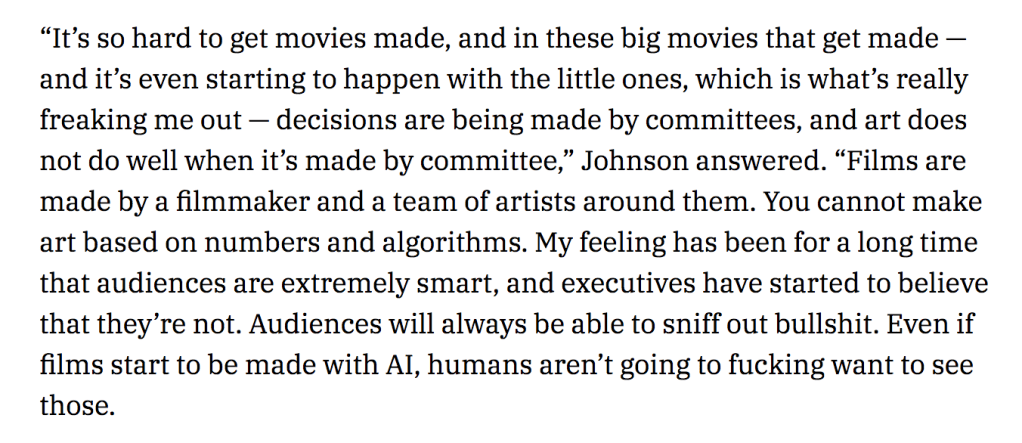
Dakota Johnson survived everything about Fifty Shades of Gray, she can surely shake this off too.

“Decisions are made by committees….art based on numbers and algorithms.” This hits hard because the shadier businessmen of Hollywood are surely looking to A.I. to pump out algorithm-satisfying garbage in order to save a buck. But for years it’s people sticking their fingers in where they probably don’t belong.

Film is a collaborative medium, and that’s a beautiful thing. I’ve seen my work in a whole new light after an editor or colorist has done their job, and I’ve seen scripts blossom through the work of careful critique and notes. Where it falls apart is when execs or producers or whoever start trying to make their mark and just doing arbitrary things they think the audience will want. Or they want. Like a giant mechanical spider in Wild, Wild West, which was originally pitched for the unproduced Superman Lives script. I don’t even have time to get into that one. Read about it here.

One of those arbitrary things is hiring someone like themselves to direct a film. Men in power tend to hire men that remind them of themselves.

This Variety article references a study about how first time directors get fewer offers, but even experienced directors are more likely to be hired if they are white and male. The stat speaks for itself:

  • 4.8% of experienced directors are female. 95.2% of experienced directors are male.
  • 16.3% of experienced directors are BIPOC, the rest are white.

“The results of this study are eye-opening. For underrepresented groups, there remain obstacles, structures and processes that stand in the way of getting that critical first shot. I’m encouraged that first-time directors get equal results, but they just need to be given equal opportunities,” said Dr. Yalda T. Uhls, founder of the Center for Scholars & Storytellers at UCLA.

It’s 2024. The time for arguing about more inclusivity seems to be falling on deaf ears. So let’s shout it a little louder. And in the meantime, keep your mind open about who to hire on your next film. You may be surprised by the incredible artists you connect with.

Sources:

Study shows ‘catastrophic’ 10-year low for female representation in film

First-Time Directors Still Have Limited Opportunities in Hollywood, New UCLA Study Reports (EXCLUSIVE)

Giant Spiders, Giant Flops: The Enduring Awfulness of ‘Wild Wild West’

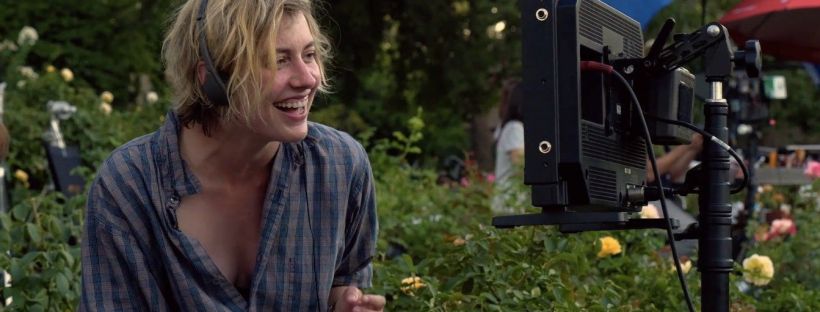
Featured Image: Greta Gerwig directing Ladybird.
Podcasts that put the strike in perspective

One way I’ve stayed in tune with the impact of the WGA and SAG-AFTRA strikes is through podcasts.

I wanted to share several selections from podcasts I’ve listened to recently that stress the necessity for the strikes in the spotlight. I’m on the crew side, so hearing from writers and actors helps put things in perspective.

I listen through Audible, but I imagine you can find most if not all of these on Apple Podcasts and Spotify.

Scam Goddess -“The Film that Hid Fraud”

Laci Mosley (Lopez vs Lopez) and her guests started this episode talking about the insanity of the markup on wedding things – also known as the wedding tax — and it ended up making commentary on film worker’s lives.

Naomi Ekperigin (actor Mythic Quest  and writer Mrs. Fletcher): “Someone’s like ‘Oh yeah, I’ve seen you on TV.’ Just because I’m on TV… doesn’t mean I want to spend all the money I have on this. You don’t know my life. You don’t know my circumstance. We work in a business too where — okay yeah, it was a good year but we don’t know if it will be next year.”

Mosley: “We up on a whole strike right now! It’s up and down. You never know how long you’re gonna need to save your money.”

The episode then covered an interesting story about the fraudulent film production of A Landscape of Lies, so check out that episode. Laci and her guests are very entertaining.

Listen here.

Deadline Strike Talk – Week Sixteen with guests Gale Anne Hurd and Glen Basner

On this episode, host Billy Ray talked with producer Gale Anne Hurd (Terminator) and Glen Basner (FilmNation CEO), and the talk inevitably turned to the problem of AI.

Gale Anne Hurd pointed out that the concept of AI (like ChatGPT) writing scripts would be just a rehashing of what’s been done before. AI can “theoretically formulate box office successes” that are just copies of what was popular before. “The great age of cinema and television series,” Hurd stated, “was always when there was innovation.”

Basner: “If you look at a distributor like A24, Neon, Bleeker Street — they may be great theatrical distributors and there may be an audience at the theatrical level for those movies, but if they can’t sell their movies to paid TV or streamers, at the levels that they currently are, then the whole economic model upends itself and we have to readjust to say well creatively these may make sense but we may need to make them for 60% of the cost that we have been beforehand and that’s not sustainable in the long term to keep reducing the cost structure of each film.”

Hurd: “There’s gonna be continued consolidation.”

Billy: “If streamers add ads, wouldn’t they have to be transparent about their numbers with their advertisers?”

Hurd: “There have been lawsuits about fake data. About just how many people are actually seeing ads on those platforms. I’m always concerned that metrics will not be reliable. I can’t tell you the number of times I’ve had to sue for profits on my films. Some of my most successful films are still not profitable. If they’re not sharing that data with us accurately, I think they will share unreliable data with advertisers.”

Listen here.

Scam Goddess – The Fake Film for… Feminism?

Laci Mosley’s podcast gets a second mention because of her episode with Abbott Elementary writer Brittani Nichols.

Mosley: “I think that regular everyday people look at the strike and think ‘Oh these are Hollywood writers who live in Hollywood mansions and then have millions of dollars and they want even more?! They’re so greedy!’ Where in truth most writers aren’t super duper rich.”

Nichols: “Correct. Our guild is largely working class.”

Mosley: “And the middle class has been shrinking all our guilds because in SAG you used to make residuals and now streaming’s like ‘We’re not going to tell you how many people watched it.’ “

Nichols: “The entire industry has shifted. Streaming has put a squeeze on the middle class writer and made it harder to move up the ranks. Made it harder for people to have a sustainable career.”

Mosley made the example of an actor who did a voiceover line for Friends and still gets a $300 check each month as it re-airs. with streaming, it’s $0.

Their talk then shifted to AI, another major sticking point for both actors and writers during strike negotiations.

Mosley: “We get paid for ADR [sessions] but with AI, they could do it without us.”

Nichols also countered that the AMPTP (or at least streamers like Netflix) doesn’t want a traditional writer’s room. They want to pay the bare minimum and make it a freelance, gig based environment.

The pay for writers and actors may look high at first glance, but it also takes into account the fact that they might not work again for a very long time. It’s the nature of the business, so if a line isn’t drawn in the sand now, it’ll only get harder for that shrinking middle class actor/writer to survive.

Listen here.

Movies in Focus – $34. Filmmaker Joe Russo Gives Insight Into the WGA Strike

Podcast host Niall Browne invited writer/director Joe Russo (Au Pair Nightmare, Nightmare Cinema) onto the podcast to talk about how streamers treat their libraries, and therefore impact the discussion of residuals. Have you ever wondered why a show just up and disappears? Why a show gets canceled for seemingly no reason?

Russo: “What’s happening with streamers is they’ll run a show for one, two, three seasons maybe and as soon as they decide, as soon as that algorithm decides that show is not bringing in new subscribers, they cancel it. And so the chance to make those residual payments over dozens and dozens of episodes, that’s gone away. They’ll replace it with a new show, a new shiny bauble, to try to bring in new subscriber growth.”

Joe Russo went on to describe that the idea of any long term success is fleeting when streamers can just delete a show off their platform like this. Sometimes they barely get a release.

Russo: “They’ve been pulling things off the platform. There was a Disney movie that was released on Disney+ in May and it came down June 30th. It was on the platform 6 weeks. That’s hundreds of people’s labor, time, 1-2 years of their life invested into this thing for 6 whole weeks. And who knows if it’ll ever be seen again.”

Listen here.

Feel free to check out these podcasts and others to learn more about the strike from the perspective of those walking the picket line.