Unusual Shot Design to Evoke a Tone: Knock at the Cabin

My film professor Bear Brown would always say “Never stop learning.” We do this by practicing the craft of cinematography, reading about it, learning new technologies, and dissecting movies and TV to understand what was achieved.

Let’s look at the shot design of M Night Shyamalan’s Knock at the Cabin together!

While vacationing at a remote cabin, a young girl and her parents are taken hostage by four armed strangers who demand that the family make an unthinkable choice to avert the apocalypse. With limited access to the outside world, the family must decide what they believe before all is lost.

Anamorphic Lenses

Let’s dig into how I knew this film was shot on anamorphic lenses even though I can’t find any solid info on which camera or lenses were used.

All I could find was that Shyamalan wanted a 90s horror-thriller vibe and filmed with lenses from the 90s. These were used in flashbacks primarily. We could have had a mix of lenses and cameras for different scenes. That’s something the Directors of Photography (2 in this case) and the director would hash out. Ultimately it boils down to what the right tool is to tell your story. Given the unsettling feeling of the narrative, using anamorphics does make sense.

Anamorphic lenses capture twice the amount of horizontal image as a traditional spherical lens. that image is then de-squeezed in post production editing to get the final image. I’ve done a couple Steadicam gigs on anamorphic lenses now and it’s always a weird feeling seeing that strangely square image squished onto your monitor. (You then of course go through the monitor settings and get it de-squeezed so you can see what the final image would be).

Anamorphic lenses have unique properties. You can get fun J. J. Abrams style lens flare, oval-shaped bokeh (instead of the usual circular bokeh). They also feature reduced sharpness (focus is not always perfect!) and increased distortion of the image around the edges.

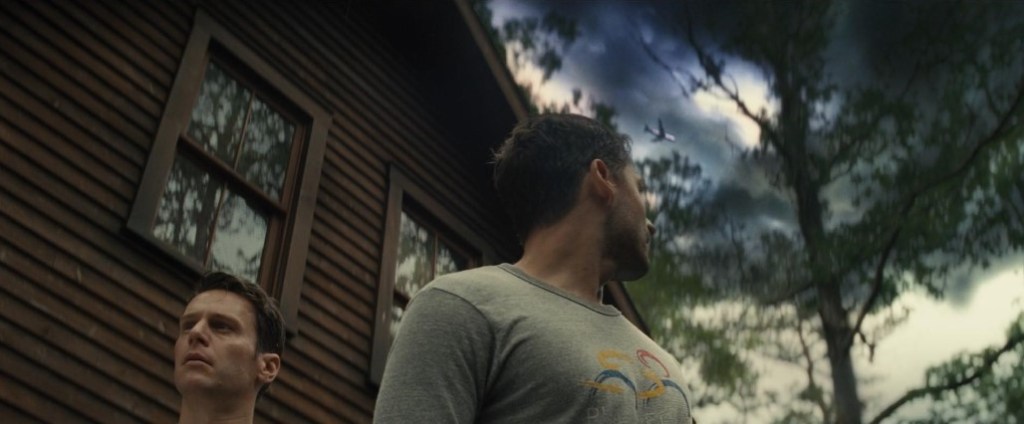
I mention all this not just because of the beautiful bokeh I witness in the background of certain shots….

look at those pretty bokeh ovals

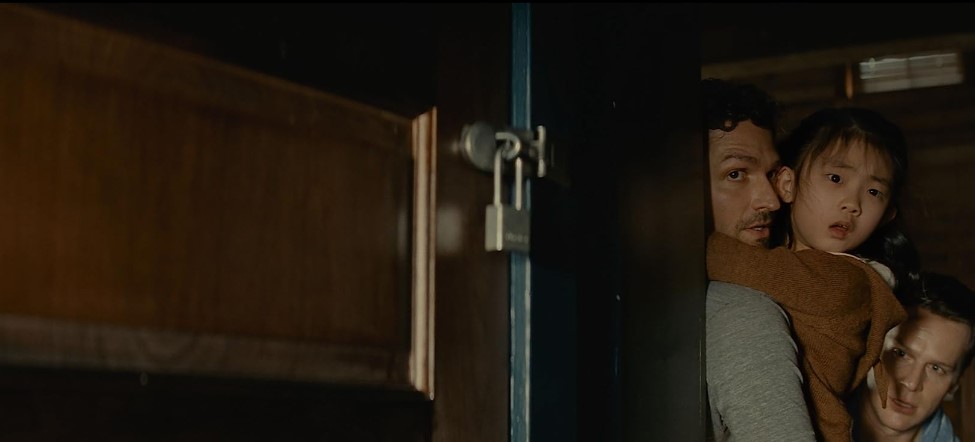
… I also say that because it motivates the characters to be up front and center-framed more often than on the sides. There are a lot of shots where characters are center framed. The viewer’s focus goes to the center and everything else is set dressing for whatever the center of attention is.

You also notice distortion if you look at any straight lines, such as doorways, bookshelves, etc. The lenses make them bend away at an unnatural angle. As you’re watching a film with this lens, you don’t typically notice this if you’re not looking for it. Your mind is focused on the story and characters and subtly translating this background information to be a little unsettling or off-putting.

A lot of other shots, however, were framed predominantly on the right. This is interesting because assuming you read left to right, you would look at the image from left to right, even if it happens in an instant. Often times, an important character will be on the left of the screen. Or you may have an equal distribution of shots that are framed left, right, and center. What made these right framed shots stand out was the sheer number of them. When things weren’t centered, they were right of frame.

I believe this was to keep things off-balance and to give the viewer time to scan the image before settling on the subject in frame.

Camera Movement

The use of camera movement was very intentional in this film. Most of the time, it felt like the camera was attached to whatever it was following, like Leonard’s low shot of his feet walking in the woods.

You can see that walking shot in the beginning of this clip: https://www.youtube.com/watch?v=Pgk1VGlWiDI

Another great shot, which I can’t find a clip of, is when the parents are confronting the people who invaded the cabin. the camera is basically stuck to a close-up on the parent’s face as he circles in the cabin. It was probably accomplished using a snorricam technique. A snorricam is a device that mounts a camera directly to an actor. Think “way too much effort for a selfie.”

Even better was this really cool shot of Leonard swinging his weapon. The camera movement is perfectly timed and matching the angle of the axe coming down.
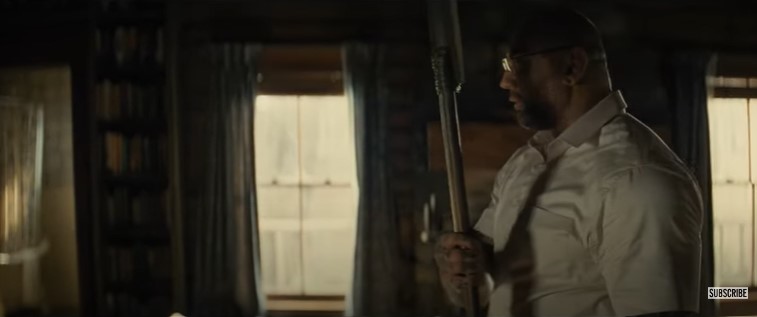
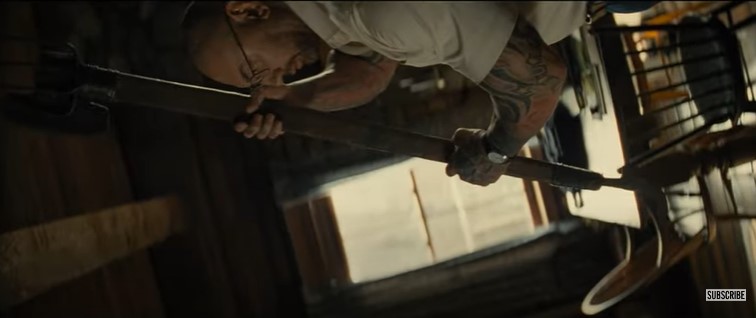
Big spoiler if you see the video of this scene, but here’s Leonard swinging that axe: https://youtu.be/p3Zth0YEn5A?si=07_S3tmxakWRlmrF&t=147

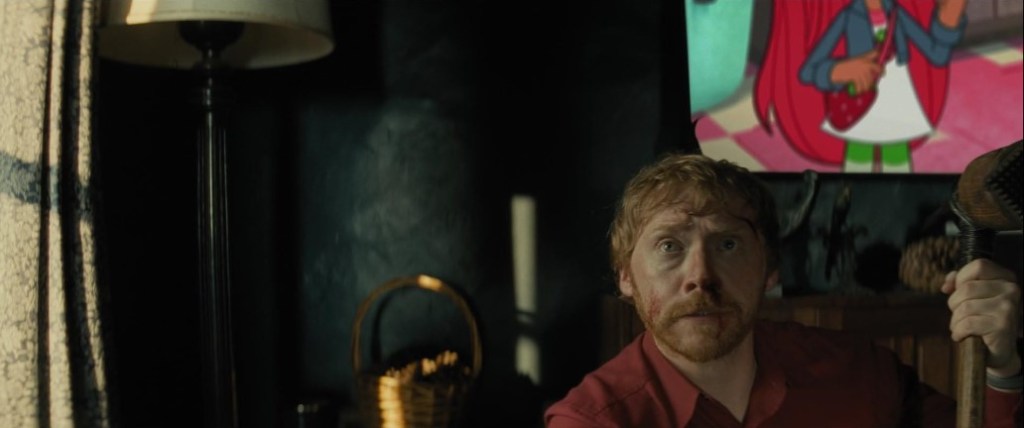
The DP’s also used a famous technique of a zoom-dolly (ala the famous beach scene in Jaws) to underscore when Leonard is proving that his doomsday story is real. The technique is achieved by utilizing a zoom and pushing in or away from an actor at the same time. The resulting distortion creates an uncomfortable feel that warps reality around the character. Pretty cool!
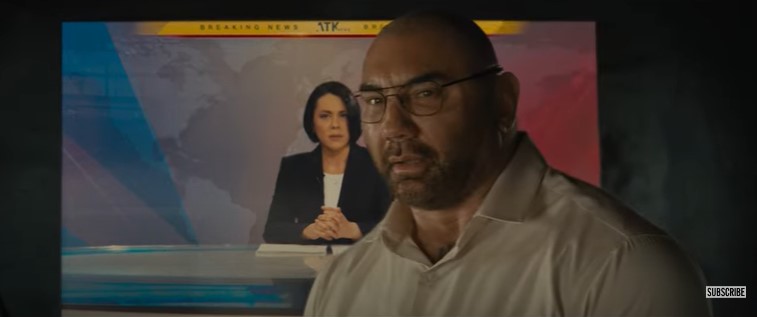
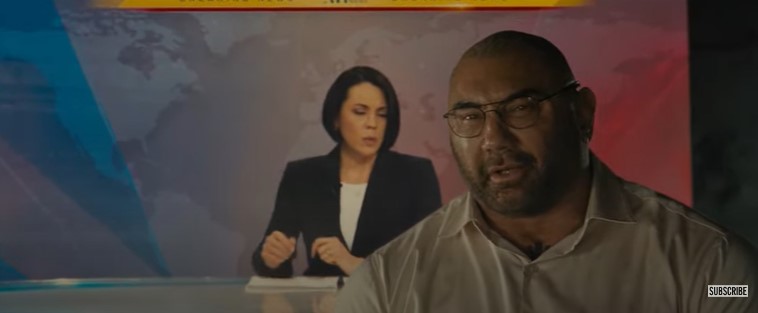
Look at how the perspective of the TV behind him changes over the course of this shot.

See that zoom-dolly in action here: https://youtu.be/xf8ILZnoSr4?si=wDYOefTrl0ymYX_n&t=74

Details hidden in the background

There’s a flashback to when Andrew and Eric adopt Wen from China. I used Google Lens to translate this text: “Children, when we love others, we should not only love them with words and tongues, but also show them in actions and sincerity.” It directly ties into what Leonard says about this couple having to choose who should die in order to save the world.

The blackboard in the cabin had a few questions on it. I started looking at it but didn’t really think about them until I came across this screenshot.

The questions are:

  1. Who invented chess?
  2. The first color named?
  3. Why school buses don’t have seatbelts?

The answers to those questions, when searched are:

  1. Uncertain. The origin is unknown though it likely originated from the Indian game of chaturanga.
  2. Light and Dark (White and Black). In almost all languages this is the case.
  3. They are bigger, heavier, and sit off the ground. Buses protect kids through compartmentalization.

In this small detail, we see nods to our Indian director (Shyamalan), the concept of light and dark (good and evil) and the safety of many. It directly speaks to the film’s themes and it’s just a thing in the background you might miss as you’re watching the action of the film take place.

Credit to the DP’s Jarin Blaschke and Lowell A Meyer for some really interesting work.

So is the movie worth watching?

Eh, well that’s up to you. For the purpose of seeing these shots in action? Sure. I like the unique way this film was shot, obviously enough to write about. But upon finishing the movie with a friend, we were both left with a bunch of questions and a puzzling sense of “was this movie good or not?” The movie both under- and over-explains the premise. I don’t get answers I want. I’m left wondering if certain actions were necessary. I think the bones of a good story are there, probably present from its beginning as the 2018 novel Cabin at the End of the World by Paul G. Tremblay. Shyamalan’s script version is reminiscent of the awkward dialogue I don’t like in his other movies. Maybe I’m biased. I’m still mad about The Last Airbender and annoyed that I wasted time watching trees blow gently in the breeze in The Happening.

Sources:

Knock at the Cabin – Prime

What are Anamorphic Lenses? – PhotographyLife.com

Anamorphic Lenses: The Key to Widescreen Cinematic Imagery – BHPhoto

Small Details You Missed in Knock at the Cabin – Looper

A Film Is Born Three Times Pt. 1: Re: Writing

“A film is born three times. First in the writing of the script, once again in the shooting, and finally in the editing.” — Robert Bresson, French film maker.

I think folks at first take for granted that a film is a thing born of an idea, written, produced, and edited and then it just exists… but there’s so many changes along the way. Your first draft is almost never, ever going to be what appears on screen. And it probably shouldn’t. Some first drafts are better left being forgotten, but you can’t make a final draft without suffering through the whole writing and re-writing process.

The Road Less Traveled

I talked a bit about my short horror film The Road Less Traveled in my how-to post here: Making the No Budget Horror Film – Bridget LaMonica

The very first very rough draft was written in 2014 while I was at SCAD. Cassie is abandoned at a bar by her friends and captured by two bad men named Miles and Dawson in a cool car.

While in their nefarious clutches, Cassie calls her mother, who races to try to find her. Cassie gets her revenge, only to have her mother finally arrive in time to bury a couple bodies. I called the story Werewolf because that was the monster at the end of the story.

Hunted, an early draft of The Road Less Traveled:

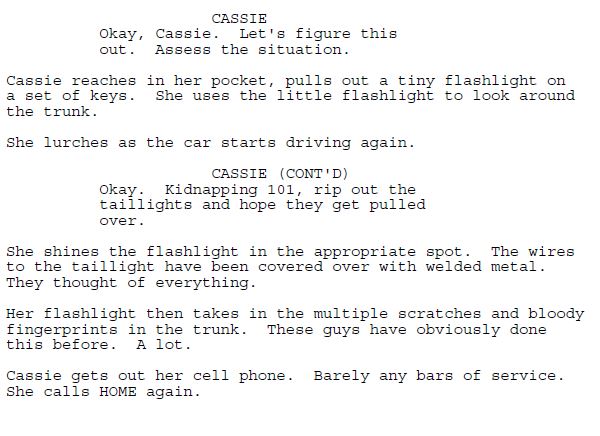
Cassie talks too much. There’s a lot of her talking on the phone, to a friend at a bar, to the kidnappers. Blegh.

She has a cell phone and is able to call for help (kind of a horror movie no-no).

Cassie is resourceful. She knows ways out of her situation but finds her methods were anticipated.

I sent the draft to my friend Masha, who gave me a great critique. Eventually I created the story that was much more interesting to me: Mia (formerly Cassie, now with a more appropriate name – Missing In Action) kidnapped by a lone serial killer named Clyde (the name is never said out loud) who brings her to an abandoned slaughter house to do his evil work. Jokes on him, because Mia fights back. This was called Hunted.

The script was presented to director Lindsay Barrasse. With Lindsay’s attachment to the script and her love of classic horror, we leaned further into classic horror tropes and set the story in the 1970s instead of modern day. No more convenient cell phone.

Draft 9:

Cassie is now Mia and she has no spoken dialogue (only a few lines of voice over).

This version mentions a “90’s style watch” but later we changed the date to the 70s.

Mia is adept at survival — she knows some skills but is unable to escape until later.

I wanted a horror story that played on the classic tropes while delivering some surprises. I had a not-so-subtle reference to a favorite TV show, Supernatural.

Hunted became The Road Less Traveled, inspired by the Robert Frost poem “The Road Not Taken”, Supernatural‘s “The Road So Far” and the fact that we had a female victim who would prove herself capable. The film became more and more about female empowerment, especially since most of our production team was female.

A note: I almost never find my title until a few drafts later. Same with a theme or tone — sometimes it just takes that long to finally whittle down to what I want to say.

Routine Procedures

Before The Road Less Traveled was produced, I had a thesis film at SCAD called Routine Procedures.

This script began in a short script writing class. The basic premise being a group of soldiers discovering an alien box in the woods that could spell doom for all mankind.

The very first (equally very bad) draft saw Johnson, your average Gary Stu with his boss Magnus and a feisty Latina soldier Reyes (inspired by Private Vasquez in Alien). Reyes ends up being an alien. There might have been some idea about aliens enslaving humanity or something? I dunno. This draft doesn’t exist anymore and nor should it.

This script went through several drafts in the class, becoming a time travel story in which these soldiers discover this alien artifact that forces them to relive the same day over and over as they deteriorate. Only one soldier notices, and he is freaking out, man.

Draft 3, Page 1:

In this version we have about 5 characters: Johnson, Sterling, Reyes, Magnus and Hopkins.

This draft was way too talky with too many characters. Still I can see all the major things I kept from this draft forward: Johnson as our lead who figures things out, Magnus as the hard-as-nails superior who is afraid of change, the story starting by mentioning de ja vu.

I condensed the best parts of Hopkins into Reyes and deleted Sterling entirely. He was a useless jerk.

I worked with director Nick Bow to make the film. He suggested Johnson should be a woman. I stopped. I was about to argue. And then I realized, yeah, why didn’t I think about that? The genders of Johnson and Reyes were flipped and we put out a casting call. We got some excellent people to fill out these roles and it wasn’t who we originally expected.

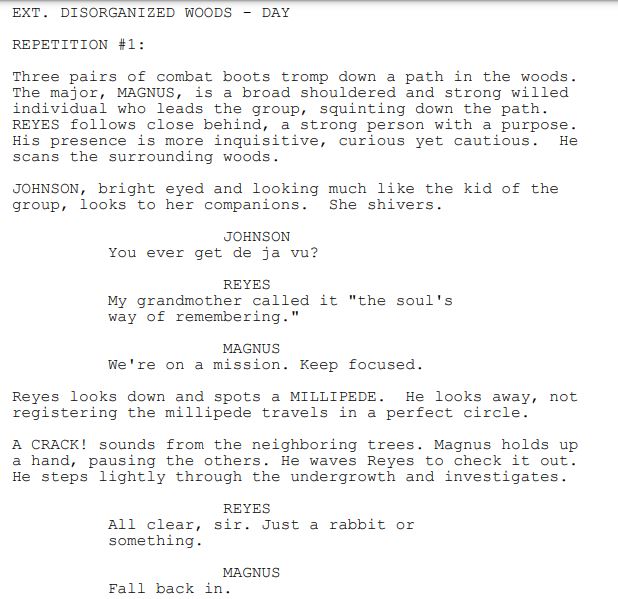
Draft 9, page 1:

The characters were reduced to 3.

We wanted to be clear what happened where (time travel stories get complicated). We labeled the repetitions and the different sections of landscape we were shooting in.

In Draft 3 Reyes saw a snail stuck in a loop. Here it’s a millipede.

Less dialogue and more focused.

As I recall, the title Routine Procedures was there for most of the drafts. I think the first one or two were called Maneuvers or something vaguely military-esque. When I settled on Routine Procedures, it helped sell the fact that this was a time travel story.

Let’s Wrap This Up

Drafts are called such because they are a continuously changing process. The first draft is often called a vomit draft (ew) because you might need to get your initial idea out fast. You bring it to a critique group or a trusted friend who can give you notes, and then you incorporate that into a rewrite. The script is never actually done until it is filmed, and even then it’s open for interpretation.

Next up, Part 2: Production.

Reading List: Screenwriting

Malcolm Gladwell wrote in his book Outliers: Secrets of Success that in order to become an expert in anything, you need 10,000 hours of practice. That is also true for screenwriters and film makers.

I am of the belief that if you want to be good at something, you’re constantly working to enhance your knowledge, hone your craft and try new things.

When I interact with young screenwriters, I find myself recommending the same reading material over and over again, so my next logical step was to list them here.

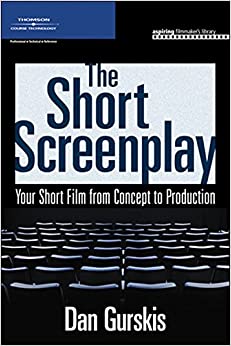
The Short Screenplay: Your Short Film from Concept to Production

Before you run, you must walk.

Before you write a feature, I highly recommend you write a short film.

A short film can range anywhere from 1 min to 45 or so, but usually around 5-10 mins is the common format that can find itself programmed into film festivals. That’s the sweet spot, so you might want to look in that range specifically.

Find it here.

Save the Cat! The Last Book on Screenwriting You’ll Ever Need

Often touted as the “Bible of Screenwriting,” Save the Cat! is a famous book on the craft. This book takes a more Hollywood approach to screenwriting that’s beneficial for those wanting to understand the formula of most popular films.

From the initial idea, to creating a beat sheet to marketing your script, Save the Cat! is a great resource to dive into.

the book’s strength lies in its foundation of the formula of story arcs and organizational tools such as the beat sheet, so this is definitely a book you should check out.

Find the book here.

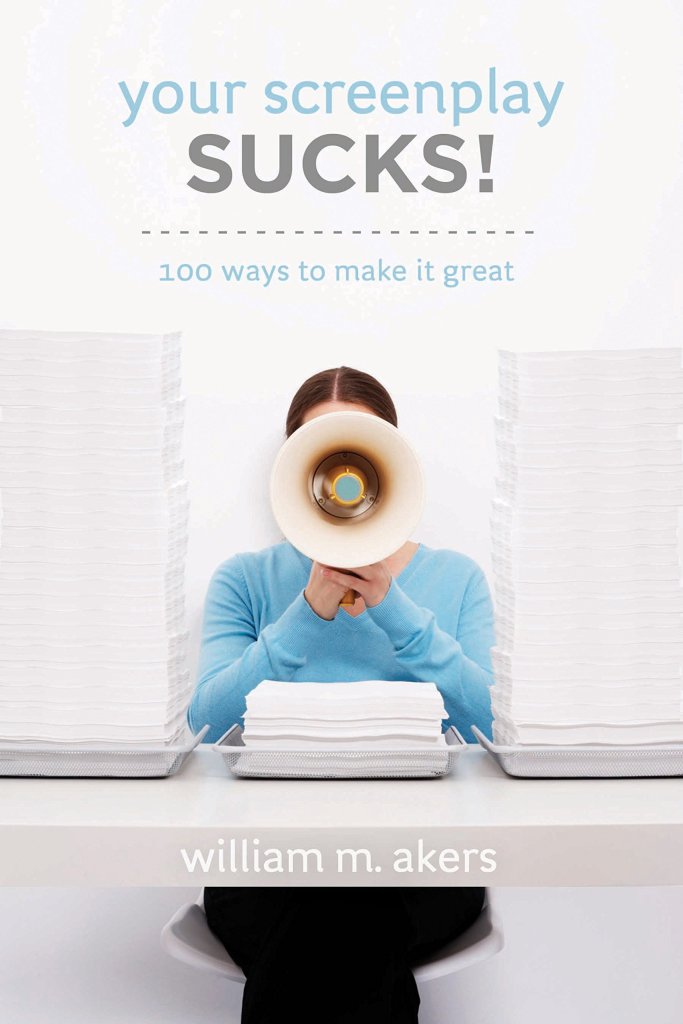
Your Screenplay Sucks! 100 Ways to Make it Great

I always send this book recommendation with the disclaimer “This is by no means a commentary on your script!”

This book is broken up into digestible chunks that go into details on common problems and how to fix them. This book explores structure, the nitty gritty of story and other details that might have been missed during your first draft, such as a deep B story or multi-faceted characters.

Find the book here.

Crafty TV Writing: Thinking Inside the Box

This is the book for any sort of TV writing. Here you learn about the particular format of broadcast television writing. TV writing is a different game than writing a feature by a long shot, as it pertains to act breaks, teasers, tags, and how to best tell a joke (the funny word comes last!).

This book also has a meaty section on agents, navigating the world of spec script writing and pitching.

Find it here.

Honorable Mentions:

The Coffee Break Screenwriter: Writing Your Script 10 Minutes at a Time. Find it here.

Secrets of Film Writing. Find it here.