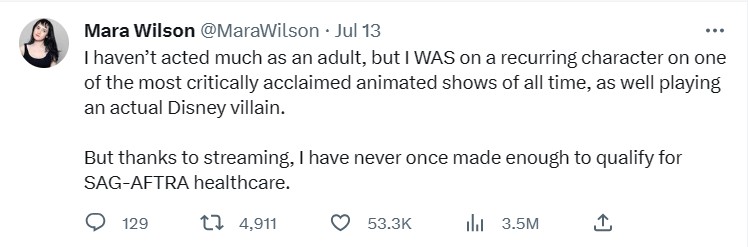
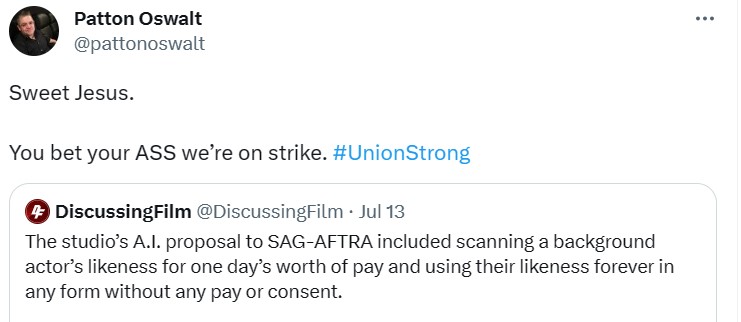
SAG-AFTRA just threw their Voice Actors under the A.I. bus

2023, the year of the strikes.

The combined writer’s and actors strikes, WGA and SAG-AFTRA respectively, won workers more residuals and consulted the affected workers on issues of A.I. usage.

Then, yesterday, SAG-AFTRA dropped this bomb and acted like it was a good thing:

SAG-AFTRA and Replica Studios Introduce Groundbreaking AI Voice Agreement at CES

Replica Studios (Replica), an artificial intelligence (AI) voice technology company, and The Screen Actors Guild – American Federation of Television and Radio Artists (SAG-AFTRA) announced today the introduction of a groundbreaking AI voice agreement during an event at CES….

This new agreement paves the way for professional voice over artists to safely explore new employment opportunities for their digital voice replicas…

The agreement between the leading AI voice company and the world’s largest performers’ union will enable Replica to engage SAG-AFTRA members under a fair, ethical agreement to safely create and license a digital replica of their voice. Licensed voices can be used in video game development and other interactive media projects from pre-production to final release.

http://www.sagaftra.org

I like that they used the words “fair, ethical, safe” to describe how they were stabbing their membership in the back.

Why do I think that this went behind SAG-AFTRA membership’s backs? Simply because I found out about this because of how many voice over artists called it out, saying, “We didn’t vote OR hear about this. What the hell.” (paraphrasing)
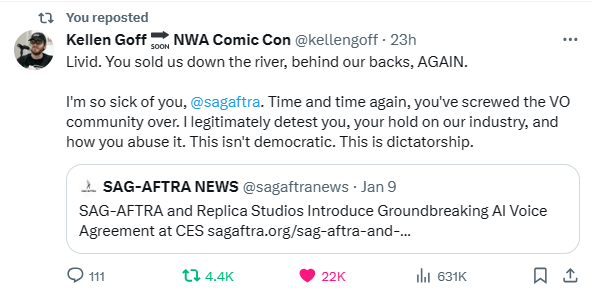
Kellen Goff: Voice actor Five Night’s at Freddy’s (videogame), My Hero Academia, Attack on Titan, Black Clover

Elias Toufexis: Voice actor Starfield (videogame), Deus Ex: Mankind Divided (videogame), Blood of Zeus
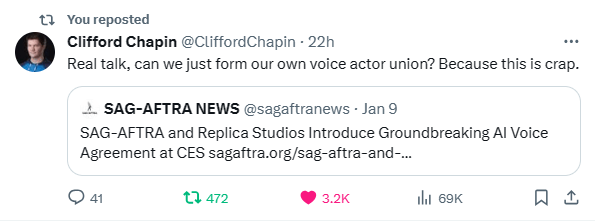
Clifford Chapin: Voice actor in My Hero Academia, Attack on Titan, Spider-man 2 (videogame)

The technology already exists to sample someone’s voice and create a pretty convincing, if not soul-less replica of their voice. This isn’t only un-creative, it’s also completely un-ethical. This argument has also come up with the advent of deep fakes.

“Typically used maliciously or to spread false information.” Such as when someone made a deep fake of House Speaker Nancy Pelosi to act like she was impaired. Deep fakes can make it seem like anyone said anything, and that’s very damaging. And do I need to remind you how wrong it is?

Circling back to voice actors, what does this entail? Doesn’t the deal with Replica Studios just give voice actors the ability to sell a digital imprint of their voice? This could be interpreted as the actor’s choice.

This issue was also brought up by SAG-AFTRA membership last year, when it became clear that production companies wanted to pay background actors a one time fee to digitally scan them, and then use that image in perpetuity. That’s forever, babe. That’s multiple thousands of dollars that person will never be able to make. That’s a likeness of them out there that could be made to do anything.

“But, I can’t afford to pay an artist/actor/voice actor/graphic artist for their work! I have to use A.I.!”

What did you do before the days of this technology? Several options: 1. Save up the money or fundraise so you could do your project. 2. Take the time to learn the skills yourself. 3. Reach some kind of deal with the artist you need, like bartering services in kind or deferred payment.

“But Bridget, you say. You don’t work in voice over or animation or videogames.”

I know, anonymous person in my head, but here’s the thing. When you attack one artist, one creative profession like this, you attack us all. And I like videogames and animation and artwork and writing, so I’m going to support the people affected and continue to fight for them.

Hey it’s not all bleak. Recently Wacom (a well known drawing tablet manufacturer) had to apologize for accidentally using AI imagery in their ad campaigns. This cute dragon image falls apart when you really look at it. A tail sprouts from the wrong direction, fur mushes into scales and other weird artifacts are present.

I’m just including the above example, not all 4 that artists uncovered because this post is already bloated.

Artists immediately threw backlash at Wacom. Simply, a company for artists should support them. They had to apologize.

“We want to assure you that using AI generated images in these assets was not our intent.

Here is what happened: Wacom purchased these images through a third-party vendor where it was indicated that they were not AI generated. We vetted the images through a few popular online tools that also indicated that they were not AI generated. However, given the community’s feedback, we are now not sure how the images were created. For this reason, we immediately discontinued their use.”

Wacom’s statement

This $750 Million dollar company can’t claim poverty. They could have commissioned a legion of artists for their marketing campaign.

If you’re like me, you’re going to continue to fight against companies replacing artists with soulless computer interpretations. The next job they take could be yours.

Sources:

SAG-AFTRA and Replica Studios Introduce Groundbreaking AI Voice Agreement at CES

The deal that ended the writers strike: A look at what the 3-year agreement says

Movie extras worry they’ll be replaced by AI. Hollywood is already doing body scans

Doctored Nancy Pelosi video highlights threat of “deepfake” tech

Artists are making creative companies apologize for using AI

A response to community questions concerning Wacom using AI-generated art in US marketing assets
Podcasts that put the strike in perspective

One way I’ve stayed in tune with the impact of the WGA and SAG-AFTRA strikes is through podcasts.

I wanted to share several selections from podcasts I’ve listened to recently that stress the necessity for the strikes in the spotlight. I’m on the crew side, so hearing from writers and actors helps put things in perspective.

I listen through Audible, but I imagine you can find most if not all of these on Apple Podcasts and Spotify.

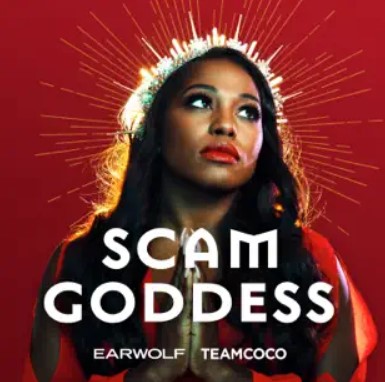
Scam Goddess -“The Film that Hid Fraud”

Laci Mosley (Lopez vs Lopez) and her guests started this episode talking about the insanity of the markup on wedding things – also known as the wedding tax — and it ended up making commentary on film worker’s lives.

Naomi Ekperigin (actor Mythic Quest  and writer Mrs. Fletcher): “Someone’s like ‘Oh yeah, I’ve seen you on TV.’ Just because I’m on TV… doesn’t mean I want to spend all the money I have on this. You don’t know my life. You don’t know my circumstance. We work in a business too where — okay yeah, it was a good year but we don’t know if it will be next year.”

Mosley: “We up on a whole strike right now! It’s up and down. You never know how long you’re gonna need to save your money.”

The episode then covered an interesting story about the fraudulent film production of A Landscape of Lies, so check out that episode. Laci and her guests are very entertaining.

Listen here.

Deadline Strike Talk – Week Sixteen with guests Gale Anne Hurd and Glen Basner

On this episode, host Billy Ray talked with producer Gale Anne Hurd (Terminator) and Glen Basner (FilmNation CEO), and the talk inevitably turned to the problem of AI.

Gale Anne Hurd pointed out that the concept of AI (like ChatGPT) writing scripts would be just a rehashing of what’s been done before. AI can “theoretically formulate box office successes” that are just copies of what was popular before. “The great age of cinema and television series,” Hurd stated, “was always when there was innovation.”

Basner: “If you look at a distributor like A24, Neon, Bleeker Street — they may be great theatrical distributors and there may be an audience at the theatrical level for those movies, but if they can’t sell their movies to paid TV or streamers, at the levels that they currently are, then the whole economic model upends itself and we have to readjust to say well creatively these may make sense but we may need to make them for 60% of the cost that we have been beforehand and that’s not sustainable in the long term to keep reducing the cost structure of each film.”

Hurd: “There’s gonna be continued consolidation.”

Billy: “If streamers add ads, wouldn’t they have to be transparent about their numbers with their advertisers?”

Hurd: “There have been lawsuits about fake data. About just how many people are actually seeing ads on those platforms. I’m always concerned that metrics will not be reliable. I can’t tell you the number of times I’ve had to sue for profits on my films. Some of my most successful films are still not profitable. If they’re not sharing that data with us accurately, I think they will share unreliable data with advertisers.”

Listen here.

Scam Goddess – The Fake Film for… Feminism?

Laci Mosley’s podcast gets a second mention because of her episode with Abbott Elementary writer Brittani Nichols.

Mosley: “I think that regular everyday people look at the strike and think ‘Oh these are Hollywood writers who live in Hollywood mansions and then have millions of dollars and they want even more?! They’re so greedy!’ Where in truth most writers aren’t super duper rich.”

Nichols: “Correct. Our guild is largely working class.”

Mosley: “And the middle class has been shrinking all our guilds because in SAG you used to make residuals and now streaming’s like ‘We’re not going to tell you how many people watched it.’ “

Nichols: “The entire industry has shifted. Streaming has put a squeeze on the middle class writer and made it harder to move up the ranks. Made it harder for people to have a sustainable career.”

Mosley made the example of an actor who did a voiceover line for Friends and still gets a $300 check each month as it re-airs. with streaming, it’s $0.

Their talk then shifted to AI, another major sticking point for both actors and writers during strike negotiations.

Mosley: “We get paid for ADR [sessions] but with AI, they could do it without us.”

Nichols also countered that the AMPTP (or at least streamers like Netflix) doesn’t want a traditional writer’s room. They want to pay the bare minimum and make it a freelance, gig based environment.

The pay for writers and actors may look high at first glance, but it also takes into account the fact that they might not work again for a very long time. It’s the nature of the business, so if a line isn’t drawn in the sand now, it’ll only get harder for that shrinking middle class actor/writer to survive.

Listen here.

Movies in Focus – $34. Filmmaker Joe Russo Gives Insight Into the WGA Strike

Podcast host Niall Browne invited writer/director Joe Russo (Au Pair Nightmare, Nightmare Cinema) onto the podcast to talk about how streamers treat their libraries, and therefore impact the discussion of residuals. Have you ever wondered why a show just up and disappears? Why a show gets canceled for seemingly no reason?

Russo: “What’s happening with streamers is they’ll run a show for one, two, three seasons maybe and as soon as they decide, as soon as that algorithm decides that show is not bringing in new subscribers, they cancel it. And so the chance to make those residual payments over dozens and dozens of episodes, that’s gone away. They’ll replace it with a new show, a new shiny bauble, to try to bring in new subscriber growth.”

Joe Russo went on to describe that the idea of any long term success is fleeting when streamers can just delete a show off their platform like this. Sometimes they barely get a release.

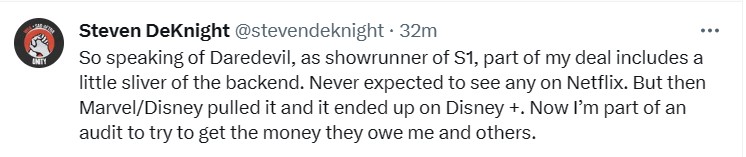
Russo: “They’ve been pulling things off the platform. There was a Disney movie that was released on Disney+ in May and it came down June 30th. It was on the platform 6 weeks. That’s hundreds of people’s labor, time, 1-2 years of their life invested into this thing for 6 whole weeks. And who knows if it’ll ever be seen again.”

Listen here.

Feel free to check out these podcasts and others to learn more about the strike from the perspective of those walking the picket line.

Why Residuals Are a Big Factor in the SAG-AFTRA and WGA Strikes

The WGA and SAG-AFTRA are both on strike against the Alliance of Motion Picture and Television Producers (AMPTP) halting TV and film productions and leading to a very sparse year financially for many film workers. They’re just asking for more money, right? Yes and no. This is certainly not a case of greed from the average film worker, but from corporate CEOs who make hundreds of millions of dollars a year while balking at a small percentage that writers are asking for. To put it in perspective, since 2018 writers have seen an inflation-adjusted fall in revenue of 14%. For writer-producers it’s worse at 23%. In recent years, the numbers of writers working at a WGA minimum went from a third to half of all writers. Meanwhile SAG-AFTRA actors report paltry residuals and popular TV shows that didn’t properly compensate them either, and a big culprit is streaming.

The WGA Strike Began May 2, 2023

The WGA went on strike in May when negotiations broke down. How far apart was the WGA’s proposal from the AMPTP counter offer? The WGA asked for a pay increase for members totaling $429 million per year (that’s only about 5% on WGA minimums). The AMPTP countered at $86 million per year, an amount they called “generous.”

You can consult this page to see the WGA’s terms and the AMPTP counter offers.

The WGA has gone on strike for several reasons, one of them being paltry residuals for streaming shows. Residuals are compensation for a performer when their work is re-run, syndicated to another network, or sold as a physical media such as a DVD box set to name a few. Streaming obviously complicates this because programs are not broadcast in the same fashion as on traditional TV.

“Over the past decade, while our employers have increased their profits by tens of billions, they have embraced business practices that have slashed our compensation and residuals and undermined our working conditions,” said the WGA Negotiation committee to its members prior to the strike beginning.

Surprisingly, WGA West’s fiscal report in March 31, 2022 reported an “all time high” in guild collected residuals. How does that make sense when writers claim they’re making less?

Because they are making less!

The total residuals may appear higher, but that is due to the volume of extra projects being made. It’s no longer just theatrical releases and network TV. There is a cornucopia of different streaming platforms all vying for a catalogue of material to get you to sign up for another subscription service.

Charles Slocum, assistant executive director at the WGA West, indicated that residuals slashing was taking place on a per-program basis, and the major culprit was streaming services.

And so, when WGA contracts were coming to an end this year, residuals were one of the main points they would negotiate for — as well as not having writers replaced by the likes of ChatGPT.

Slocum also made the point that companies have not agreed to pay residuals at broadcast levels for streaming programs. “If you write for a streamer, you get two residuals payments – one for domestic streaming and one for foreign streaming. It’s a set amount of money. If it’s a big hit, you do not get paid more residuals in streaming, whereas in the broadcast model, you do because of its success. That’s the sense that residuals were slashed – they have not agreed to a success factor when a program is made for streaming.”

Many writers, actors, and other film industry professionals have taken to social media to explain what position they are in. Screenwriter Daniel Kwan, Oscar-winner for Everything Everywhere All at Once, said on Twitter, “It’s about maintaining a healthy middle/working class of writers in our industry. It’s about showing our collective strength as new tech threatens to take away our leverage.”

The average person may assume that screenwriters (and actors!) are making so much money already that this argument is unnecessary. But the truth is, the majority fall into middle class status or lower. Only a small percentage make the insane bucks that make headlines.

Shrinking writer’s rooms has also been a factor that has plagued modern writers. In traditional TV, you’d have a group of people hammering out episode ideas, sharing script writing duties for 20+ episode seasons. Now, with streaming’s angle towards shorter seasons (8 episodes seems the norm these days) and fewer writers, the entire process has shifted. Shorter seasons and smaller rooms equals fewers weeks of pay and more gaps in work for writers and actors alike

SAG-AFTRA Strike Began July 14, 2023

Actors too, are striking for better conditions. They decry similar concerns such as waning residuals from streaming to A.I. creating virtual versions of actors and replacing them, the actors were ready to put their foot down and join the WGA on the picket line.

“There has been a sea change in the entertainment industry, from the proliferation of streaming platforms to the recent explosion of generative AI, and at stake is the ability of our members to make a living,” said SAG-AFTRA Chief Negotiator Duncan Crabtree-Ireland. “We must ensure that new developments in the entertainment industry are not used to devalue or disrespect the performers who bring productions to life.”

The culture’s shift to streaming has led to shorter season runs, and therefore fewer episodes and less work for recurring performers on shows.

Most actors, like the writers, do not make the big bucks that make readers of Variety blush. Many are considered middle class or even struggling to get by. As the strike was authorized, numerous actors took to Twitter to provide anecdotes on why the strike was necessary.

The popularization of A.I. tech has made both writers and actors nervous about the reality of losing their jobs. This is a huge topic, and difficult for me to cover without this post ballooning into a novel’s length, but suffice to say that AMPTP has unironically looked at A.I. as a cost-cutting maneuver to replace people.

This post went around recently by Justine Bateman, A.I. consultant to SAG-AFTRA during the negotiations.:

All indicators are showing that we’re going to be in this for the long haul.

Sources:

Deadline: Are Streaming Residuals Being Slashed? As WGA’s Own Data Shows, It’s Complicated

YouTube Video: Steve Schmidt explains how the SAG-AFTRA & WGA strike impacts the American middle class |The Warning

Tensions from the last writers’ strike cast a shadow over current labor fight

Why Actors Are Going on Strike

Mini Rooms Drive Major Controversy as Creative Community Feels Strain of TV’s Vast Expansion

SAG actors strike, joining Hollywood writers. What are we supposed to do now? Read?