Teachable Moment: The Nxivm Case

My last post was about separating artist from art. Weinstein was a topical case study of course, but my intention was to ask whether we could still enjoy art created by problematic people. Y’know, the Hitchcocks of the world.

During all the discussions regarding problematic directors and producers, I never felt personally affected, except to put trust in the victims and decry the actions of those who abused their power.

But I’m getting ahead of myself.

In 2001, Smallville premiered. The TV series that showed Clark Kent’s journey to become Superman quickly became my favorite. Show runners Alfred Gough and Miles Millar, in addition to bringing in a number of classic characters of the Superman mythos, also introduced a couple original characters. One such character was brave and smart. She stopped at nothing to expose the truth, help her friends and make a better world in her own way.

I’m talking about Chloe Sullivan, played by Allison Mack. She was the nascent reporter turned pseudo-Justice League Watchtower. She was my favorite character besides Clark.

Last year I saw someone share an article that didn’t look legit. It stated that Allison Mack had been found to victimize girls and prostitute them for cult leader Keith Raniere. Pimp Mack, they called her. I was sure this article wasn’t true.

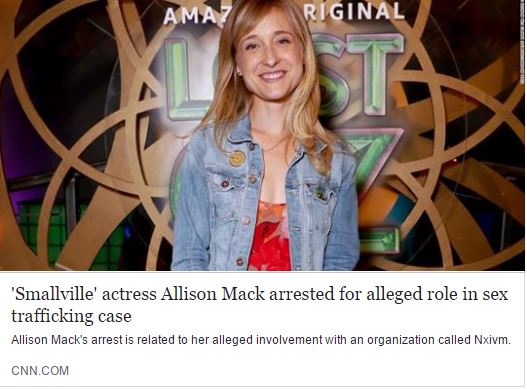
This week Mack was arrested. The story was real.
mack

See full article here.

Mack co-founded Nxivm with Keith Raniere. The organization operated under the guise of a mentorship program for young women. The company website states: “NXIVM is a company whose mission is to raise human awareness, foster an ethical humanitarian civilization, and celebrate what it means to be human.”

No. It’s a pyramid scheme meant to trap women, self-branded as a form of self help and entrepreneurial endeavor.

Apparently Kristin Kreuk, the actress who played Lana Lang on Smallville, recruited Mack before eventually getting out of it herself. Kreuk shared in a statement on Twitter that she had joined the group to help with her shyness, assuming it was simply a self help workshop. She closed her statement with how she is “deeply disturbed” and thanked the women who came forward about the violent inner workings of Nxivm.

Mack continued in the group, leveling up to Raniere’s inner circle by luring girls into the pyramid scheme turned sex trafficking ring. Women were encouraged to recruit other women in order to become masters instead of slaves. Girls were branded and made to starve themselves to fit Raniere’s sexual fantasies. These were impressionable women who were seeking to better their careers through what they thought was mentorship.

Emil: Chloe, I couldn’t help but notice that you practically jumped out of your chair when I came in here. I’d prefer that if there were no secrets between us.
Chloe: Then you’re in the wrong business.

Smallville Season 9, Episode 6: Rabid

I usually use this blog to teach about film, but sometimes those teachable moments are less about technique and more about the seedy underbelly of the entertainment industry.

It upsets me to my core that this case has brought to light the dirty laundry of an actress I thought I could admire. It upsets me that it was an actress at all who lured women into this trap.

I look back at her most famous role, that of the dynamic and strong Chloe Sullivan.  I feel betrayed by a person I never met who doesn’t know I exist. She doesn’t owe me an explanation. An actor is not their character. This much is definitely clear here. We must out predators wherever and whomever they are.

We must not throw judgment on the young women who were sucked into this world. Like with any cult, it probably didn’t seem so bad until they were in deeper than they could escape. Maybe that’s even how Mack’s involvement began.

“I’m not sure if you’ve noticed, but the people who are the worst at taking care of themselves are the ones the world actually needs the most.” — Chloe Sullivan, Smallville

I hope that young women will take note from this case, and be very careful who they put their faith in for mentorship opportunities and career advancement. Not all who say they are there to help you have your best interests at heart.

Hopefully this will be a teachable moment for Allison Mack too. She could have taken many lessons on doing the right thing from the character she portrayed for ten years. Instead she, like the Weinstein-like men before her, must face consequences for her actions.


Teaching through example: Zootopia

Plot/synopsis:

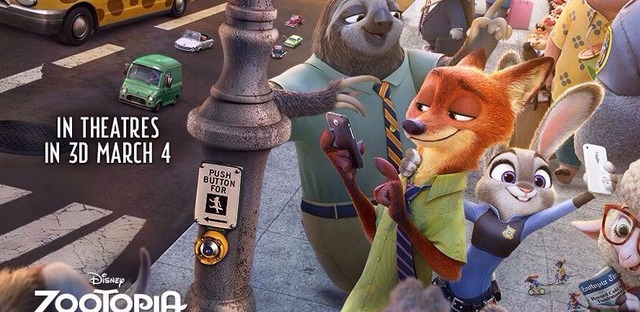
Zootopia is about go-getter bunny Judy Hopps, who defies her family’s wishes and fulfills her dream of becoming a police officer in the city of Zootopia. Only problem is: nobody takes this tiny bunny seriously, and she’s delegated to meter maid duties. She gets interested in the case of missing animals across the city and is determined to find an answer, even if at the expense of her job.

Even from the trailer, it was obvious that this would be a metaphor for females breaking the glass ceiling and working extra hard to prove themselves. The writers chose to make Judy a bunny: an innocent, small, traditionally-helpless creature that represents the stereotypes associated with the feminine. The rest of her fellow police officers are typical predators, or at least large formidable prey like her bison chief. Nobody expects this bunny to succeed.

That makes her all the more eager to prove herself. “Anybody can be anything” is this bunny’s attitude, and she lives it to the fullest. She is truly a positive role model for the children going to see this film.

What’s most important–besides the delightful humor, artful design, and excellent voice acting–are the overriding themes of racism and sexism leading to a frightening world. We see the sexism through Judy’s eyes, in her pursuit of her dreams. We see the racism between predators and prey, and especially when stereotyping a species (or ethnicity.) Our other main character is Nick Wilde, a fox, who is labeled as shifty and untrustworthy because of his species.

Judy proves herself better than most by not assuming the worst of Nick the fox. In fact, she rolls her eyes at her parents offering her “fox repellant” and sticks up for Nick in an ice cream shop that tries to deny him service.

There will be somebody, somewhere out there, that thinks this movie is preachy, and that it didn’t need to be made. I would disagree with that hypothetical person. This movie is important, and it shows themes that are integral to helping kids understand at an early age that just because someone is different from them, doesn’t mean they are bad.

Every generation has its teaching models like this.

Examples:

Ferngully (1992): A boy named Zak is brought down to fairy size to see the plight of the fairies when a logging company destroys their home. It’s been like, 20 years since I’ve seen this, but I figure it was as good an early example as any.

Doug (1991–1994): Hey 90’s kids, remember this Nick cartoon series? The characters were varying shades, from beige to purple to blue. These colors were never mentioned, and the stories were average woes befalling the preteen and teenager.

Cats Don’t Dance (1997): A movie that played heavily on themes of disclusion and racism, set in ’30s Hollywood. The animals were the minority figure. They were show people, but never the star. Just look at Miss Dimple’s infuriating golden locks and psycho stare and tell me she doesn’t represent institutionalized racism.

Milestone Comics and Static Shock (2000–2004): Milestone Comics was a company founded in 1993 whose titles were published by DC, and notably was more conscious of promoting minority superheroes. This eventually led to the creation of a cartoon series, Static Shock. The cartoon centered around a teenager named Virgil Hawkins who witnesses a gang war and through an accident ends up with superpowers. This show was an excellent balance between different races, and the traditional “love interest” girls were as smart and capable as the guys.

Judy-Hopps-in-Zootopia

Judy Hopps. Go get ’em, Tiger. Or um…bunny.

Why bother?

Why bother showing race issues through children’s media? I am so glad you asked, hypothetical reader.

I think we need this gentle reminder here and there that there are all different kinds of people out there,  and the world is simply a better place with inclusion and variety. Films, TV shows, and even printed media is so full of white and male representation as to think of it as the baseline for normal. That’s a problem.

Unfortunately, children absorb a lot of what they see and experience. If they keep seeing action movies with buff, white male protagonists, they can’t imagine women or minorities being the hero. If they see one “token” minority character who is present to take the brunt of the jokes, they might start thinking it’s fine to make fun of the different kid at school. Kids learn by example. Where parents leave gaps, the world fills it in. We just want to be sure they’re filling it in with the right stuff.

If we need to teach such lessons through cartoon animals, then so be it.

Spoilery Section:

This is the review section. Here there be spoilers. You have been warned.

This film plays on expectations, as much for the kids’ sake as for adults. Predators vs. prey is not always clear cut. In fact, SUPER DUPER SPOILER ALERT……. it’s the prey that is the villain (no doubt a fear response against a perceived threat from predators). There’s a lot of smart political, socioeconomics at play here. I’d liken it to how some countries feud with others in anticipation of an attack, thereby creating the problem to begin with, but I don’t want to get political here.

There are a few minor missteps with the racism theme that I think go a bit too far. One is where Clawhauser calls Judy a cute bunny, and she gets all uncomfortable and says how only bunnies can call each other cute. Then later, when Nick is playing with the Assistant Mayor’s hair/wool, Judy freaks out and tells him, “You can’t touch a sheep’s wool!” These are both real-world examples of complicated race-tensions that felt a little awkward in this movie. It could have been accomplished otherwise. Maybe someone else wouldn’t think so. I’d need a second opinion.

What might seem like a misstep (but is actually an integral plot point and teaching tool) is after Officer Hopps has solved the case, she says things that are taken out of context in a press conference. She infers that predators are naturally prone to becoming “savage” (aka dangerous), and although she is just repeating information another character told her about how the animals were going crazy, she says the wrong thing to a crowd of fearful reporters who all happen to be prey animals. Good intentions but poor execution lead to Judy accidentally starting an extreme racist reaction to predators in general. One of her buddies even loses his position on the police force because “nobody wants to see a predator when they walk into the ZPD.”

These moments echo so powerfully the irrational fears against minorities that are the root of the problem. Judy only realizes belatedly how her words were taken to the extreme, and resigns in protest.

Zootopia was such a fantastic movie that doesn’t have to talk down to kids to be enjoyable. If you haven’t gotten a chance yet, I suggest you go see it yourself.