How to Avoid Film Job Scams – Take Six

Okay, first thing — Thank you to everyone who shared the blog and reached out to tell me that they used my blogs on scams as a resource to keep themselves and their friends safe. It really warms my heart to see a difference being made.

I don’t only write about scams but since getting the word out has been useful, I’ll keep up the occasional update post on the topic.

Recently I spoke at another Atlanta Film Production Mixer about my career and what red flags to look out for. Again I had multiple people telling me about scams they encountered.

Lovely photo shot on actual film by one Marco Gutiérrez.

It’s time for an update. Here are a few more scams to look out for. Now, keep in mind how they are done, not necessarily the individual job itself. Most of these posts have dates that have passed now. It’s literally impossible for me to keep up with them. But if you note why these posts are scams and arm yourself with that in the future, you are less likely to become a victim.

The Math isn’t Math-ing.

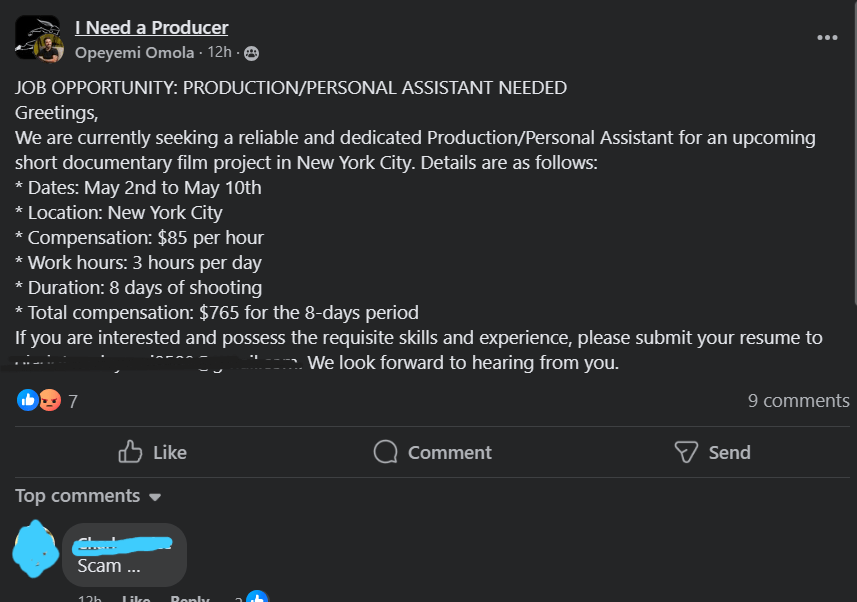
How can you tell this one is not a real job?

For one, some quick simple math will tell you something is up. They claim the job pays $85/hr. It’s 3 hours a day for 8 days. $85×3= $255/day. $255/day x 8 days = $2,040. The post claims the Personal Assistant PA is getting $765 for the entire job. Wow.

Also, a “personal assistant/production assistant”? Those are two different jobs.

For some reason I’m also seeing this “3 hours a day” grift a lot lately. Maybe it’s to entice people for a seemingly large reward for minimal work.

Another thing to do when considering if a job is a scam or not is to check the likes and comments. Here you can see one person who is familiar with this particular scammer and calls them out.

That’s…Not How This Works

This can be a scam or just a person who doesn’t know much about the film industry. Sometimes that’s the same person.

I’ve seen multiple jobs asking for “two DPs” or a media manager who is actually acting as an editor assistant.

The two DP’s thing I want to elaborate on quickly: a project typically has one Director of Photography. That’s the lead guy or gal in charge of the camera department. You don’t want too many cooks in the kitchen. You may find multiple DPs on very large Hollywood style projects or big features, because you might have a second unit DP in charge of stunts and other scenes. You would also have multiple DPs for different episodes of TV shows.

But if you see a post for a small project looking for multiple DP’s, they are either misunderstanding what a camera operator is or …

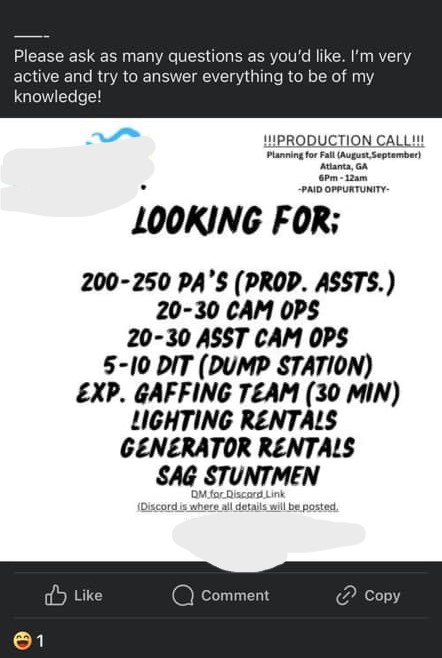
200 PA’s and 20+ camera operators and assistants? Either this is a huge show or…

Maybe just see that they want you to join a Discord for more information and realize what the problem is.

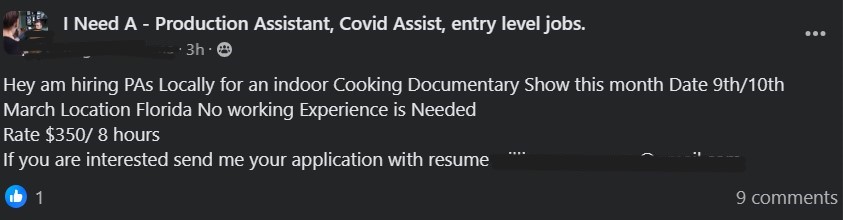
“No Experience Necessary!”

Be very wary of any film job that says “no experience necessary.” I’ve seen that on a lot of scams too.

Truth be told, production assistant is an entry level position. A job can ask for a more experienced PA or one who has worked on certain shows, but the understand is that sometimes this is a PA’s first job.

But how about a job offering a suspiciously high rate for a first time PA?

Yeah, stay away from these.

The Forgotten Casualties of the WGA & SAG-AFTRA Strikes

Motion Picture and Television Fund (MPTF) President Bob Beitcher pointed out that although the WGA and SAG-AFTRA have been supportive financially to their own members, a lot of people have been left behind. How about the folks who run cables, operate cameras, apply makeup, design sets, record sound, organize schedules or serve lunch?

“They have become the forgotten casualties during these strikes, overlooked by the media. Let’s face it, actors and writers make better subjects for strike stories; and now crew members are not getting the philanthropic support they’ve earned and deserve.”

Bob Beitcher

The stats are illuminating. Prior to the writer’s strike on May 2, 2023, the MPTF would receive calls from about 100 crew members weekly looking for financial or other assistance. That jumped to 500-1000/week since July.

From the Crew’s Perspective

There have been more than a few unkind remarks from people — trolls — online. “Actors make too much already! Writers are just complaining! Get a real job!” We’ve all heard some variation of this.

“The endgame is to allow things to drag on until union members start losing their apartments and losing their houses.”

anonymous studio executive to Deadline

An anonymous executive made the comment that the studios would wait out the writers until they lost their homes. That kind of thing is already happening. And not just to writers. When the writers and actors aren’t working, neither can the crew members who work on those projects.

Let’s face it — the studios knew there was going to be a strike. So even prior to May 2, a lot of us felt it coming. Shows that should have started production in March or April just…didn’t. I remember countless talks with fellow film workers from March on: “Things are slow, right? Yeah they’re slow. Hope it doesn’t stay that way.”

Can I prove this was done on purpose to squeeze the crew and make them as anti-strike as possible? No, but the idea is in your head now, isn’t it? It also could be due to the mergers of various studios which I touch upon in the next section.

Film is a very difficult business. When work is good and plentiful, it seems really good. In fact, most people working regular jobs would probably scoff at some of the day rates I’ve gotten, and I’m not getting the crazy high rates that get advertised in Deadline.

The thing is though… you always have the possibility of not working for weeks or months after a job. You might be hopscotching from one day play gig to another, constantly hustling to find the next gig. There are film workers who already had a backup job as a safety net, and now that’s not even enough to get by.

The Answer is Easy. Just Work on Reality TV!

“But what about non-union? I can just work Reality TV! They aren’t affected by the strike!”

That’s not exactly a consolation prize and I’m a little annoyed people keep thinking like that. There’s a vast number of film workers who specifically work in the reality scene aka unscripted — and they’re being told that people in scripted could just take their jobs instead.

Reality is also not an answer because it’s not even booming like some would expect.

“… something one would assume is that there’s a lot of work and a lot of more projects getting greenlit, and that doesn’t seem to be the case for some reason. You know, I’ve talked to a number of producers who said this is the toughest moment they’ve seen for unscripted TV right now in terms of people aren’t working. There have been long stretches where since maybe December that a lot of people have been in without work.”

Ryan Gajewski, The Hollywood Reporter via article on PBS.org

In this Deadline article, it details the layoffs and cost-cutting that is plaguing reality tv for mid-size production companies. That includes Bunim/Murray Productions (Keeping up with the Kardashians, Real World) cutting eight staffers and Half-Yard Productions “right sizing” the company after being purchased by The North Road.

Mergers have definitely played a role. The Warner Bros Discovery merger, for one, took place in April 2022. That is being felt this year, as shows are just not being greenlit or put on a backburner for what feels like forever. I for one would have started on a season of a show this past April, except the date for production kept moving as it hadn’t been greenlit yet. Then I also heard that some people wouldn’t be able to return anyway — the company (whom I shan’t name so I can be hired again) would only be hiring in-house for certain jobs.

Survival Mode

I just deleted a home renovation show off my calendar. Easy come, easy go. On a normal year, this is a thing that happens from time to time, but there’s other projects to take away the sting. This year, it hurts losing even the possibility of a one-day gig.

This is scarily reminiscent of 2020, when all film work ground to a halt and most of us were out of work for nearly a year. Now, in 2023, we’re facing a similar situation. Some folks might not have had time to recover from 2020 yet. There are going to be film workers who finally just throw up their hands and change careers.

We waited for a while to see what would happen. 2023 started with a whimper, shows that should have started pre-strike didn’t and then the strike solidified it. This career has become even more dicey to try to hold onto.

Friends of mine have resorted to taking part-time jobs or even gig-economy jobs like Uber or dog walking. I’ve seen folks comment online that they can’t even get a job because employers don’t want to hire someone who will jump ship when the strike ends.

Nexxt steps are challenging.

Typical job search engines aren’t keyed into production style resumes.

And just try navigating unemployment when you’re a freelance film worker who can’t easily fit into the government’s forms. Imagine sitting down for hours, filling out information that is not always easy to find (was that job a W-2 or a 1099? What was the payroll company? How many weeks did I work in the last 18 months?) and then getting a call saying you missed one item — now you have to refile the entire application again.

There’s no easy answer right now.

No matter how long the strike takes, even if it ended today, it’ll be months before episodes are written and production actually begins. Meanwhile our rent, car payments, healthcare, and increased costs for groceries and gas still need to be paid.

Having said all that… I am still supportive of the strikes.

I understand, and many of my film fellows agree, that the issues the writers and actors are fighting for will have major repercussions down the line. They need to set standards for streaming and residuals, the middle class actor and writer needs to be able to afford to keep doing what they want to do, and a line in the sand must be drawn against AI use in writing and acting. The fight they are in will effect all of us in the end.

It’s time for the AMPTP to start understanding that.

Anyone interested in helping the MPTF’s emergency relief funding efforts can donate here: http://www.mptf.com/donate.

Sources

Hollywood Crew Are “Forgotten Casualties” in Strike, MPTF Chief Says in Call for Financial Aid

Hollywood Studios’ WGA Strike Endgame Is To Let Writers Go Broke Before Resuming Talks In Fall

Doom & Gloom In Unscripted TV: Producers Battle Challenging Conditions As Mid-Sized Firms Face Layoffs

What You Need to Know about the Warner Bros Discovery Merger

How the Ongoing Writers Strike Impacts Reality and Unscripted TV

header image: Photo 129097006 | Film Crew © Ppengcreative | Dreamstime.com

Feast or Famine: Looking at the Stats

It’s the end of February, and all I’ve heard from various film friends is “I’m not working right now, are you?” A winter slump is normal, especially December into January. I just go into these months expecting the slowdown, and for things to pick up in March.

But another kind of work anxiety hits. How much do I need to reach out to jobs before I work regularly? It’s not an easy answer, but looking at my own data, I can see some patterns.

Since 2018 I’ve been keeping track of how many jobs I’ve applied to or been recommended for, and how many jobs I actually got. I meant well, but as times got busy, I eventually lost track or didn’t keep the best data. But I decided, you know what? There’s still something here to see. At least from 2018-2021.

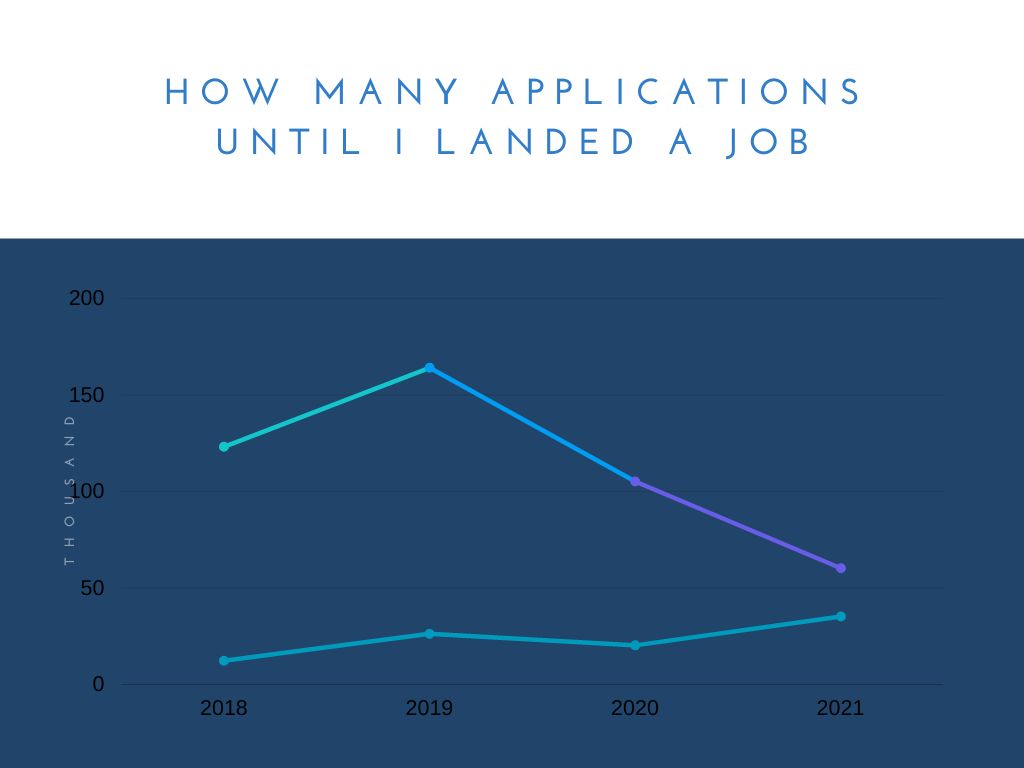
I’m looking at two main things. Gigs applied to, referred to, or inquired about vs Gigs actually worked.

A Handy Dandy Chart

YearGigs AppliedGigs WorkedHow many applications until a job
20181231210
2019164266.3
2020105205.25
202160351.7

Within 4 years, you can see that I went from sending out 10 applications to get to one job, to sending out about 2. Now, I went to art school so I can’t Math all that well, but that looks like a good trend to me.

If I just don’t think too hard about it, the math checks out

I didn’t bother showing info from 2022 because I had several long running gigs and decided not to be Type A about showing what jobs I applied to anymore.

Represented as a hastily thrown together graph on Canva, that looks like:

Top line = Number of applications

Bottom line = Number of jobs landed

Closing the gap is a good thing.

There’s a few things I want you to know about this data.

  1. It takes a lot of effort to establish yourself in a new market. When I arrived in Georgia, I had to do a lot of legwork to start getting jobs.
  2. As time went on, a lot of my applications were actually just recommendations — people recommending me for gigs. When you become known, the work starts coming to you.
  3. I didn’t bother keeping track in 2022 because I was almost 100% working based off recommendations and had several longer runs on shows, whereas previous years I had more day-play opportunities.

If I look at my Google calendar from those years, I see wide swathes of nothing going on for days or weeks during the same slow months. Film is a marathon, not a sprint, and you’ve got to plan accordingly for the slow times. And those slow times can make you feel like you’re beating your head against the wall.

And it’s not just as simple as applying to jobs you see posted on job boards or Facebook groups or throwing your name in the ring for open crew calls.

A lot of the work I did alongside all this was networking, meeting people for coffee, doing casual fun things with fellow filmmakers, helping out on friend’s sets, speaking to students and film clubs, and even writing this blog. Self-promotion is a big deal in addition to applying for jobs. Networking is the glue that holds it all together.

I also applied to a lot of jobs in the slow months of January and February each year. There’s a lot more competition then, because less people are actively working.

This is my way of saying, if it’s slow right now, it’s not just you. It’s a lot of us, and there’s a lot of folks scrambling for the next job.

Keep in mind we’re also on the brink of a possible union strike down the line, and theories have been floating around about productions holding back from starting. I don’t know for sure. All I can say is to hold tight and know that you’re not the only one not actively working right now, and if you’re new — it’s going to take a lot to get yourself established.

This is not an easy industry to get into, but those who have the fortitude to stick through the hard times end up successful.

Sources:

Hollywood Braces for a Possible Writers Strike: Why the WGA and Studios Are on a Collision Course

Networking in the Digital Age

Earlier this year I borrowed a book on networking from the local library. Build Your Dream Network by J. Kelly Hoey was not likely to help me much in my business, and I knew this going in. The film industry is less about LinkedIn and corporate ladders as it is about building a reel and meeting people who want to hire you again. Reading this book was slow going–

–and then the pandemic hit. Suddenly a book on networking just seemed ironic when everyone was stuck at home and every gig and job for the year was cancelled.

Thanks to a very generous library return policy, I finally finished this book and wanted to share some insights on networking as it applies to working in film.

I’m also keeping in mind the quarantine aspect of our current situation. Going to any sort of networking or meet-and-greet event is currently out. Stay socially responsible and do make your connections from home while things are still slow and social gatherings are not possible.

Networking in General

Networking is defined as “the action or process of interacting with others to exchange information and develop professional or social contacts.”

Making connections is how you get jobs. Sure, you can get gigs by applying to online job postings, but if you’re a freelancer, much of your work will be through repeat hiring by people who like you and projects that received your name as a recommendation. Expanding your network is a way to get some sense of job security. The stronger your network, the more likely you will work. See what I did there?

Also, networking should be considered an ongoing process. It’s not just something you do until you get the first job, or for the first year of your career — it’s continuous. Contacts come and go and production companies can move. You don’t want all your eggs in one basket.

I also highly recommend having some sort of network in place before you move to a new place. Reach out to some folks in the area you want to live, ask questions, put examples of your work out there. You’ll be more established than if you go in blind.

My Networking Experience

When I first moved to Georgia, I spent the first few months living off my savings and reaching out to as many people as I could. I also went to some networking events with varying degrees of success.

Most of my connections were made through Facebook groups. Thanks to Atlanta Film Community’s bi-weekly “Self Promotion Posts,” I was noticed by a local DP and director, both of whom have continued to hire me on their projects.

Networking is connecting through shared stories and experiences. Its building a human connection, not simply stating a need to be filled (or, in the case of startups, a check to be written).” – J. Kelly Hoey

I’ve connected with other people by seeing their online presence on social media, reaching out and having a chat, exchanging resumes and reels.

One sound designer I networked with put up a self promotion post on a general film page. I saw it, looked at his work and contacted him. After seeing his quality of work and interacting online, I knew he’d be a talent to have on set. After our first film together, I continued to recommend him for numerous jobs, and he’s done the same for me.

A fellow camera assistant posted about wanting to connect with like-minds in Atlanta. I reached out, and we’ve both recommended each other for jobs. She even had me over at a dinner party (ahem, in January, pre-COVID) where I was able to connect with even more people.

You should be getting the sense that networking is not about saying “hire me,” it’s about developing a relationship and mutual respect with another person. This should be done delicately. Don’t spam post anywhere, don’t eek out desperation, and know the right time to send an unsolicited message to someone you don’t yet know. You should know when the time is right.

Reach out to people you admire, whose work you appreciate. Check out someone’s work on Instagram, Twitter feed or their website and demo reel. Send them a quick message if you like their work. It means a lot. That might even open up a dialogue, but you shouldn’t try to force someone to hire you.

Thanks to these weird times we live in, the latest film festival to show my short The Road Less Traveled — Cat Fly Film Festival of Asheville, NC — held an online streamed event. I reached out to two people — one in Atlanta who I hadn’t met before, and the director of the film I liked the most in the festival By Sunrise, a superbly done short horror film. Thanks to interacting at this streamed film festival, I made excellent connections I may be working with in the future.

Networking fails

Build Your Dream Network also had some great pointers on how not to network.

One such piece of advice is very sound: don’t just reach out to someone when they’ve landed a big job or coveted position.

“But,” you argue, “Didn’t you just say to reach out to people whose work you admire?”

Sure! But did you establish a relationship with someone, only to ghost them until that success and it looked like you could get something out of it? Don’t be selfish. Keep up on your contacts, check in with the people you like and recommend people for jobs. It’s all good relationship fodder.

Now, you can say “congrats!” to them if you feel necessary, but if that’s the only time you’ve contacted the person, the contact might be too little too late — at least according to J. Kelly Hoey’s book.

I’m proud of my friends and colleagues when they post their successes, and I try to do my part by sharing what they want shared, supporting a fundraising campaign or posting when they’re going to do a livestream or a radio interview. It means a lot to have that kind of support.

Conclusion

If you have a garden, do you only water it when the tomatoes are ripe? Think of that daily watering and maintenance as a way you should approach building your network. In the film industry we meet scores of new people at every job — you don’t want your name to disappear in a thrown away call sheet.

So, while things are still slow, this is your time to reach out to people, make those connections, and maybe polish all your public profiles and make sure things are up to date. You’ll want to hit the ground running when production starts back up.