Why Aren’t There More Women Directors?

Women have got to realize something:

We’re not funny…

We can’t do action…

We certainly can’t direct…

Maybe we should go truly old school and just have castrated men play all the parts? Worked in Shakespeare’s day, didn’t it?

Obviously the above is satire from my part, but it’s not satire on some corners of the Internet. When a movie does well, suddenly it’s “Oh my gosh, women can be funny!? What a good director! Amazing!” but when a movie goes bad, suddenly it’s “This is what happens when you cater to women. This was a bad female director, actor, writer, etc.” We’ve all heard the Madame Web jokes at this point.

I personally love the part where she says, “It’s Madame Webbin’ time.”

I too did not see that movie. But I probably will because I’m a glutton for punishment.

A 2024 Guardian article pointed out the discrepancy of proposed diversity and inclusion promises and what actually happened.

USC’s Annenberg Inclusion Initiative called out the major studies who claimed they would promote more diversity in their hiring practices after 2020 as “performative.” The study didn’t show any actual progress towards pushing for that change.

Women comprised 16% of directors on the 250 top grossing films in 2023, according to the study conducted by the Center for the Study of Women in Television and Film at San Diego State University. That’s down from 18% the year before.

I’m sorry, down?! Aren’t we more inclusive, more diverse than ever? Nope.

Of the 116 directors attached to the 100 top grossing films of 2026, only 14 were women. Look at those numbers again. That’s 12%.

These numbers are in direct contrast to the women dominated juggernaut of 2023, Greta Gerwig’s Barbie which was a $1 billion success.

By the way, only 4 of those directors were women of color.

Diversity and inclusion are — spoiler alert — not a bad thing. I work in the Atlanta film industry. I work with some of the most diverse crews you’ll see, and yet I still see so many sets that are primarily white and/or male.

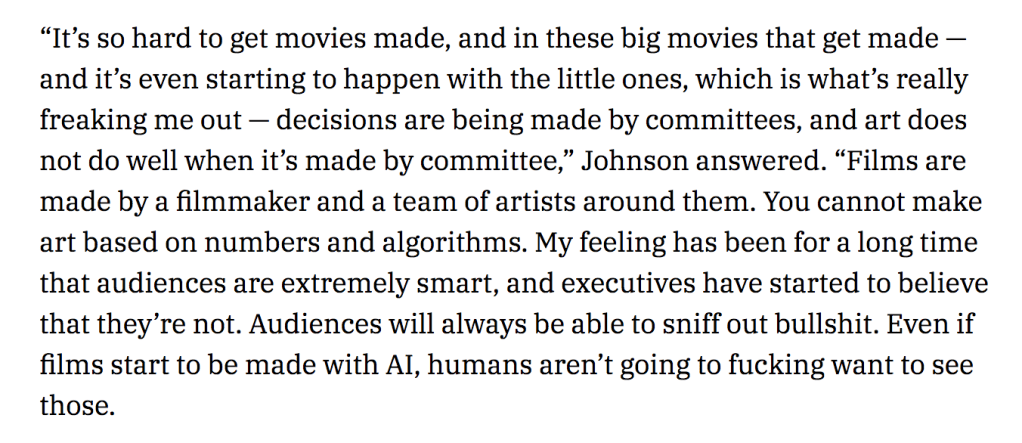
As people complain about superhero fatigue or girly movies just not appealing to mass audiences (The Marvels, Madame Webb) I want to share this piece of a statement from Dakota Johnson, the titular Madame Webb herself:

Dakota Johnson survived everything about Fifty Shades of Gray, she can surely shake this off too.

“Decisions are made by committees….art based on numbers and algorithms.” This hits hard because the shadier businessmen of Hollywood are surely looking to A.I. to pump out algorithm-satisfying garbage in order to save a buck. But for years it’s people sticking their fingers in where they probably don’t belong.

Film is a collaborative medium, and that’s a beautiful thing. I’ve seen my work in a whole new light after an editor or colorist has done their job, and I’ve seen scripts blossom through the work of careful critique and notes. Where it falls apart is when execs or producers or whoever start trying to make their mark and just doing arbitrary things they think the audience will want. Or they want. Like a giant mechanical spider in Wild, Wild West, which was originally pitched for the unproduced Superman Lives script. I don’t even have time to get into that one. Read about it here.
One of those arbitrary things is hiring someone like themselves to direct a film. Men in power tend to hire men that remind them of themselves.

This Variety article references a study about how first time directors get fewer offers, but even experienced directors are more likely to be hired if they are white and male. The stat speaks for itself:

  • 4.8% of experienced directors are female. 95.2% of experienced directors are male.
  • 16.3% of experienced directors are BIPOC, the rest are white.

“The results of this study are eye-opening. For underrepresented groups, there remain obstacles, structures and processes that stand in the way of getting that critical first shot. I’m encouraged that first-time directors get equal results, but they just need to be given equal opportunities,” said Dr. Yalda T. Uhls, founder of the Center for Scholars & Storytellers at UCLA.

It’s 2024. The time for arguing about more inclusivity seems to be falling on deaf ears. So let’s shout it a little louder. And in the meantime, keep your mind open about who to hire on your next film. You may be surprised by the incredible artists you connect with.

Sources:

Study shows ‘catastrophic’ 10-year low for female representation in film

First-Time Directors Still Have Limited Opportunities in Hollywood, New UCLA Study Reports (EXCLUSIVE)

Giant Spiders, Giant Flops: The Enduring Awfulness of ‘Wild Wild West’

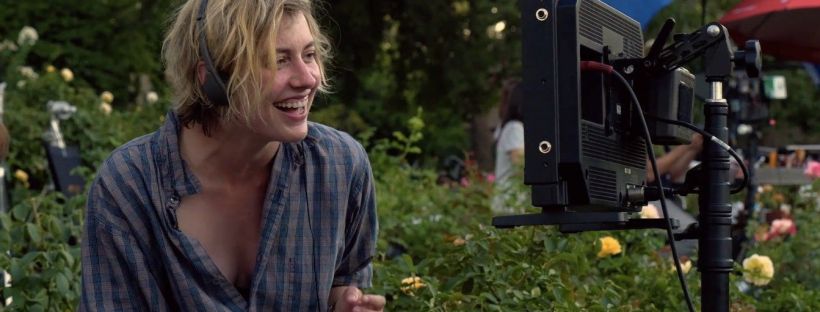
Featured Image: Greta Gerwig directing Ladybird.

How to Avoid Film Job Scams – Take Five

It would be a full time job for me to update this blog everytime I find a scam posted or someone I know shares a scam they found with me. There’s no way to keep up. My overall goal is to equip you with the know-how to see the red flags and avoid being scammed at all costs.

Sometimes I can’t name names. There’s a few reasons for this:

  • scammers can also be identity thieves who stole someone’s picture and name. You don’t want the real person to get in trouble.
  • It’s just a fake made-up name that will evaporate anyway. Like one I covered, Jake Smith became Jeffery Cooper became Ethan Snith.
  • Maybe I’m wrong. Or maybe the poster is just inexperienced and went about things the wrong way.

I do however want to bring the following items to light, and also reinforce the red flags you should look out for when vetting a scam job post.

Red flags to look out for when vetting a scam:

  • bad grammar/spelling
  • incorrect film terminology. (I.E. Production Assistance instead of Assistant.)
  • unusually high rate or weird weekly rates/hourly rates for usually a day rate job
  • Job poster turned off commenting on the post. That’s usually because people started getting suspicious and asking the right questions.
  • large blocks of text that ramble on about the proposed job.

You can also do your due diligence by briefly looking into the job poster. Do they have no Facebook friends? Did they recently make an account, or change their name and profile pic? Did they post a very similar job in multiple groups with different dates?

Now these things don’t guarantee a scammer, but if you checked a few of them off a list, that’s a real good indicator.

Kevin – But Not Really

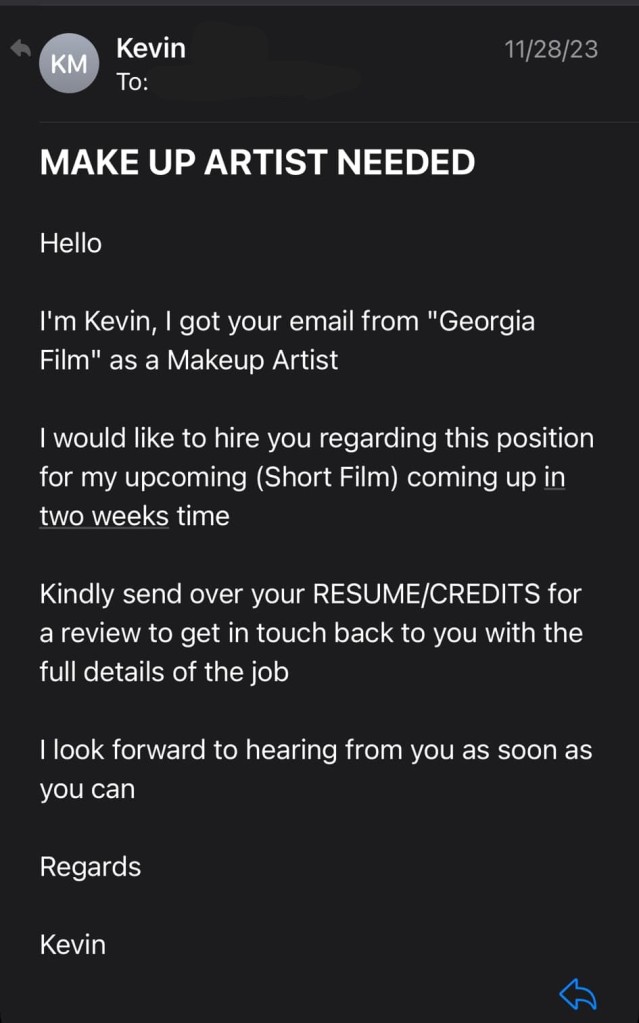
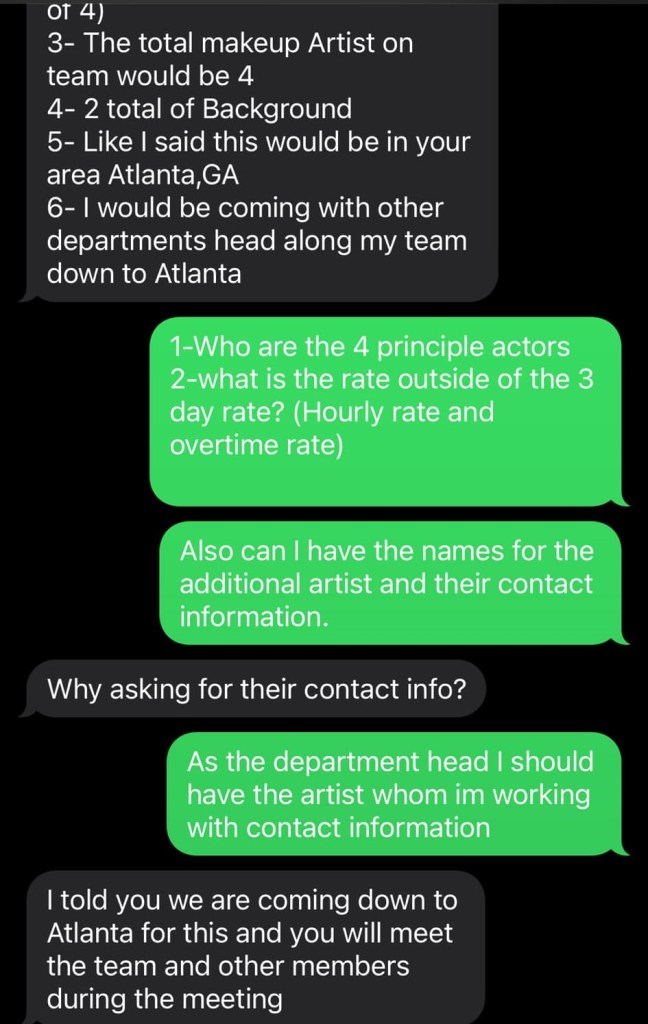
An Atlanta makeup artist was contact by a legit enough sounding job poster. They used a real person’s name who is in no way connected to the resulting attempted scam, so I deleted the last name.

It uses a familiar format: Fake Kev contacted the makeup artist saying they found their info on “Georgia Production website.” Sometimes it’s called a film directory or similar, but a lot of scams used this “I found you on (something that doesn’t exist).”

They also said “Kindly,” “regards,” and “send over your resume/credits.” which are all things I’ve seen a hundred times in these scam emails.

Although our makeup artist was excited at the opportunity to department head on a project, they kept a cool head and did their due diligence. They asked for a deal memo, tax docs and contact info for the additional makeup artist. This is all normal, good stuff to check on if you’re offered a job.

Then this mystery job poster sent a $3000 check to the makeup artist’s home….from an electrical company.

Folks, never, ever receive payment before a job. It is a check phishing scam. After that check goes in your bank and you immediately withdraw the funds for some equipment they ask you to pay for or, in this case, hiring an additional makeup artist, the bank finds out a day or two later that the check is fake and now you’ve sent your own money right back to the scammer.

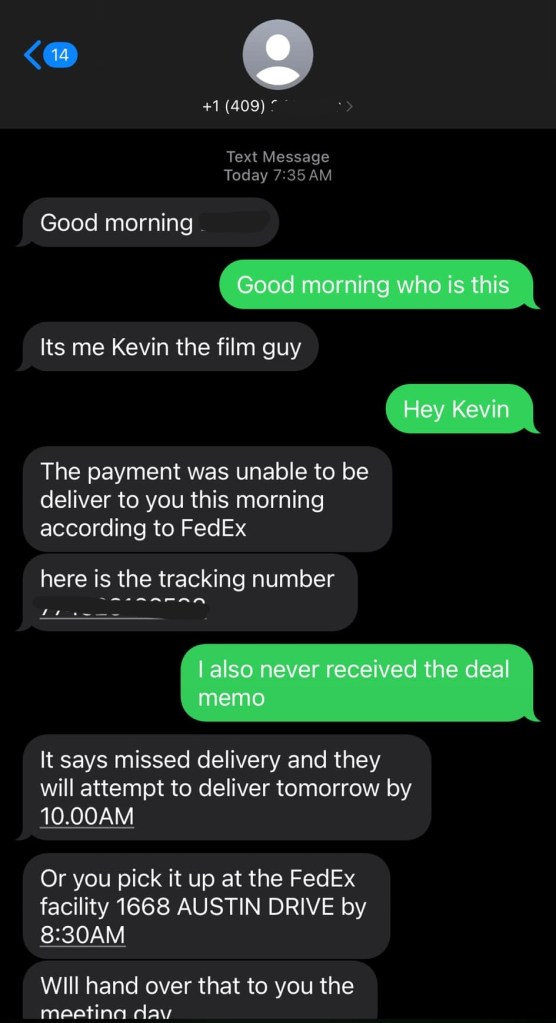
“It’s me Kevin the film guy” said the scammer

Our makeup artist did not get scammed because they knew when things weren’t adding up.

The scammer tries to guilt the makeup artist by saying they already confirmed (they didn’t) and trying to place blame on them for not stipulating a lack of deal memo was a deal breaker. And the scammer clearly didn’t know what a deal memo was because they proceed to call it a “demo” a couple times.

Sometimes these scammers know just enough about film to get by, but their story falls apart very quickly when a professional digs in.

Also note the poor grammar that indicates a non-native English speaker. “The payment was unable to be deliver,” “I will hand over to you meeting,” “You should have tell me this.” Look, I get it scammer, using past tense is hard. But if you want to make the Duolingo owl happy, you have to at least try.

Cinebyte

This one is posting a lot so I wanted to bring it to everyone’s attention.

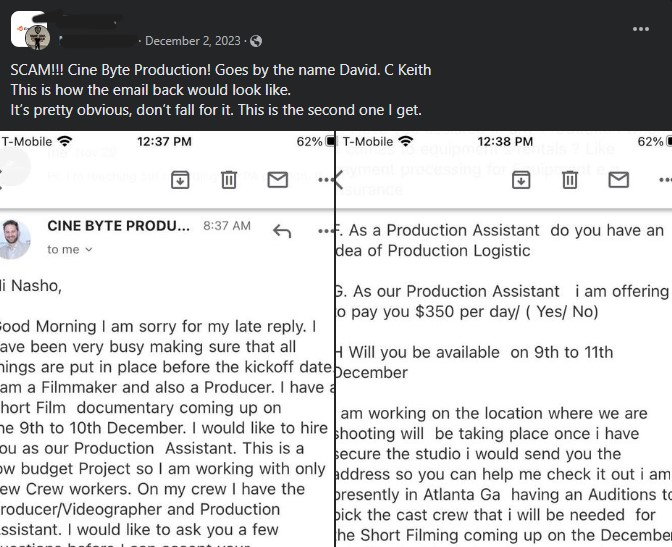
Another crew member in a Facebook group called out Cinebyte Productions as a scam, even posting the highly suspect email he received from the company.

The email is full of bad grammar and is just a huge block of text. I’ll reiterate what I’ve said in the past. When you are a professional in the film industry and someone offers you a job, it usually starts. “Hey, so-and-so recommended you. Are you available to cam op a scripted series in May?” And then you proceed to get more details on further communication.

The Cinebyte job postings are posted by several different people (or the same person using different names, isn’t this fun?). They also use multiple emails. So far I’ve seen: cbytefilm@gmail, lanawilson496@gmail, cinebyteproduction3, etc.

The postings are fake but the company is real. Someone stole David’s name and pic and the company name to seem legit.

I wanted this entry to end here. Guys, I’m tired of chasing these scams. I just want to catch non-Pokemon branded creatures in Palworld and relax for once. But there’s one more I’ve got to cover.

The Music Video Scammer

I’ve covered another shapeshifter before. He went by Jake Smith, Ethan Smith, Jeffery Cooper and every version of those names. Now we’ve got this guy.

Someone named “Eric” (but not really, follow along) posted this job for a PA on a music video. Responsibilities included driving talent and “on-set assistance” (groan).

A number of PA’s hungry for work fell into this supposed job. I learned they did do some driving around, but it became apparent that things were not on the up-and-up. PA’s were expected to pay for lunch, pay for an iPhone SE and headphones. They picked up Ken, a man who was supposedly in a car accident and couldn’t drive himself around. I suppose Ken, who claimed to be the rapper’s manager, the contact they were driving around, hair/makeup artist who, on closer inspection, might not have been an actual HMU. The driver/PA did three days of pickups/drop off’s to such places as a park in a seedy neighborhood, Cookout and, amazingly, Dave n Busters.

Every PA who responded to and did this job (it must have been more than the 3 days, as multiple people were scammed), did not get paid and were ghosted by Ken/Eric.

So Ken/Eric got called out on Facebook, and not long after he changed his name and profile picture to Chris, copying another real filmmaker’s profile pic and image, and posted this job:

I wasn’t ready to post the blog when this went up, so I immediately posted right after this that “Chris” was the same guy who scammed the music video PA’s. Within minutes, “Chris” deleted or changed his Facebook again. Whatever identity he picks next, I’m sure he and many others are out there ready to scam again.

A lot of our scammers are overseas, trying to steal your account information or get you to send them equipment and you’re out the money. But some scammers do this up close and personal. Let’s keep our community safe and keep each other informed.

Previous posts on this topic:

New Year, Same Old Film Job Scams

How to Avoid Film Job Scams – Take Four

New Year, Same Old Film Job Scams

I use the blog on my website to teach what I know about the film industry. But one topic keeps coming up: Scams. It’s gotten so common that now people just associate my blog as “the scam blog.” My last scam related post was in August, but I’d have enough fodder to update the post weekly.

Here’s an example:

Love that comment.

I highlighted the red flags that should stand out for you:

  • Generally poor grammar: “The dates for a documentary-style TV show for Veles Productions (extra space added) this month are August 21-25.” Also the weirdness of hiring a Production Assistant/Personal assistant, two completely separate jobs.
  • Astronomically high rate for a PA $1500 for 12 hours (and weird added “4 hours per day.”) Day rates for PA’s range around $175-250ish per day (12 hours) depending on the market and type of gig.
  • Must have “terminology knowledge.” What!?
  • Using the word “staff” instead of “crew.”
  • The PA is helping set up “lights, props and tools.” PA is an entry level job and typically shouldn’t be doing any of these things, but as budgets get tight (read: stingy) a lot of places are making PA’s take on extra responsibilities. It’s not great but… I’ve seen it done.

That’s your typical example of a film job scam that’s posted to social media. It could be Facebook, Instagram…heck I’ve even seen scams posted to StaffMeUp and LinkedIn. Nowhere is safe, so always keep your guard up.

I wanted to shift gears for the new year and arm you with two other types of scammy jobs to look out for: Illegal internships and opportunity scams.

Illegal Internships

I’ve worked on a number of movies, tv shows and other projects where we’ve got some newbies working as PA’s who are billed as interns.

Internships have been under fire before in the entertainment industry. A famous case occurred during the production of Darren Aronofsky’s Black Swan. Two interns sued on behalf of 100 Fox Searchlight interns for backpay as they did work as employees, not interns. The class action lawsuit was resolved in the interns’ favor.

But I’ve also run into it on several low budget features and other projects where someone eager to enter the film industry comes in as an intern. Read between the lines — unpaid labor.

Sometimes I make a point to ask the intern “Are you in college right now? Are you getting college credit?” If not, then it gets sketchy. A legal internship benefits the intern alone, through work experience and/or college credit. Typically an employer is helping the intern but not benefitting themselves — well, in theory. But if that intern is doing the work that a full time employee would do? That’s a problem.

If you want to volunteer on someone’s project, that’s up to you. But I wouldn’t ask you to take the title of intern if you’re doing an actual job for someone. I even wrote about deciding whether or not to volunteer on a film set before:

“This is your opportunity!”

The real reason I was inspired to do an update on scams is because I came across this on Eventbrite.

This “event” someone posting that you could work on a faith based film — for the low, low price of $199! That you pay them.

Oh jeez, where do I start with this one?

You should never pay to work on a movie.

I’ve seen this scam before in another form, someone advertising they needed crew for a movie and asking the crew to pay to work on the film. The audacity of this.

Oh also, “star” in a movie? With no acting experience? That’s fishy enough. At best you’d be an extra. Someone sitting on a park bench in the background or filling tables in a restaurant. Not a main character with lines.

Sign up from our website and receive a 25% discount!

Star in a Faith-Based Christmas Movie! No Acting Experience Required. Now available in over 50 major US cities. Bring the whole family!

If it wasn’t clear this was a scam before, I clicked on the website link and saw that the “admission fee” was now $50 (how generous! And also not the definition of 24% off from the original $199) and now the location was listed as another state. Not Atlanta but Venice Beach California, Detroit, Los Angeles, etc. It’s a “pop up filming event” (the heck is that!?) in over 50 major US cities!

Using the word “local.” So many of the Facebook-posted job scams I’ve covered have used terms like “local” or “in your area” so they can scam far and wide. Or there’ll be a weird space before the location or date because it’s clear they copy and paste and change a couple details.

There are plenty of other scammy looking opportunities, classes, events that try to sell the dream of a career in film to new people. If something seems too good to be true or glamorizes the whole prospect of joining a film production, think twice before you submit or pay for anything.

Stay safe in 2024.

Sources:

Fox Settles ‘Black Swan’ Interns Lawsuit After Five Years

More than 40% of interns are still unpaid—here’s the history of why that’s legal

How to Avoid Film Job Scams – Take Four (blog)

5 Reasons for and Against Volunteering on a Film (blog)

How to Avoid Film Job Scams – Take Four

I really hate that this has become a recurring theme I have to address. I really just want to teach about the fun stuff. Instead, I have to keep drudging up the fact that there are many people out there taking advantage of the film community.

Things are not good right now. The SAG-AFTRA/WGA strikes combined with corporate studio greed has contributed to a painfully difficult year to work in film. 2023 has brought major career changes, such as layoffs and unemployment and the need for survival jobs to many creatives affected by the strikes.

Facebook film groups are rife with scammers taking advantage of people desperate for work and green people trying to get their start in the film industry.

Here’s some of the latest scams and suspicious posts that I and several community members have come across.

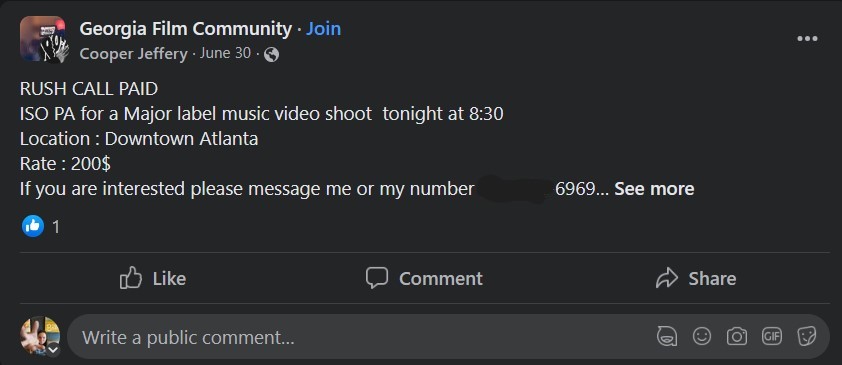
Jake Smith/Jeffery Cooper

This is likely not this guy’s real name. For one, he went from Jake Smith to Jeffery Cooper to Cooper Jeffery. Also a quick Google and both names show up as actors. Maybe they’re just common names, and that helps lure in an unsuspecting individual.

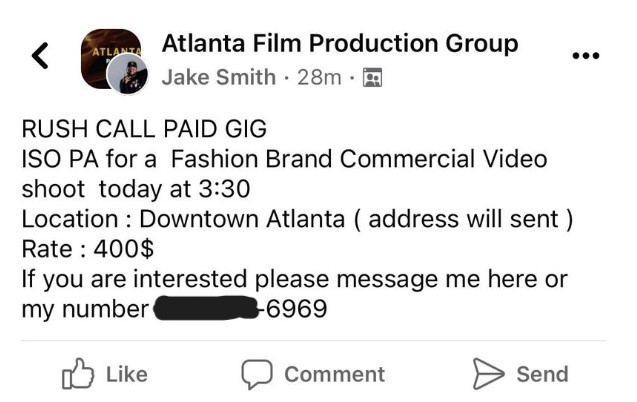
Bad grammar is often a dead giveaway on scams.

“Address will sent.” “400$”

Jeffery/Jake’s posts are rife with spelling and grammar issues. Normally that points to an overseas scammer unfamiliar with English. He appears to be in Atlanta though, because people have worked with him in the Atlanta market before. And one or two of the disposable phone numbers he’s used come back to Marietta, GA.

Be highly suspicious of jobs that are taking place “in a few hours” or the same day. Honestly, it can happen that a production needs last minute help. Someone got sick, had an emergency and couldn’t come in, your feature realizes they don’t have enough extras for a party scene (saw that one happen in person).

But be very suspicious of a job that needs you to throw all caution out the window and immediately jump in head first. They are banking on your desperation, and you will pay for it. Literally.

Yes, I blanked out the phone numbers so nobody makes the mistake of calling him.

One person, who we will call Mary, worked with “Jake Smith” on a rush call gig offering $400 for a PA on a music video. Although Mary had some concerns about it seeing like a high rate for a PA, she took the job. On this gig, she spent over $100 of her own money and was told that someone would pay within two weeks.

What followed was several weeks of ghosted phone calls. No $400 pay or $100 reimbursement. Later when she looked at Jake Smith’s profile, she found he’d changed his name to Jeffery Cooper. His profile pic also changed.

That was weeks ago. Recently, another Atlanta based film worker we’ll call Frank talked to me about the same individual, though now he uses the name Cooper Jeffery. The man sounded very shady on the phone. Frank told me that Jake/Jeffery was asking for a transport PA (Uh, okay?) to use their own car and gas and food and be reimbursed later. Jake/Jeffery then hesitated to give a name of a production, didn’t know what a COI (Certificate of Insurance) was, and soon hung up on the job seeker since they asked too many questions.

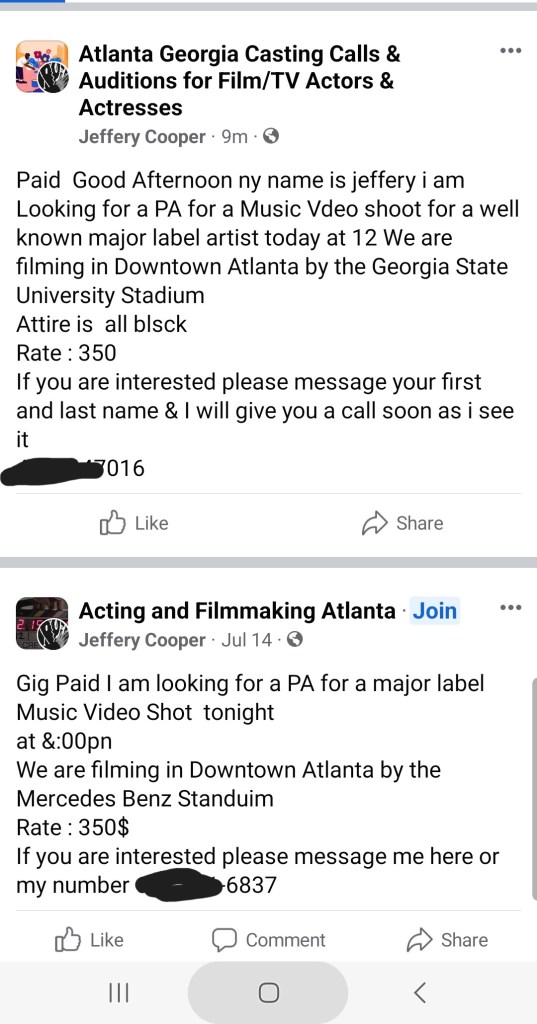
The spelling/grammar have gotten even worse. Note that the phone number changed too.

Do your due diligence. Ask questions. Know exactly what you’re getting into.

As I was writing this post, this one popped up:

These “jobs” were posted on different days, on different Facebook groups, and always last minute. This latest one was posted at 10pm, for a rush call “at 12”. So…midnight?

A Data Entry Scam Targets Women in Film

Many people who work in film are turning to survival jobs to get by right now. That includes looking into work from home opportunities. Don’t worry, the scammers have you covered there as well.

I blocked this one’s name because it’s possible this name and profile pic were stolen.

A community member I’ll call Haley alerted me to a somewhat legit looking data entry job targeting women film groups. When she asked for more information, the “employer” asked for her bank information to give her funds in order to purchase equipment.

This is a play on a standard scam that targets film people, so it’s interesting that they re-skinned it as a data entry job. The scam asks a production assistant (usually) to purchase film equipment and then get reimbursed later. It’s not real. If they send you a check, it bounces, and you’re out ALL the money.

Do not use your own money to purchase film equipment or supplies for a job, even if it seems like a legit job. In a real production, they’ll give you petty cash or a P-card in order to purchase supplies, and a PA should never be purchasing equipment at all. A PA could purchase crafty, office supplies, etc, with the production’s funds, but never equipment and never with their own money.

The Huge Paragraphs of Doom

Yet another community member contacted me about a scam she came across from someone we’ll call O. I blocked out the name because I can’t be sure if this name was also stolen.

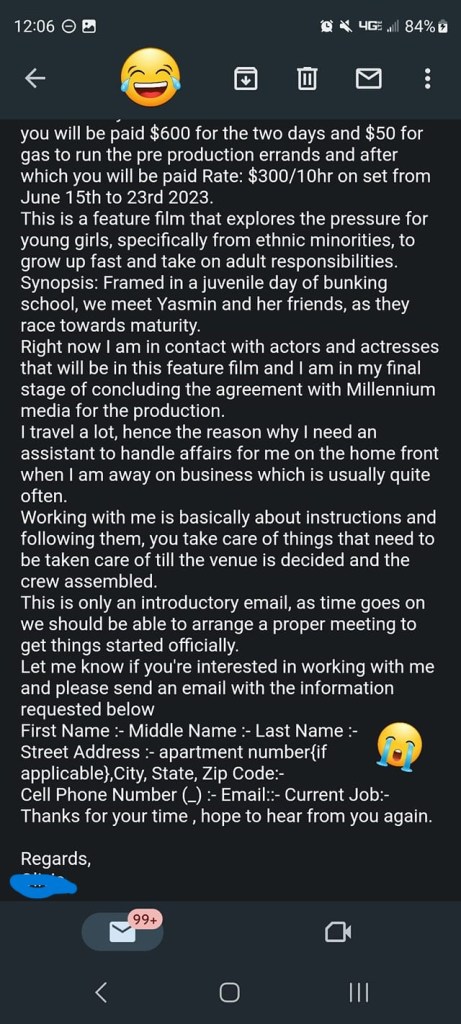
This is an example I’ve covered before — the word vomit job offer. Honestly, just the giant block of text in enough to provide you pause before you give any info.

The TLDR version of our analysis is this:

  • over explanation of what a PA does
  • Duties that a PA doesn’t do, like check processing and booking travel.
  • “I travel a lot…so I need an assistant there.” That’s a common scam tactic.
  • Requesting a ton of personal info right away. This exact same block of text appears in a number of scams I’ve covered before.
  • overall weird formatting

Most of my job e-mails are this:

“Hi, This is Insert-Name-Here from This Show. Got your name from So-and-So. Are you available to camera operate on a 6 week reality show starting May 7th?”

That’s it. Maybe even less. Producers know you know what a production assistant is. They aren’t interested in giving you a show synopsis. They’ll get your info when you’re officially hired and you sign a Deal Memo.

After this person posted her experience with the suspicious job poster, the job poster O, started sending threatening texts and promised to “destroy you …mess up your F-ing life.” I mean, seems legit, right?

RED FLAGS TO LOOK OUT FOR:

  • Name of famous producer or production company (for instance, just got one from “LucasFilmsLTD” recently.
  • Very short notice request for work.
  • Strangely high rate or strangely worded rate (“weekly pay” “1800 flat” “you get $600 for 2 days”)
  • Job poster doesn’t answer simple questions.
  • They want you to use your money to purchase something for the production.
  • They immediately ask for your banking info.
  • The Facebook account of the poster is new, and/or seems like it’s never used (no friends, no pics, etc).
  • The job poster meets any of these red flags and also just joined the Facebook group you saw the post in.

Where on Facebook did I see these posts?

The Facebook groups I saw these scams in were:

  • Film Production in GA
  • Georgia Film Production
  • Georgia Film Community
  • Atlanta Film Production Group
  • Atlanta Film & TV Casting & Jobs Board (CS)
  • Women in Film & Television Atlanta (WIFTA)
  • Acting and Filmmaking Atlanta

Some groups are less moderated and more prone to scam posts than others (lookin’ at you Film Production in GA). It doesn’t mean you can’t join any and all film related Facebook groups, but it does mean more of the work of identifying scams and bad jobs will fall on your shoulders.

What Can You Do To Avoid Scams?

Ah, that’s easy. Delete Facebook, unplug your internet, and throw your phone into the sea. Not an option?

Then you’re going to have to do more research than you want, but trust me, it’s worth it.

If something seems off about a job, start looking into it. Is the pay rate for the job too high? Are they asking for the wrong job duties for the job title, such as a PA operating a camera? Is the spelling and grammar all wonky?

Google can tell you a lot. Google the name of the employer, the production company they are associated with, or the email. If someone else has run into a scam, they might have shared that info online. Ask your fellow film professionals, “Hey, does this job look scammy to you?”

Look at the Facebook profile of the person posting the job. Is it a new Facebook account? That alone is a warning sign. Doubly so if they just joined the group they posted in. Even more so if they turn off comments on their posts in order to avoid people warning each other.

Be cautious if anyone is trying to pressure you into taking a job without getting all the details straight.

Sources

Layoffs begin in the film industry, as Hollywood strikes continue

Philadelphia film office warns filmmakers against scammers

Feast or Famine: Looking at the Stats

It’s the end of February, and all I’ve heard from various film friends is “I’m not working right now, are you?” A winter slump is normal, especially December into January. I just go into these months expecting the slowdown, and for things to pick up in March.

But another kind of work anxiety hits. How much do I need to reach out to jobs before I work regularly? It’s not an easy answer, but looking at my own data, I can see some patterns.

Since 2018 I’ve been keeping track of how many jobs I’ve applied to or been recommended for, and how many jobs I actually got. I meant well, but as times got busy, I eventually lost track or didn’t keep the best data. But I decided, you know what? There’s still something here to see. At least from 2018-2021.

I’m looking at two main things. Gigs applied to, referred to, or inquired about vs Gigs actually worked.

A Handy Dandy Chart

YearGigs AppliedGigs WorkedHow many applications until a job
20181231210
2019164266.3
2020105205.25
202160351.7

Within 4 years, you can see that I went from sending out 10 applications to get to one job, to sending out about 2. Now, I went to art school so I can’t Math all that well, but that looks like a good trend to me.

If I just don’t think too hard about it, the math checks out

I didn’t bother showing info from 2022 because I had several long running gigs and decided not to be Type A about showing what jobs I applied to anymore.

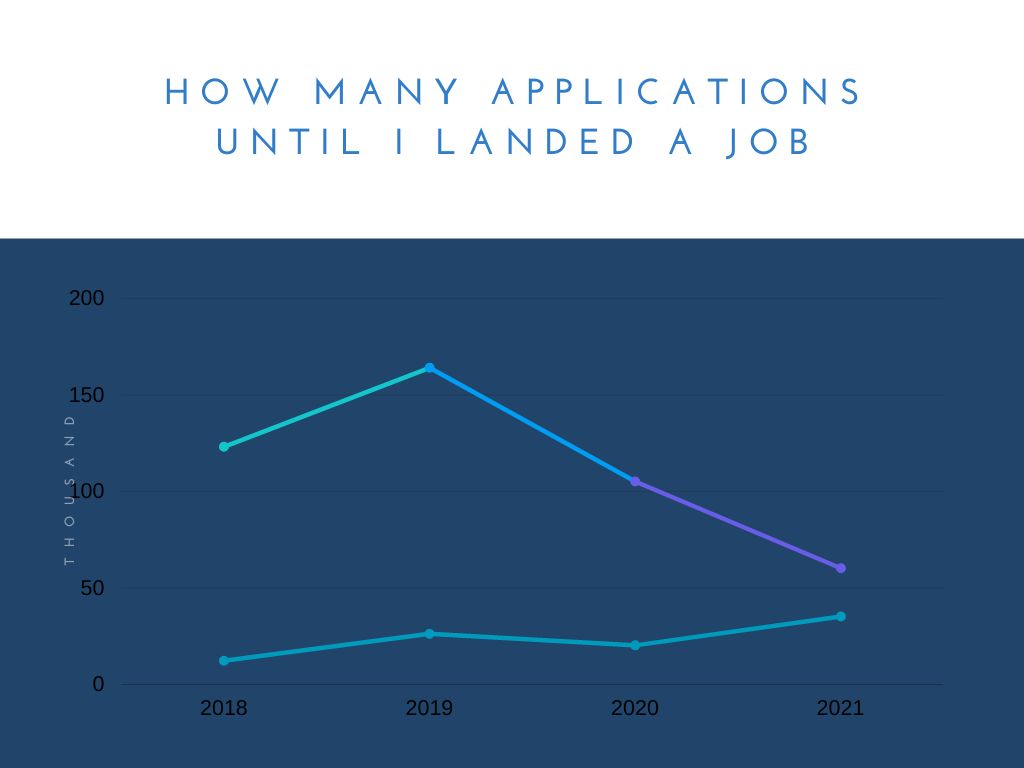
Represented as a hastily thrown together graph on Canva, that looks like:

Top line = Number of applications

Bottom line = Number of jobs landed

Closing the gap is a good thing.

There’s a few things I want you to know about this data.

  1. It takes a lot of effort to establish yourself in a new market. When I arrived in Georgia, I had to do a lot of legwork to start getting jobs.
  2. As time went on, a lot of my applications were actually just recommendations — people recommending me for gigs. When you become known, the work starts coming to you.
  3. I didn’t bother keeping track in 2022 because I was almost 100% working based off recommendations and had several longer runs on shows, whereas previous years I had more day-play opportunities.

If I look at my Google calendar from those years, I see wide swathes of nothing going on for days or weeks during the same slow months. Film is a marathon, not a sprint, and you’ve got to plan accordingly for the slow times. And those slow times can make you feel like you’re beating your head against the wall.

And it’s not just as simple as applying to jobs you see posted on job boards or Facebook groups or throwing your name in the ring for open crew calls.

A lot of the work I did alongside all this was networking, meeting people for coffee, doing casual fun things with fellow filmmakers, helping out on friend’s sets, speaking to students and film clubs, and even writing this blog. Self-promotion is a big deal in addition to applying for jobs. Networking is the glue that holds it all together.

I also applied to a lot of jobs in the slow months of January and February each year. There’s a lot more competition then, because less people are actively working.

This is my way of saying, if it’s slow right now, it’s not just you. It’s a lot of us, and there’s a lot of folks scrambling for the next job.

Keep in mind we’re also on the brink of a possible union strike down the line, and theories have been floating around about productions holding back from starting. I don’t know for sure. All I can say is to hold tight and know that you’re not the only one not actively working right now, and if you’re new — it’s going to take a lot to get yourself established.

This is not an easy industry to get into, but those who have the fortitude to stick through the hard times end up successful.

Sources:

Hollywood Braces for a Possible Writers Strike: Why the WGA and Studios Are on a Collision Course

A Film is Born Three Times: Pt. 2 Production

“A film is born three times. First in the writing of the script, once again in the shooting, and finally in the editing.”

Robert Bresson, French film maker.

Part 2 of 3. Read Part 1 on Re-writing here.

You’ve written the script. You’ve done the pre-production. You have your shotlist in hand and you’re ready to shoot. Surely, you have an image of what your film is going to look like in your head. The thing is — it’s really hard to make that a reality.

Once you’ve made your first or even fourteenth film, isn’t part of you a little disappointed it doesn’t look exactly how you pictured it? No? Just me, okay.

There’s a number of factors that go into why your film will change during production. Let’s go over a few reasons:

  • casting
  • location
  • equipment

Casting

You and a friend are prepping for a film competition and it’s the night before your first shoot day. You’ve got your gear and props, your script finalized, your cast set and call sheets sent out. Now all you need is–

Oh wait, your lead actor just quit. Now it’s 11pm at night and you’re supposed to be filming a mere 10 hours from now.

This is exactly what happened to Desiree and I when we were prepping our Mystery Box Film Challenge short. Our lead actor was cast via the film commission in Philly, and he decided at 11pm the night before the shoot that he wasn’t going to drive to Northeast Pennsylvania to do the short. Because he’d have to get up early. I can’t even make this up. The actor had the script and knew where he’d be filming for days in advance, and chose literally the 11th hour to change his mind.

Desiree and I very calmly… went into panic mode. After a moment of us going “literally, WTF” we contacted everyone we knew in the local film community, and the search was on. Friends contacted friends until we connected with a guy named Joe, who was more than happy to help us. He turned out to be a great actor, a better choice than we originally had, and our short film continued as scheduled.

Especially in the case of short films and volunteer projects, you could lose people at the last minute. The goal is to have a network you can turn to in order to fill in the gaps. Or start getting creative with the cast you already have.

Location

When I originally wrote The Road Less Traveled, I had envisioned a cat and mouse chase inside a literal slaughterhouse. Instead, we ended up in an antique barn, which I ended up liking so much more.

Sometimes your limitations on location will be budget related. You intended on x but had money for y (or z was free).

Weather, too, can play a part. If originally your location was going to be outdoors and a storm blows through, you might have to re-evaluate and see if you can film an indoor scene instead.

My thesis film, Routine Procedures took place in a crater….but since that’s impossible to create on no budget, we filmed in a sand pit used by construction. We filmed on days they weren’t out scooping the sand. A unique feature was that a lot of it was flooded, so we needed to purchase a canoe to get to the optimal location.

Equipment

You’ve got everything planned. Absolutely nothing could go wrong.

You get the idea now, right?

You don’t have enough batteries to continuously shoot. Your media fails. Your stabilizer isn’t stabilizing. Your mattebox donut has ripped and too much light is now hitting the filter.

This is one example where we had to replace a piece of equipment with something unexpected. The rubber “donut” that goes from the mattebox to the lens had torn, and too much light was hitting the filters. We replaced it with an old school mousepad with a hole cut in it. It worked great! Plus I ended up seeing this kittycat mouse pad on the next project I worked with this DP so obviously it made an impression.

Film sets are Murphy’s Law Incarnate. You need to be able to roll with the punches.

The following scenarios have happened to me or someone I know:

  • the DP underestimated how much media we’d need to record on and nobody media managed even after I pointed out we were going to run out of cards. The last scene of the day was filmed shooting one line of dialogue at a time on the last two minutes of card space.
  • Your wireless follow focus has lost signal and has some issue that can’t be solved, so you pull it off the barrel of the lens and pull focus by hand (like the pioneers did!)
  • The director suddenly wants a Steadicam-like shot without there being a budget or an actual Steadicam around. You see a rolling desk chair and get some ideas…

Don’t let an equipment malfunction limit your ability to shoot your film. There’s often a way around it if you take a moment to look at your options.

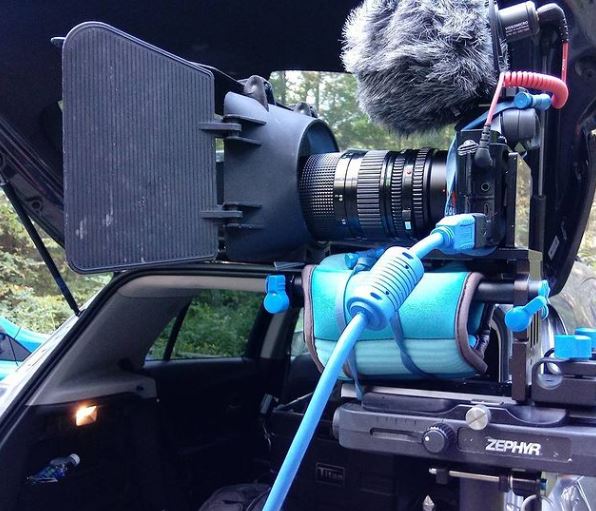
A Steadicam setup I did years ago for someone’s crowdfund campaign. The camera was way too light for the Steadicam, so I bongo tied a few 5lb ankle weights on there to compensate.

One of the absolute best skills you can have as a film maker is problem solving. If you can be adaptable, creative and a team player, you can find a way around your problem and into a solution.

Screenwriting Basics #5: Scene Description

I want to spend time showing examples, so very quickly here’s what goes into scene description (also called action lines):

Elements of Scene Description:

  • tells you what the characters are doing in the scene
  • describes the setting
  • details what can be seen or heard in the scene
  • sets tone and pacing or rhythm that informs the edit
  • uses ALL CAPS to highlight important things (use sparingly)
  • avoids camera direction (don’t use “the camera dollies in…”)

We’re going to look at pages from three very different scripts: Spider-Man: Into the Spider-Verse (2018) by Phil Lord and Rodney Rothman, Zodiac (2007) by James Vanderbilt, and Butch Cassidy and the Sundance Kid (1969) by William Goldman

Spider-man: Into the Spider-verse (2018)

This animated film balances humor, pathos and a coming-of-age story in a superhero origin film. It is excellent, and for that matter, so is the script.

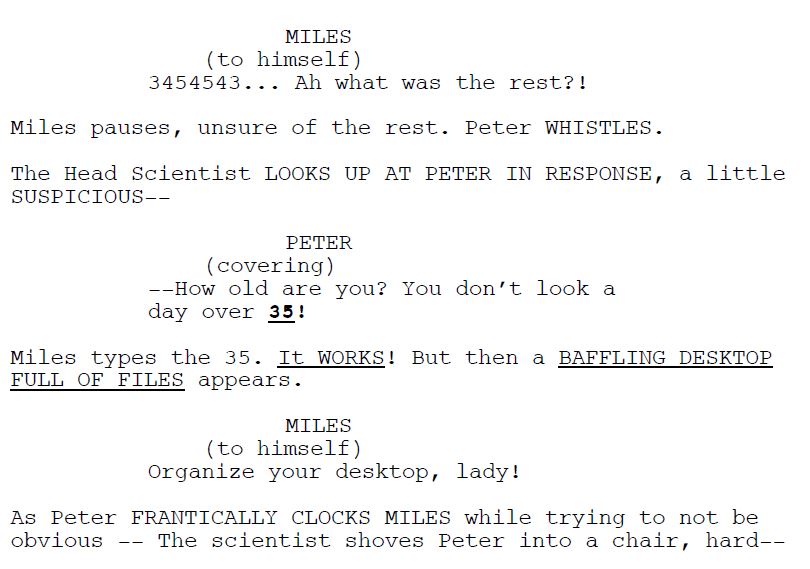
Into the Spider-verse has a narrative told through a comic book filter, and for that reason the script has to show this comic flair as clearly as possible. That includes scripting out the comic thought bubbles and things that appear across the screen. Note that the pivotal moment “EVERYONE KNOWS” is played up for comic relief — the script has it appear in giant letters behind Miles, the last period landing with a resounding note.

Later in the script, when Miles is trying to help Peter B Parker hack into a computer they have to work around the Head Scientist Olivia Octavius. This fun exchange happens:

That “organize your desktop, lady!” line got big laughs in the theater, and that’s partly because of how starkly we’re shown the “BAFFLING DESKTOP FULL OF FILES” right before that. So relatable. If that moment hadn’t been scripted out, it wouldn’t have played to such laughs.

Zodiac (2007)

Lots of good feelings from the first example. Let’s go down a darker path.

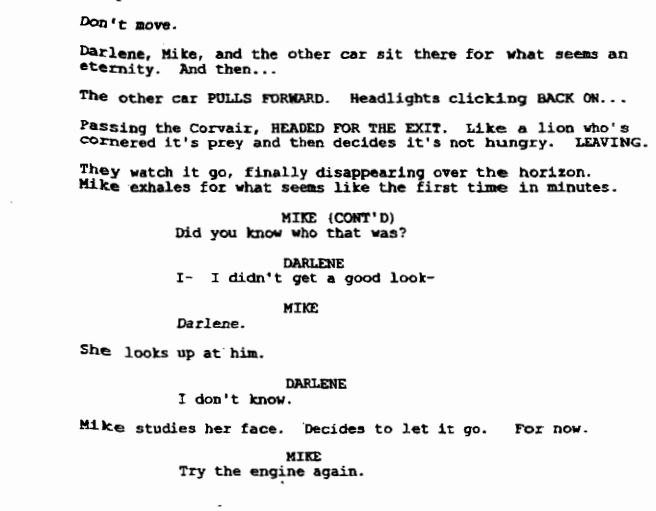
Writing horror, thriller, suspense… they come with other challenges. How can you communicate that a scene is scary? Get out this page from Zodiac, the movie based on the real story of the Zodiac Killer.

Look at how the car following Darlene and Mike, soon-to-be-victims, is characterized. Like a hungry lion. It’s not literal, and yet it works to get the point across.

What was interesting when I looked up this example was the fact that the script I lfound and the resulting film were very different scenes. In the script, this car has been following Darlene and Mike for miles, resulting in a car chase and eventual car trouble. In the movie, things are quite innocent until the killer’s car pulls up behind them.

An early draft could look totally different from what you eventually see on screen. Why this car chase scene was skipped over was possibly two-fold — the car chase scene took too long and detracted from the rest of the movie, and possibly because it wasn’t true to what really happened. This is a real killer this movie is based on, so some attempt at reality should be made.

Butch Cassidy and the Sundance Kid (1969)

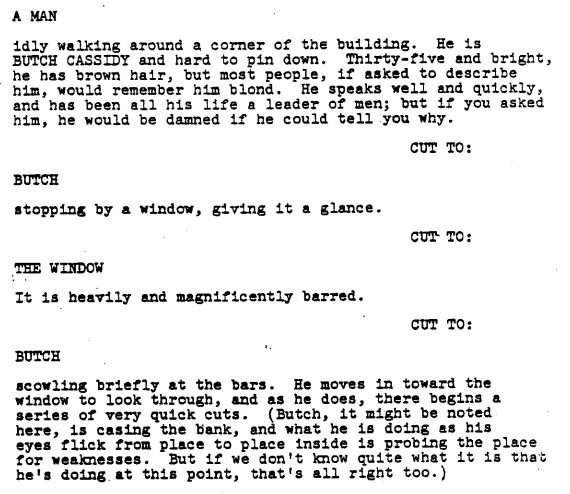
In the opening of this Western, we’re introduced to our main character Butch Cassidy. The scene descriptions give us a good idea of what type of man he is and how he should be portrayed.

William Goldman is a very well known screenwriter, and he could get away with some tricks that you probably shouldn’t do in your first scripts. For one, he’s scripting out a lot of stuff that cannot be seen, like how Butch speaks and that he’s been a leader of men all his life. For the most part, if you can’t see or hear it, you should think twice about writing it in your action lines.

The format is also a little off from the norm, or at least what we see today. A MAN is separated from the rest of the description. This could be very intentional rhythm illustrated for the scene, having the director and actor take their time letting this introduction play out before the camera. Nowadays, write the subject in the same paragraph. William Goldman can do all this. We can’t. Yet.

I also want to note Goldman’s use of “CUT TO:” between each segment here. This is a stylistic choice — it’s not necessary. Sometimes this can give a sense of pacing. Personally I find script pages to be prime real estate — I might need to hit very specific page counts and I find the CUT TO unnecessary because…well, what else are you going to do? If you’re jumping to another scene, you’re gonna cut.

Sources:

The Magic Bullet: Action Lines – ScriptMag.com

5 Ways to Write More Effective Scene Description – The Script Lab

Screenwriting Basics #4: Dialogue

One way to get me interested in your script: Have really compelling, interesting, and/or funny dialogue.

Writing dialogue is hard. Heck, writing at all is hard. It takes years of study — reading everything you can get your hands on, practicing at your craft, sucking at the first few scripts you try, doing better with each draft and receiving constructive criticism that leads you down the right path.

First, let’s understand what counts as bad dialogue.


*snore*

Is anyone else bored yet? I know I am. Dialogue like this, although similar to how we talk in real life, does nothing to advance a plot and frankly bores the reader into a stupor. Authentic dialogue does not mean word-for-word small talk. Authentic dialogue is more simulated reality.

Another example:

If some kid scares off some robbers with his, um, karate skills? Wouldn’t you want to see that happen?

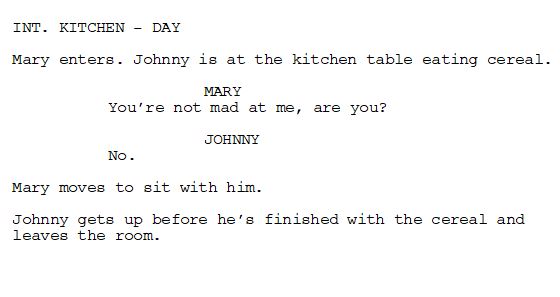
Here’s where we remember the cardinal writing rule of Show, Don’t Tell. It’s much more interesting to see action scripted out, happening before us, than to have some character explaining it. Johnny’s dialogue here becomes an info dump — blurting out a series of events in an unnecessarily long rant. It is so dull to hear a character explain things that should have just unfolded on screen.

Another fun, yet difficult one to learn. On-the-nose dialogue.

On-the-nose dialogue is when characters say what they actually feel in the moment or describe things that are obvious. It’s the opposite of subtlety. This is where subtext comes in, and that’s a tricky subject.

Subtext is the implicit meaning of a text—the underlying message that is not explicitly stated or shown. Subtext gives the reader information about characters, plot, and the story’s context as a whole.

https://www.masterclass.com/articles/what-is-subtext-learn-the-definition-and-role-of-subtext-in-writing-plus-5-tips-to-better-incorporate-subtext-in-your-work

A character’s feelings, or even the situation at hand, can be described using visuals, settings, character body language and more to be conveyed. Sometimes, a character will say the opposite of what they mean, but we as the audience can see the truth behind it. Humans lie a lot. Your characters could too.

Yeah. Johnny isn’t happy.

Your characters can say a lot without really saying much. Trust the actors to do the acting. Body language coupled with dialogue can change an entire meaning of a line.

Great dialogue is, of course, subjective. Beauty is in the ear of the beholder. But there are a number of films out there that many folks agree has good dialogue. Check out this scene from The Shawshank Redemption. Spoilers if you haven’t seen this famous film from 1994.

“It always makes me laugh. Andy Dufresne… who crawled through a river of sh*t and came out clean.”

– Red

This scene comes at the end of the movie. Andy Dufresne has already escaped, and Morgan Freeman’s character Red laments his loss. It’s expositional. It’s telling, not showing. It shouldn’t work but it does. It wraps things up beautifully, told in the unique voice of Red.

“I’m Mad As Hell and I’m Not Gonna Take This Anymore!”

– Howard Beale

This scene from Network is a great one to study. A news anchor losing his cool on national television! But the story behind the scene is not that he’s mad about current events… it’s truly about his anger over the fact that he’s losing his job. Subtext!

“That ain’t no Etch a Sketch. This is one doodle that can’t be undid.”

– Convenience Store Clerk

I really like Juno. The characters all have very strong, individual voices. Even the bit parts, like the clerk at the convenience store, are interesting characters for an actor to play.

You want to be the type of writer who could attract someone to any part in your film, and screenwriter Diablo Cody became quite the Hollywood darling after this film premiered.

Sources:

How to Avoid Writing On The Nose Dialogue – Screencraft.org

15 Movies Screenwriters Should Watch to Study Dialogue – Screencraft.org

What is Subtext – Masterclass.com

Screenwriting Basics #3: Character

Unless you’re writing the type of artistic film where you only show time lapses of moss growing or something, you’re likely going to need characters to populate your script. They may be a hodgepodge group of high schoolers or even anthropomorphic cars.

The most important of which is your main character. And they should do more than just go through the motions.

Your main character needs to be interesting. Infuse them with details, quirks, dialogue that makes the reader, and eventually audience, enjoy going on this ride with them.

How do you do this? Start thinking details. Are they funny? Smart in a really unique way? Do they see the world in a way others do not? Do they have a personal struggle and you can’t help but root for them?

Do they have a general disdain for humanity but also the propensity for curing everyone’s ills?

Lookin’ at you, Doctor House.

You want to avoid stereotypes in your main character. Instead of having a genius doctor, you have a genius doctor who lacks a bedside manner, has a physical disability which leads him to a dependency on narcotics.

So let’s talk round vs flat characters.

“A round character is deep and layered character in a story. Round characters are interesting to audiences because they feel like real people; audiences often feel invested in these characters’ goals, successes, failures, strengths, and weaknesses.”


https://www.masterclass.com/articles/round-vs-flat-characters-in-fiction

Round characters are more interesting and make your reader and audience more invested in the story.

“A flat character is a two-dimensional character lacking depth or a real personality. Usually, flat characters have just one or two perfunctory traits. Often considered “stock characters,” flat characters can often be summarized in one word (like “bully” or “love interest”) and never digress from or transcend their role.”

https://www.masterclass.com/articles/round-vs-flat-characters-in-fiction

A flat character lacks the great detail that makes a compelling character. They fall into stereotypes — the distracted professor, the overworked single mom, the ditsy cheerleader… we’ve seen these time and again. It’s fine if they populate the rest of your world a bit, but for the characters we follow? We want more.

How to write a round character:

  • Character Traits. What are their character traits, both good and bad? What is the flaw your main character possesses that might cause them grief later in the story?
  • Details. What are their likes/dislikes? What is their appearance? What sports do they play? Where do they work? You might not use all of these, but it will help you make more informed decisions on how your character will act.
  • Believability. Your main character has believable reactions to events based on their character traits. A generally mellow person won’t just blow up at a minor inconvenience. It wouldn’t fit their character. Don’t lose your reader, and later your audience, by making your character behave strangely.
  • Conflict. Give them an internal and external conflict. The main conflict may be the fate of the world ending, but the internal conflict may be a father regaining the love of his estranged daughter.
  • Dialogue. Your character has a voice, and it should be a distinct voice. If you cover up the names of all the characters in your script and read the dialogue, you should be able to tell who is speaking. Don’t let everyone sound the same.

Building a really interesting main character is one part of writing that great first script.

Sources:

https://blog.reedsy.com/round-character/

https://www.indiewire.com/2013/11/screenwriting-101-5-tips-for-writing-better-characters-into-your-screenplay-33156/

https://www.masterclass.com/articles/round-vs-flat-characters-in-fiction

Screenwriting Basics #1: Budget Friendly Screenwriting Software

This is the first in a multi-part series breaking down the screenwriting process so you can get started writing your next great idea.

First, let’s talk where you write the script. I don’t care if you start in a paper notebook or scribble outlines on napkins, at some point you’re going to have to type this into proper screenwriting format on a computer.

Professional screenwriting programs like Movie Magic Screenwriter or Final Draft are a major investment. Screenwriter 6 is currently at the sale price of $169. It’s usually $249. Final Draft 12 is on sale for $185 (again, usually $249).

That’s a hefty price tag for someone who is just starting out. Luckily, there’s some really good free and cheap options out there too:

  • YouMeScript – a Google Drive extension. Features the ability to have multiple writers working at the same time from different computers. Great for collaboration but make sure you save often. It does not automatically save for you.
  • Fade In – Fade in provides a free trial to get you started. It is only $80 for the full version.
  • Writer Duet – a Cloud based software that has a lot of nifty features. The free trial lets you write your first 3 scripts on the program for free.
  • Celtx – This used to be free but it seems it’s gone through some updates and is now $15/mo for the most basic package.

The free options are fine for when you are learning to write or if you are simply writing for your own short films, but if you decide to go big time and start submitting to agents or contests or major production houses — get Final Draft or Screenwriter. There can be little formatting issues with the free programs that the pricey programs would sort out.

Study the Craft

You can’t expect to grow as a writer unless you work at it, study it and see what’s been done before.

You can see my list of recommended screenwriting books here: Reading List: Screenwriting.

How do you expect to write a script if you don’t read them first? The following link gives resources to the best screenplays to read in each genre.

You can also check out a lot more scripts on Simply Scripts and Drew’s Script-o-Rama. Just keep in mind some are transcripts written by a fan watching a show, which makes them not worth studying. You may also have to click through a few, especially on Drew’s site — some links are broken.

“So what’s all this I hear about formatting?” We’ll talk about that in the next Screenwriting Basics post.