Around 2016, I approached Lindsay Barrasse and David Corigliano of Voyager Video with a script I wanted to shoot.
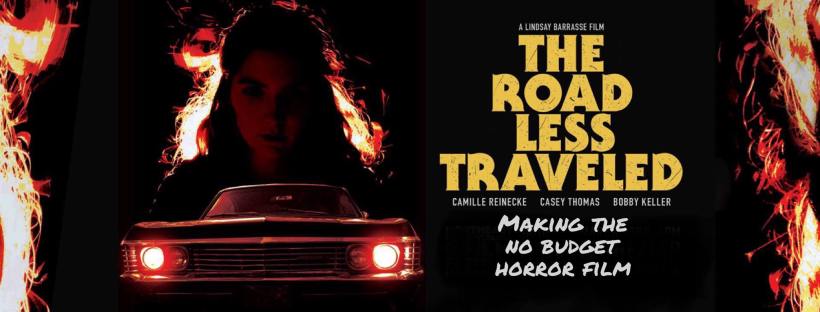
The project was the short horror film The Road Less Traveled, and after a couple years of pre-production, re-writes, rescheduling, etc — we brought it to reality. Not just that, it’s also been accepted to over 20 film festivals and won 3 awards: Best Suspense at Con Carolinas Film Festival, Best in Show at the Sands Film Festival and Best Director at the Highlands Film Festival.

Genius poster design by Des Z Graphics. You can see more of her work here.
Here I will go over the basics of putting together the no-budget short film so you can apply similar principles to your own film making exploits.
I’m keeping some details vague because I want you to see this film at a screening without being spoiled.
Script
Even a short film needs a good script. The Road Less Traveled (originally Hunted and something a little more spoilery) went through about 15 total drafts.
 Around 15 drafts in 3 different screenwriting programs
I wrote the very first, very rough draft in 2014 while I was still at SCAD. In it, a girl named Mia is abandoned at a bar by her friends, and is captured by two bad men in a badass car for nefarious purposes.
I had my dear friend Masha T. Jones, a fantastic writer, critique the first early drafts. She gave me great pointers. Eventually the story shaped into what it needed to be for me to present it to Lindsay to direct.
With Lindsay’s creative mind attached, we added a scene with a gas station attendant to set up our story’s main antagonist, Clyde.
Thanks to the helpful critiques of my fellow creatives, the script morphed from a thing with too many locations and characters to a road movie with a new destination. And that destination came about because of location issues.
Locations
When RLT was submitted to Screencraft’s Short Film Production Fund Contest, we were in the running for a 10K budget, but only managed the semi-finals. We could no longer afford to rent the slaughterhouse location we originally envisioned. After several location scouting days driving around rural Northeast Pennsylvania, Lindsay quite by accident found a client who said he had an old creepy barn he’d be willing to let us shoot in. Ronald Augelli of We Talk Shirty invited us to his property to check out the place, and after I took some location pics, we knew we found the right place where Clyde might take his victim.
The Crew
The core crew consisted of myself, Lindsay Barrasse, David Corigliano and Desiree Zielinski. We all wore multiple hats.
We all worked on separate aspects during pre-production. Lindsay and Dave were the producing team, bringing all the elements together. Desiree was off doing amazing production design, I built the monster.
The reason this all worked was because we’ve all worked with each other before, multiple times. But we also broke up the filming into reasonable chunks and worked around people’s schedules.
The best piece of advice to keep a crew happy? Make sure they’re fed. Lindsay and I split up craft services duties — we always tried to have coffee and snacks and beverages on set at all times. At the end of two major shoot days I bought everyone dinner at a local diner. A fed crew is a happy crew.
Practical Effects
We did not have the budget to hire someone to do VFX. That left one avenue for production — all practical effects.
Our fog machine broke the day we needed it, so we ended up asking Dave — such a sport — to vape-pen throughout a scene outdoors at night so we could get that lovely texture in the air. (Don’t do this, just get another fog machine!)
Our monster at the end of the story? I’ve been asked at several screenings how I did the VFX on that. There wasn’t any. That monster was created through several awkward trips to Jo-Ann’s Fabric and Michaels in Dickson City. I actually put some detail into it — moving mouth and eyes, realistic teeth and claws — but it looked a little goofy so I told Lindsay, “Let’s make sure we only see this thing in silhouette.” Sometimes the Jaws approach is best when you don’t have a professional making your monster.
Equipment
I was luckier than most, because Voyager Video is a full on production company. Lindsay and Dave came complete with lighting and sound gear. We used my Sony A7S and one of their cameras along with basic light panels.

Scheduling and Problem Solving
Our biggest hurdle was probably scheduling. This short film, though only about 11 minutes long, took us about 2 years to produce. That was because 1. we were shooting at the tail end of fall when the leaves are giving up the ghost. and 2. we had to work around everyone’s schedules.
The caveat of filming and asking everyone to work for free is you need to be very reasonable with their time. Everyone had work, different projects, plays and events to be a part of that couldn’t be put on hold for this film. So we filmed it in pieces when we could get people together. We literally had to stop filming at one point because it snowed soon after.
Some of the drone flying shots were done by Jonathan Edwards in January. Let me tell you, driving a ’67 Impala with NO HEAT in the buttcrack of winter is not fun. I was wearing a heavy winter jacket, a blanket, and several conveniently placed Hot Hands to keep me from freezing while I drove the car.
Separating that filming time caused other unique issues. One, Casey Thomas, our Clyde, misplaced his trademark green jacket before we were done with it, so we replaced it with another, similar looking one. Camille’s (Mia) red dress got a rip from running around a previous shoot day, so we avoided seeing that part of her dress the next time. Camille had also gotten an extremely different haircut, so the hair you see in the final moments of the film is actually some faux extensions she added back in. Movie magic!
 The Impala visited the Northeast Pennsylvania Film Festival earlier this year.
Working with an antique car means you might have some surprises, as I did when I tried driving it to set one day and it petered out on a hill. I became a bit of an amateur mechanic that day, sleuthing what the problem might be. Water in the gas? Bad connection somewhere? When my Dad returned from vacation we found it was power related and replaced the alternator, spark plugs and spark plug wires. After a little tuning, it ran fine.
Plan for any and every eventuality on your own film — and you’ll still be surprised by something. It happens on every set, but being able to work around small issues will be pivotal in making your own short film happen.
Film Festivals
We submitted to very specific film festivals. We picked genre specific film festivals and festivals connected to conventions. Since our subject was horror, and we had a geeky Supernatural homage in there, that was our best bet.
Upcoming Screenings for The Road Less Traveled
 October 13th – Dickson City, PA
- October 13, 2019 — NEPA Horror Film Festival
It’s at a drive-in movie theater! The Road Less Traveled will be screening during the local films block. You can also see Enoch, a film I did the Steadicam work on. Tickets for the film fest are $10 online, and $14 at the gate.
See our event page here.
 October 12th – Cary NC
- October 12, 2019 — Sick Chick Flicks Film Festival in Cary, NC.
Let us know if you can make it! Passes start from $20. See details on the website.
See our event page here.
-
October 13 – The Hobnobben Film Festival in Fort Wayne, IN.
See the film festival site for tickets and schedule here.
-
November 2, 2019 — Pennsylvania Indie Shorts Film Festival at Pocono Cinema and Cultural Center in East Stroudsburg, Pennsylvania.
An internationally curated short film festival, right in East Stroudsburg. Say hi to my alma mater ESU for me!
-
November 19-22 – The Great Northern Creative Expo at The Media Factory Kirkham Street Preston, Lancashire PR1 2XY (The UK).
See our event page here.
You can follow our ongoing journey at our Facebook page.
Find us on Instagram: theroadlesstraveledfilm



 Bridget LaMonica