
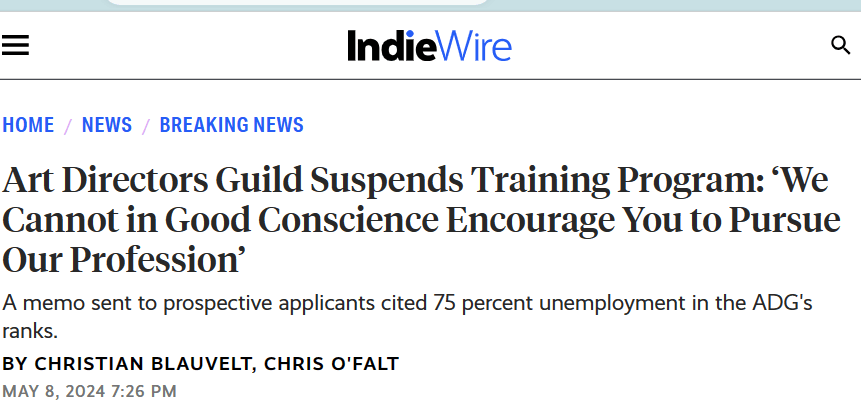
Recently, this article made the rounds:
Read more on IndieWire.
The Art Directors Guild, IATSE 800, is a union representing over 3,000 Art Directors, Illustrators, Scenic Artists, Graphic Artists and Set Designers in the film industry. In the article, we learn that the Art Directors Guild sent an email out announcing they will suspend their training program due to the 75% unemployment rate among its union member’s ranks. This decision is entirely reflective of the ripple effect of the SAG-AFTRA and WGA strikes last year.
“The industry has not resumed a full, pre-strikes level of productions, and it remains unclear if a return to that status quo is possible in a Hollywood gripped by ever-higher costs, ever-lower revenue, and increased production abroad.”
-IndieWire
This also brings to mind how many people I see announcing they are moving to Atlanta and looking for connections in the local film industry. That’s fine but, I hope everyone and anyone who is thinking about going into film for the first time or moving to continue their film career does a bit of research first. We clearly haven’t recovered from the two strikes last year (necessary though they were, they also hurt financially). I also question if we ever fully recovered from 2020, when the pandemic shuttered production across the world.
But with a pandemic that encouraged people to stay inside, there ended up being a lot of TV being consumed. The streaming companies — Netflix, Hulu, Disney+, Paramount, etc — got excited.
In 2021, Netflix boosted their budget almost 30%, putting $13.6 billion into content spending. This article from 2021 predicted their budget would balloon to $18 billion by 2025. An sharp upward trend seemed likely.
In 2023, Netflix content spending was around $17 billion. And before you point out “but 17 is so close to 18!” I need you to realize how vast a number 1 billion represents. If we were to use time as an example: 1 million seconds = 11 days . 1 billion seconds = 31 years.
Streamers are focusing on more original content in order to keep customers interested. There’s also a noted shift into reality style television, as shows like Netflix’s Nailed It cooking competition series are still popular and much cheaper to produce than narrative content. I’ve also talked before about these companies not greenlighting projects and just outright cancelling them to save a buck.
The streaming companies blew their budget on a dream, and now the bill has come due. They over estimated their profitability while fighting each other for market dominance. Instead of one triumphing over the others, we have a consumer base watered down and split amongst many services, if they even have streaming at all. Who misses cable now?
There is also likely a slow up because of this year’s negotiations between the AMPTP and IATSE, Teamsters and Hollywood Basic Crafts. The current 3 year contract expires July 31st. These unions are negotiating for proposals on Pension and & Health Plans, wage increases, residuals and concerns over artificial intelligence.
A strike doesn’t seem as likely this year. For one, the negotiations appear to be making some headway. Several unions such as Local 892 Costume Designers and Local 728 Lighting technicians have reached tentative deals.
But, the reality is that most folks can’t afford to have another strike. That’s concerning because of what’s on the docket but also…totally understandable. Those of us in this position are trying to recoup from last year. Some folks haven’t worked at all this year. That’s unheard of in most other professions.
The fact that the Art Directors Guild suspended their training program is genuinely sad to hear, but it seems to have been done with the very real concern about not putting more pressure on folks who need work right now. As hard as it is to see, not adding trainees in the guild for a time is a kindness. And surely, when things pick up, they can reassess and reopen their ranks to new people.
Will things ever go back or is this a hint at lasting change? The answer is far more complicated than we can surmise right now.
Sources:
Netflix’s Amortized Content Spending to Rise 26% to $13.6 Billion in 2021, Analysts Project
Georgia film industry sets another economic impact record




 Bridget LaMonica