The Evils of the Rolling Take and Reset

Let’s dig into a pet peeve of many on set: the rolling take.

A rolling take is when you keep shooting and keep repeating the action. Like an actor walking in to a room who flubs a line and goes back to start it over again. That can be a valid reason for a rolling take. No need to re-slate and re-call action. Just try it again.
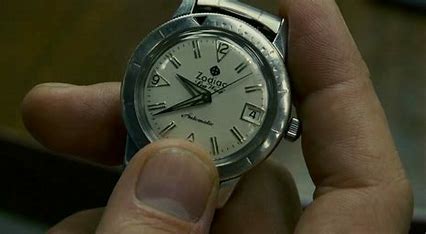
An Insert Shot: A watch being picked up and brought into the frame is a valid reason to do a series of the same action without cutting in between.

A rolling or series take might be done on a particular insert shot to get it right. Let’s say your actor needs to throw a letter to land on a desk just right. The director might ask for a series or rolling take in order to keep attempting that throw to get it the way they want. No fuss, no muss, and no wasting extra setup time to get that insert shot that you’ll see for two seconds on screen.

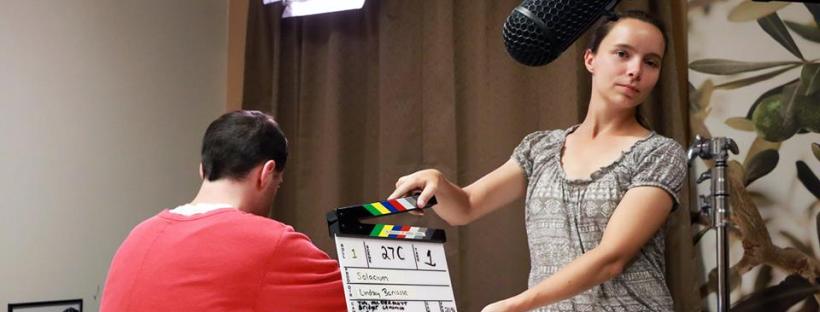
Directors don’t work the slate but I’ll allow this since it’s clipart.

Imagine this scenario: It’s after lunch. The Assistant Director is informing everyone for the third time that you are now an hour and a half behind on the schedule. You have several more scenes to light and shoot and somehow you have to make up a significant amount of time. Hence the anxiety that leads inexperienced directors to try shortcuts. One of those shortcuts is overusing a rolling take.

After experiencing this on a number of films, I’ve observed that green directors love to overuse the rolling take. They’re feeling the pressure and just trying to get footage in the can. The AD, meanwhile, is just trying to make their day. Now suddenly, you’re filming scene coverage as a rolling take, not cutting when you reach the end of the action, but waiting for the actor to reset and just going with it, maybe for multiple “takes.”

A rolling take going on and on is more trouble than it’s worth.

Time = Money

First, what should be obvious — you’re using up footage. This became less of a crisis when most of us went from actual film stock to digital, which is a much cheaper alternative, but digital does not mean free.

Film costs include the film stock, developing, processing, and digitizing so you can edit on a computer.

But just because you can hit “record” on a camera doesn’t mean that doesn’t cost money. Each card needs to be purchased, and you need to have enough available media to get through the day’s shooting without having to write over those cards with additional footage. Ideally, you want your DIT or media manager making backups throughout the day. That means the production also needs to purchase storage and backup storage for that media.

So let’s say you think you know the costs and you’re still cool with doing 40 minute takes instead of a few 5 minute takes. All that footage needs to be downloaded and viewed, meaning you’re paying for the media manager’s time to download that footage and make copies, as well as the editor down the line. A single 40 minute clip is just going to take longer to download and transfer. And you might be paying overtime to the media manager who is staying late dumping all that footage.
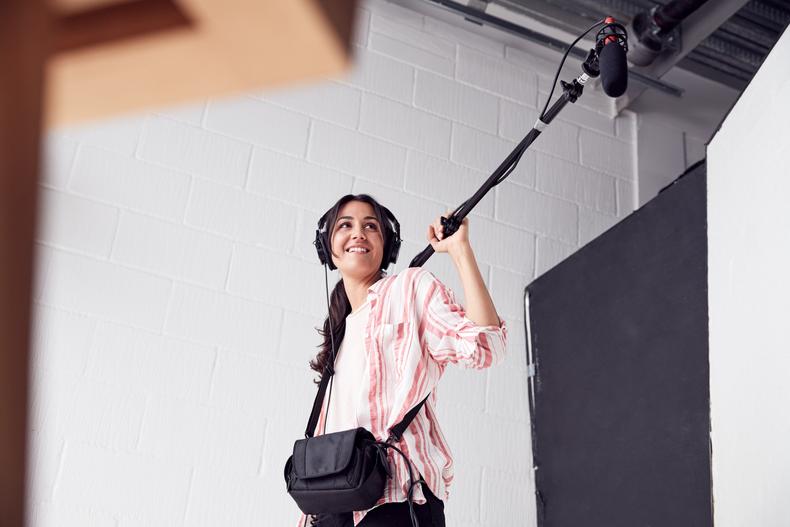
Wear and Tear on Cast/Crew

In the moment, if you abuse the rolling take, you’re quickly using up the energy reserves and physical strength of your cast and crew.

You’re also using up your camera operators and 1st ACs and boom ops and everyone doing something physical for that scene that no longer get that tiny bit of rest to reset themselves.

  • The cast has to stay in-the-moment and may get frustrated, flubbing lines more and more.
  • The boom op has to hold that boom pole and actively follow whoever is talking without getting that small break in between.
  • The camera operators might be doing handheld or Steadicam and are using up their muscles faster.
  • 1st ACs, staring at a screen for minute changes in focus, don’t get to rest their eyes.
  • Script supervisors’ notes get complicated as the same scene plays out multiple times in the same take.
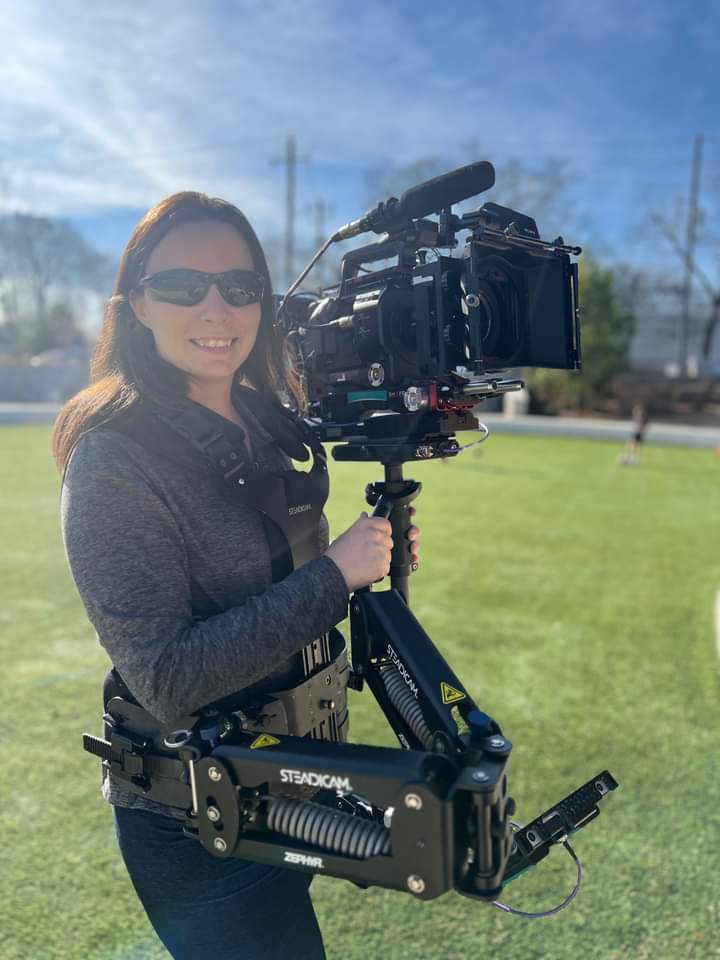
When I’m doing Steadicam or handheld, my least favorite thing is a rolling take, especially if it’s long. I just need time to reset. Sometimes there’s an adjustment needed in a handgrip on a shoulder rig or I need to fix the balance on the Steadicam.

Other concerns? Using up batteries! You might be playing beat the clock with what battery you have left in the camera or on the mic packs.

Closing Thoughts

Using a series or a rolling take can be done with purpose. It’s just another tool in your kit. Abusing it can lead you to creating an uncomfortable work environment for your crew. So before you panic and decide to just “roll on everything” look at it critically and see if a rolling take is necessary or if you need to re-evaluate and be more concise with your time.

Unusual Shot Design to Evoke a Tone: Knock at the Cabin

My film professor Bear Brown would always say “Never stop learning.” We do this by practicing the craft of cinematography, reading about it, learning new technologies, and dissecting movies and TV to understand what was achieved.

Let’s look at the shot design of M Night Shyamalan’s Knock at the Cabin together!

While vacationing at a remote cabin, a young girl and her parents are taken hostage by four armed strangers who demand that the family make an unthinkable choice to avert the apocalypse. With limited access to the outside world, the family must decide what they believe before all is lost.

Anamorphic Lenses

Let’s dig into how I knew this film was shot on anamorphic lenses even though I can’t find any solid info on which camera or lenses were used.

All I could find was that Shyamalan wanted a 90s horror-thriller vibe and filmed with lenses from the 90s. These were used in flashbacks primarily. We could have had a mix of lenses and cameras for different scenes. That’s something the Directors of Photography (2 in this case) and the director would hash out. Ultimately it boils down to what the right tool is to tell your story. Given the unsettling feeling of the narrative, using anamorphics does make sense.

Anamorphic lenses capture twice the amount of horizontal image as a traditional spherical lens. that image is then de-squeezed in post production editing to get the final image. I’ve done a couple Steadicam gigs on anamorphic lenses now and it’s always a weird feeling seeing that strangely square image squished onto your monitor. (You then of course go through the monitor settings and get it de-squeezed so you can see what the final image would be).

Anamorphic lenses have unique properties. You can get fun J. J. Abrams style lens flare, oval-shaped bokeh (instead of the usual circular bokeh). They also feature reduced sharpness (focus is not always perfect!) and increased distortion of the image around the edges.

I mention all this not just because of the beautiful bokeh I witness in the background of certain shots….

look at those pretty bokeh ovals

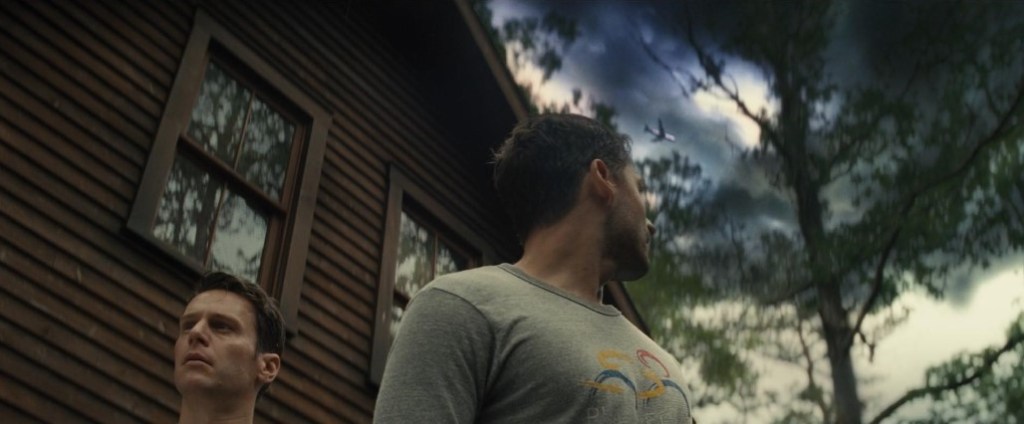
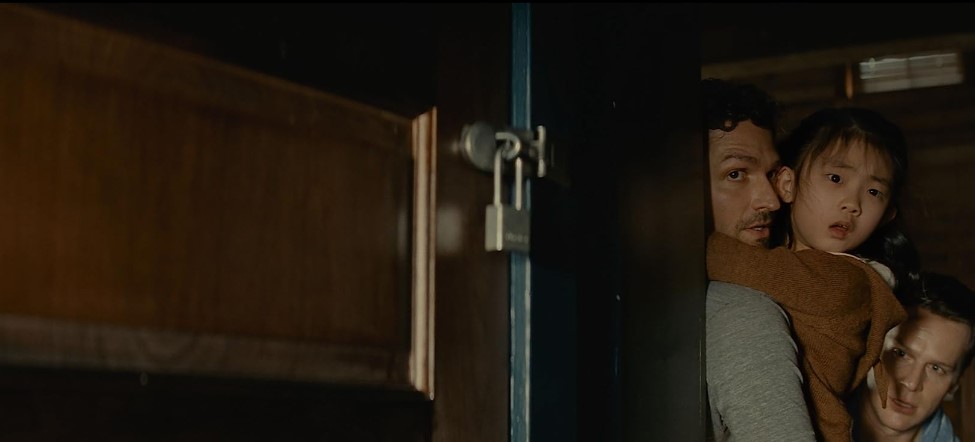
… I also say that because it motivates the characters to be up front and center-framed more often than on the sides. There are a lot of shots where characters are center framed. The viewer’s focus goes to the center and everything else is set dressing for whatever the center of attention is.

You also notice distortion if you look at any straight lines, such as doorways, bookshelves, etc. The lenses make them bend away at an unnatural angle. As you’re watching a film with this lens, you don’t typically notice this if you’re not looking for it. Your mind is focused on the story and characters and subtly translating this background information to be a little unsettling or off-putting.

A lot of other shots, however, were framed predominantly on the right. This is interesting because assuming you read left to right, you would look at the image from left to right, even if it happens in an instant. Often times, an important character will be on the left of the screen. Or you may have an equal distribution of shots that are framed left, right, and center. What made these right framed shots stand out was the sheer number of them. When things weren’t centered, they were right of frame.

I believe this was to keep things off-balance and to give the viewer time to scan the image before settling on the subject in frame.

Camera Movement

The use of camera movement was very intentional in this film. Most of the time, it felt like the camera was attached to whatever it was following, like Leonard’s low shot of his feet walking in the woods.

You can see that walking shot in the beginning of this clip: https://www.youtube.com/watch?v=Pgk1VGlWiDI

Another great shot, which I can’t find a clip of, is when the parents are confronting the people who invaded the cabin. the camera is basically stuck to a close-up on the parent’s face as he circles in the cabin. It was probably accomplished using a snorricam technique. A snorricam is a device that mounts a camera directly to an actor. Think “way too much effort for a selfie.”

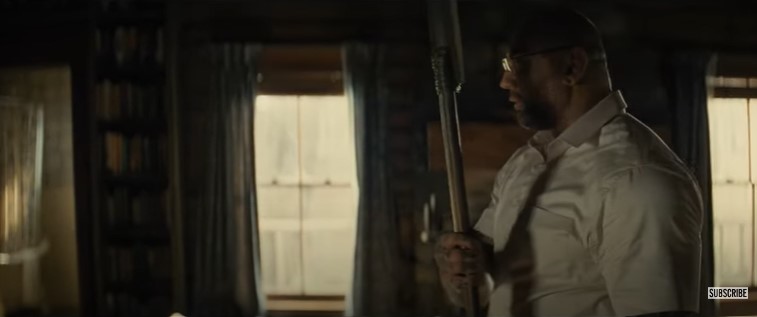
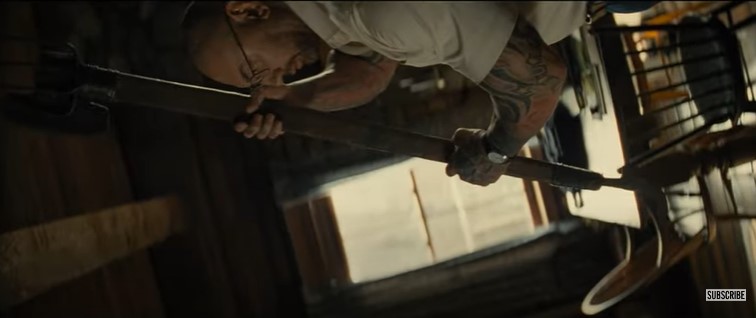
Even better was this really cool shot of Leonard swinging his weapon. The camera movement is perfectly timed and matching the angle of the axe coming down.

Big spoiler if you see the video of this scene, but here’s Leonard swinging that axe: https://youtu.be/p3Zth0YEn5A?si=07_S3tmxakWRlmrF&t=147

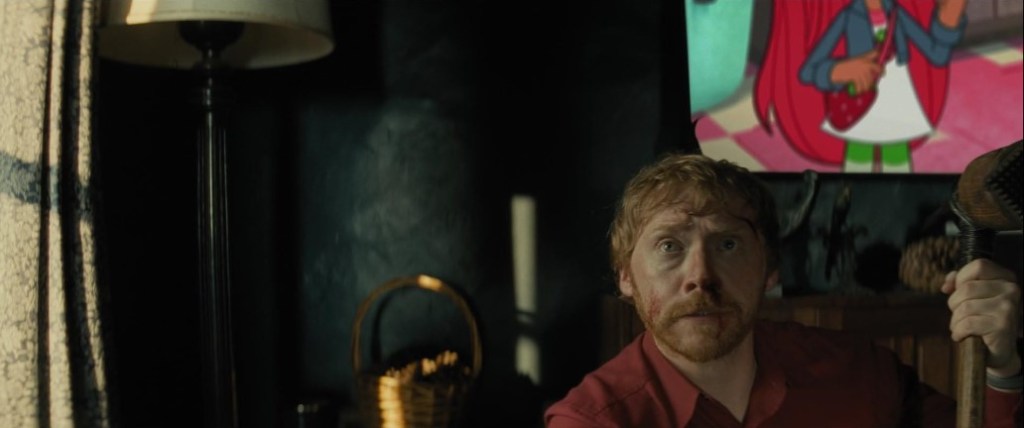
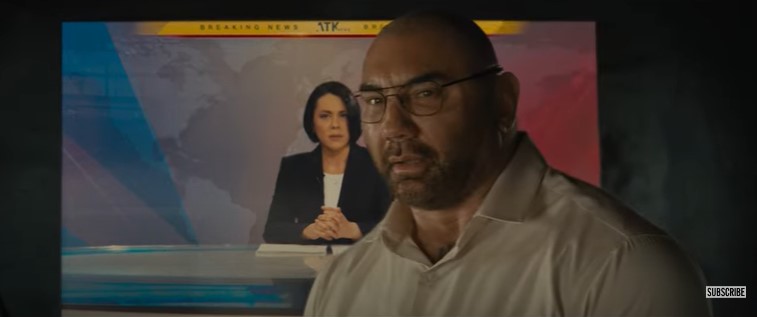
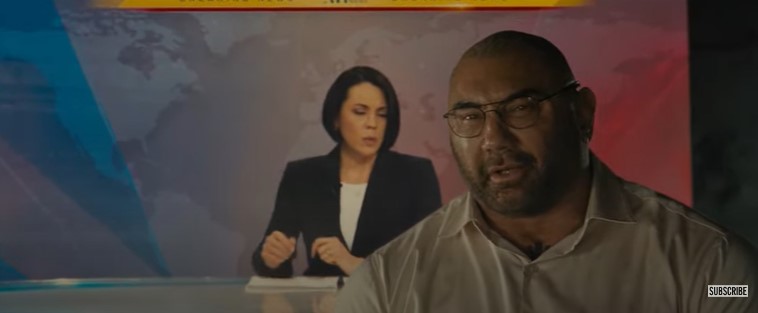
The DP’s also used a famous technique of a zoom-dolly (ala the famous beach scene in Jaws) to underscore when Leonard is proving that his doomsday story is real. The technique is achieved by utilizing a zoom and pushing in or away from an actor at the same time. The resulting distortion creates an uncomfortable feel that warps reality around the character. Pretty cool!

Look at how the perspective of the TV behind him changes over the course of this shot.

See that zoom-dolly in action here: https://youtu.be/xf8ILZnoSr4?si=wDYOefTrl0ymYX_n&t=74

Details hidden in the background

There’s a flashback to when Andrew and Eric adopt Wen from China. I used Google Lens to translate this text: “Children, when we love others, we should not only love them with words and tongues, but also show them in actions and sincerity.” It directly ties into what Leonard says about this couple having to choose who should die in order to save the world.

The blackboard in the cabin had a few questions on it. I started looking at it but didn’t really think about them until I came across this screenshot.

The questions are:

  1. Who invented chess?
  2. The first color named?
  3. Why school buses don’t have seatbelts?

The answers to those questions, when searched are:

  1. Uncertain. The origin is unknown though it likely originated from the Indian game of chaturanga.
  2. Light and Dark (White and Black). In almost all languages this is the case.
  3. They are bigger, heavier, and sit off the ground. Buses protect kids through compartmentalization.

In this small detail, we see nods to our Indian director (Shyamalan), the concept of light and dark (good and evil) and the safety of many. It directly speaks to the film’s themes and it’s just a thing in the background you might miss as you’re watching the action of the film take place.

Credit to the DP’s Jarin Blaschke and Lowell A Meyer for some really interesting work.

So is the movie worth watching?

Eh, well that’s up to you. For the purpose of seeing these shots in action? Sure. I like the unique way this film was shot, obviously enough to write about. But upon finishing the movie with a friend, we were both left with a bunch of questions and a puzzling sense of “was this movie good or not?” The movie both under- and over-explains the premise. I don’t get answers I want. I’m left wondering if certain actions were necessary. I think the bones of a good story are there, probably present from its beginning as the 2018 novel Cabin at the End of the World by Paul G. Tremblay. Shyamalan’s script version is reminiscent of the awkward dialogue I don’t like in his other movies. Maybe I’m biased. I’m still mad about The Last Airbender and annoyed that I wasted time watching trees blow gently in the breeze in The Happening.

Sources:

Knock at the Cabin – Prime

What are Anamorphic Lenses? – PhotographyLife.com

Anamorphic Lenses: The Key to Widescreen Cinematic Imagery – BHPhoto

Small Details You Missed in Knock at the Cabin – Looper

Designing Impressive Long Takes and Oners

The mark of a good director and cinematographer duo is telling a story clearly through the images that appear on a screen. The great ones find a way to go above and beyond.

One particular shot that separates the women from the girls is the “oner” or “one shot” take. The camera follows the action for a long period of time. Often this can be on a Steadicam, but you might find a fantastic oner accomplished handheld, on a dolly, or on a camera crane. Usually these are dynamic moving shots that change framing and action before your eyes, whereas a normal setup would be to edit a series of shots together.

It’s harder to do things this way, and so the oner must be deliberate and planned to perfection. It’s something you might want to try in your next film.

The best way to design something complicated is to study those that came before you. Here I’ve given four examples of incredible oners that I admire and I know you will too.

The Haunting of Hill House Season 1 Episode 6 “Two Storms

A large chunk of Netflix’s The Haunting of Hill House Episode 6 is a 17 minute long oner that spans huge passes of time, flashbacks, special effects and more. It’s an incredibly complicated task that helped tell this unique story.

Part of what makes this scene so surreal is the fact that it doesn’t break away, doesn’t give a respite from following each character around during this pivotal storm. This genius choreography couldn’t have been pulled off without careful timing and a large well-rehearsed crew and cast.

You can watch the whole episode on Netflix, but you also can get the idea from this clip:

Also worthy of watching is this Making Of Featurette, which shows some of the ways this complicated long shot was choreographed:

Children of Men (2006)

The car scene. Not only is this a long take, it’s fraught with anxiety, showing different views out the windows of the car, placing the viewer in with the passengers of the vehicle. The drama unfolds in real-time, starting off with an innocuous car ride and conversation, escalating into a mad dash away from a hoard of crazy people attacking the car’s occupants.

The way they filmed this scene is actually pretty incredible and technical. At about 1 minute into this featurette, they discuss this particular scene. They used the Sparrowhead Doggie cam, a camera suspended inside the car on a track. The car was also specially designed for this scene. The driver is not actually driving it — there’s a man in front of the car low to the ground who is actually doing the driving. They don’t show it here, but they actually had seats that folded out of the way so the camera could get past the actors. 

Birdman

Now this one gets an honorable mention because the whole movie is structured like it takes place in one long take. There are a number of hidden cuts that make this possible, but there are certainly a number of true long takes. You experience in real time Riggan getting stuck outside the playhouse during the performance and having to navigate a busy Times Square in his tighty whities.

At about 45 seconds into this video, you see a grip positioning a silk in order to adjust the lighting on the actors faces on the fly. The whole movie had to be choreographed with the actors and crew in this way in order to avoid setting up classic lighting scenarios and keep things on the move.

Baby Driver (2017)

It’s Bank Robbery: The Musical but oh so much more. I recently re-watched this movie and I’m telling you — if you haven’t seen it yet, there’s no time like the present.

Baby Driver‘s premise is genius — Baby has tinnitus from a car accident, so he’s constantly playing music through his headphones to drown out the ringing in his ears. That sets the soundtrack to which all the action happens throughout the movie. The car chases, bank robbery, shootouts — everything has been meticulously choreographed and timed to fit the music of the scene.

Check out the “coffee run” scene from early in the movie to see the level of choreography that went into the scene. Not only do the Steadicam operator and Ansel Elgort walk perfectly timed, the action also lines up with key bits of set design — watch for the trumpet and certain bits of graffiti and poster designs that link up with lyrics in the music.

Look at the graffiti that says “Right” at 0:32 and 2:31 you’ll see they added in the lyrics “Shake, shake, shake” and several new lyrics on that wall during the shot. Excellent details.

Kidding Season 1 Episode 3 (2018)

Check out this incredible scene from the Showtime series Kidding.

This scene shows how the character Shaina is inspired by a show and how her life dramatically changes in a shifting scene that transcends time.

This is some incredible behind the scenes here because you can see just how the crew choreographed and shifted the scene from the drab, dreary beginning to a lavish apartment by the end of the scene. Watch and listen to the careful choreography dictated by either the 1st AD or coordinator.

6 Types of One-Take Shots

For some more examples, and descriptions of specific oners (the establishing long take, the exposition, the tracking long take, the fake long take) check out Aputure’s video with Ted Sim and cinematographer Emma Kragen.

https://www.youtube.com/watch?v=27hCXKdyD2U