The Forgotten Casualties of the WGA & SAG-AFTRA Strikes

Motion Picture and Television Fund (MPTF) President Bob Beitcher pointed out that although the WGA and SAG-AFTRA have been supportive financially to their own members, a lot of people have been left behind. How about the folks who run cables, operate cameras, apply makeup, design sets, record sound, organize schedules or serve lunch?

“They have become the forgotten casualties during these strikes, overlooked by the media. Let’s face it, actors and writers make better subjects for strike stories; and now crew members are not getting the philanthropic support they’ve earned and deserve.”

Bob Beitcher

The stats are illuminating. Prior to the writer’s strike on May 2, 2023, the MPTF would receive calls from about 100 crew members weekly looking for financial or other assistance. That jumped to 500-1000/week since July.

From the Crew’s Perspective

There have been more than a few unkind remarks from people — trolls — online. “Actors make too much already! Writers are just complaining! Get a real job!” We’ve all heard some variation of this.

“The endgame is to allow things to drag on until union members start losing their apartments and losing their houses.”

anonymous studio executive to Deadline

An anonymous executive made the comment that the studios would wait out the writers until they lost their homes. That kind of thing is already happening. And not just to writers. When the writers and actors aren’t working, neither can the crew members who work on those projects.

Let’s face it — the studios knew there was going to be a strike. So even prior to May 2, a lot of us felt it coming. Shows that should have started production in March or April just…didn’t. I remember countless talks with fellow film workers from March on: “Things are slow, right? Yeah they’re slow. Hope it doesn’t stay that way.”

Can I prove this was done on purpose to squeeze the crew and make them as anti-strike as possible? No, but the idea is in your head now, isn’t it? It also could be due to the mergers of various studios which I touch upon in the next section.

Film is a very difficult business. When work is good and plentiful, it seems really good. In fact, most people working regular jobs would probably scoff at some of the day rates I’ve gotten, and I’m not getting the crazy high rates that get advertised in Deadline.

The thing is though… you always have the possibility of not working for weeks or months after a job. You might be hopscotching from one day play gig to another, constantly hustling to find the next gig. There are film workers who already had a backup job as a safety net, and now that’s not even enough to get by.

The Answer is Easy. Just Work on Reality TV!

“But what about non-union? I can just work Reality TV! They aren’t affected by the strike!”

That’s not exactly a consolation prize and I’m a little annoyed people keep thinking like that. There’s a vast number of film workers who specifically work in the reality scene aka unscripted — and they’re being told that people in scripted could just take their jobs instead.

Reality is also not an answer because it’s not even booming like some would expect.

“… something one would assume is that there’s a lot of work and a lot of more projects getting greenlit, and that doesn’t seem to be the case for some reason. You know, I’ve talked to a number of producers who said this is the toughest moment they’ve seen for unscripted TV right now in terms of people aren’t working. There have been long stretches where since maybe December that a lot of people have been in without work.”

Ryan Gajewski, The Hollywood Reporter via article on PBS.org

In this Deadline article, it details the layoffs and cost-cutting that is plaguing reality tv for mid-size production companies. That includes Bunim/Murray Productions (Keeping up with the Kardashians, Real World) cutting eight staffers and Half-Yard Productions “right sizing” the company after being purchased by The North Road.

Mergers have definitely played a role. The Warner Bros Discovery merger, for one, took place in April 2022. That is being felt this year, as shows are just not being greenlit or put on a backburner for what feels like forever. I for one would have started on a season of a show this past April, except the date for production kept moving as it hadn’t been greenlit yet. Then I also heard that some people wouldn’t be able to return anyway — the company (whom I shan’t name so I can be hired again) would only be hiring in-house for certain jobs.

Survival Mode

I just deleted a home renovation show off my calendar. Easy come, easy go. On a normal year, this is a thing that happens from time to time, but there’s other projects to take away the sting. This year, it hurts losing even the possibility of a one-day gig.

This is scarily reminiscent of 2020, when all film work ground to a halt and most of us were out of work for nearly a year. Now, in 2023, we’re facing a similar situation. Some folks might not have had time to recover from 2020 yet. There are going to be film workers who finally just throw up their hands and change careers.

We waited for a while to see what would happen. 2023 started with a whimper, shows that should have started pre-strike didn’t and then the strike solidified it. This career has become even more dicey to try to hold onto.

Friends of mine have resorted to taking part-time jobs or even gig-economy jobs like Uber or dog walking. I’ve seen folks comment online that they can’t even get a job because employers don’t want to hire someone who will jump ship when the strike ends.

Nexxt steps are challenging.

Typical job search engines aren’t keyed into production style resumes.

And just try navigating unemployment when you’re a freelance film worker who can’t easily fit into the government’s forms. Imagine sitting down for hours, filling out information that is not always easy to find (was that job a W-2 or a 1099? What was the payroll company? How many weeks did I work in the last 18 months?) and then getting a call saying you missed one item — now you have to refile the entire application again.

There’s no easy answer right now.

No matter how long the strike takes, even if it ended today, it’ll be months before episodes are written and production actually begins. Meanwhile our rent, car payments, healthcare, and increased costs for groceries and gas still need to be paid.

Having said all that… I am still supportive of the strikes.

I understand, and many of my film fellows agree, that the issues the writers and actors are fighting for will have major repercussions down the line. They need to set standards for streaming and residuals, the middle class actor and writer needs to be able to afford to keep doing what they want to do, and a line in the sand must be drawn against AI use in writing and acting. The fight they are in will effect all of us in the end.

It’s time for the AMPTP to start understanding that.

Anyone interested in helping the MPTF’s emergency relief funding efforts can donate here: http://www.mptf.com/donate.

Sources

Hollywood Crew Are “Forgotten Casualties” in Strike, MPTF Chief Says in Call for Financial Aid

Hollywood Studios’ WGA Strike Endgame Is To Let Writers Go Broke Before Resuming Talks In Fall

Doom & Gloom In Unscripted TV: Producers Battle Challenging Conditions As Mid-Sized Firms Face Layoffs

What You Need to Know about the Warner Bros Discovery Merger

How the Ongoing Writers Strike Impacts Reality and Unscripted TV

header image: Photo 129097006 | Film Crew © Ppengcreative | Dreamstime.com

How to Avoid Film Job Scams – Take Four

I really hate that this has become a recurring theme I have to address. I really just want to teach about the fun stuff. Instead, I have to keep drudging up the fact that there are many people out there taking advantage of the film community.

Things are not good right now. The SAG-AFTRA/WGA strikes combined with corporate studio greed has contributed to a painfully difficult year to work in film. 2023 has brought major career changes, such as layoffs and unemployment and the need for survival jobs to many creatives affected by the strikes.

Facebook film groups are rife with scammers taking advantage of people desperate for work and green people trying to get their start in the film industry.

Here’s some of the latest scams and suspicious posts that I and several community members have come across.

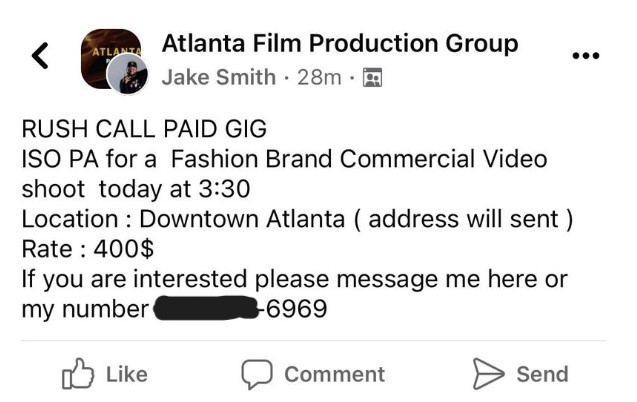
Jake Smith/Jeffery Cooper

This is likely not this guy’s real name. For one, he went from Jake Smith to Jeffery Cooper to Cooper Jeffery. Also a quick Google and both names show up as actors. Maybe they’re just common names, and that helps lure in an unsuspecting individual.

Bad grammar is often a dead giveaway on scams.

“Address will sent.” “400$”

Jeffery/Jake’s posts are rife with spelling and grammar issues. Normally that points to an overseas scammer unfamiliar with English. He appears to be in Atlanta though, because people have worked with him in the Atlanta market before. And one or two of the disposable phone numbers he’s used come back to Marietta, GA.

Be highly suspicious of jobs that are taking place “in a few hours” or the same day. Honestly, it can happen that a production needs last minute help. Someone got sick, had an emergency and couldn’t come in, your feature realizes they don’t have enough extras for a party scene (saw that one happen in person).

But be very suspicious of a job that needs you to throw all caution out the window and immediately jump in head first. They are banking on your desperation, and you will pay for it. Literally.

Yes, I blanked out the phone numbers so nobody makes the mistake of calling him.

One person, who we will call Mary, worked with “Jake Smith” on a rush call gig offering $400 for a PA on a music video. Although Mary had some concerns about it seeing like a high rate for a PA, she took the job. On this gig, she spent over $100 of her own money and was told that someone would pay within two weeks.

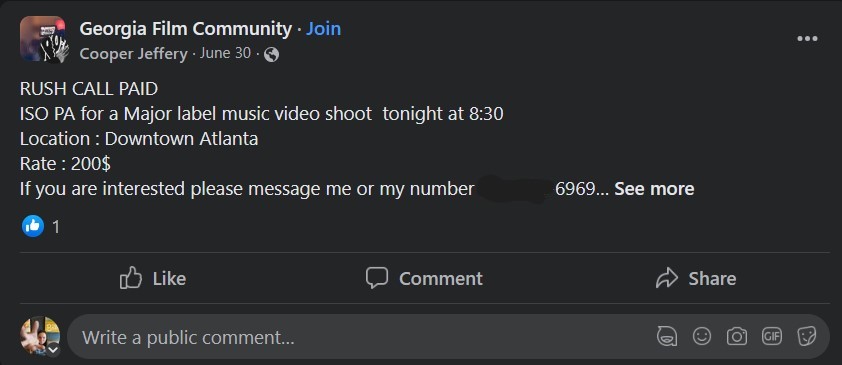
What followed was several weeks of ghosted phone calls. No $400 pay or $100 reimbursement. Later when she looked at Jake Smith’s profile, she found he’d changed his name to Jeffery Cooper. His profile pic also changed.

That was weeks ago. Recently, another Atlanta based film worker we’ll call Frank talked to me about the same individual, though now he uses the name Cooper Jeffery. The man sounded very shady on the phone. Frank told me that Jake/Jeffery was asking for a transport PA (Uh, okay?) to use their own car and gas and food and be reimbursed later. Jake/Jeffery then hesitated to give a name of a production, didn’t know what a COI (Certificate of Insurance) was, and soon hung up on the job seeker since they asked too many questions.

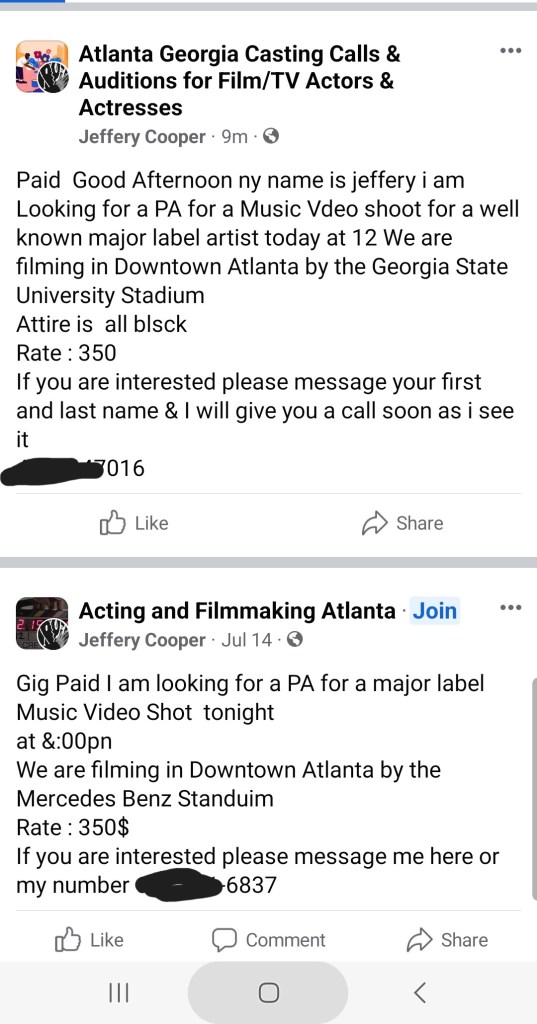
The spelling/grammar have gotten even worse. Note that the phone number changed too.

Do your due diligence. Ask questions. Know exactly what you’re getting into.

As I was writing this post, this one popped up:

These “jobs” were posted on different days, on different Facebook groups, and always last minute. This latest one was posted at 10pm, for a rush call “at 12”. So…midnight?

A Data Entry Scam Targets Women in Film

Many people who work in film are turning to survival jobs to get by right now. That includes looking into work from home opportunities. Don’t worry, the scammers have you covered there as well.

I blocked this one’s name because it’s possible this name and profile pic were stolen.

A community member I’ll call Haley alerted me to a somewhat legit looking data entry job targeting women film groups. When she asked for more information, the “employer” asked for her bank information to give her funds in order to purchase equipment.

This is a play on a standard scam that targets film people, so it’s interesting that they re-skinned it as a data entry job. The scam asks a production assistant (usually) to purchase film equipment and then get reimbursed later. It’s not real. If they send you a check, it bounces, and you’re out ALL the money.

Do not use your own money to purchase film equipment or supplies for a job, even if it seems like a legit job. In a real production, they’ll give you petty cash or a P-card in order to purchase supplies, and a PA should never be purchasing equipment at all. A PA could purchase crafty, office supplies, etc, with the production’s funds, but never equipment and never with their own money.

The Huge Paragraphs of Doom

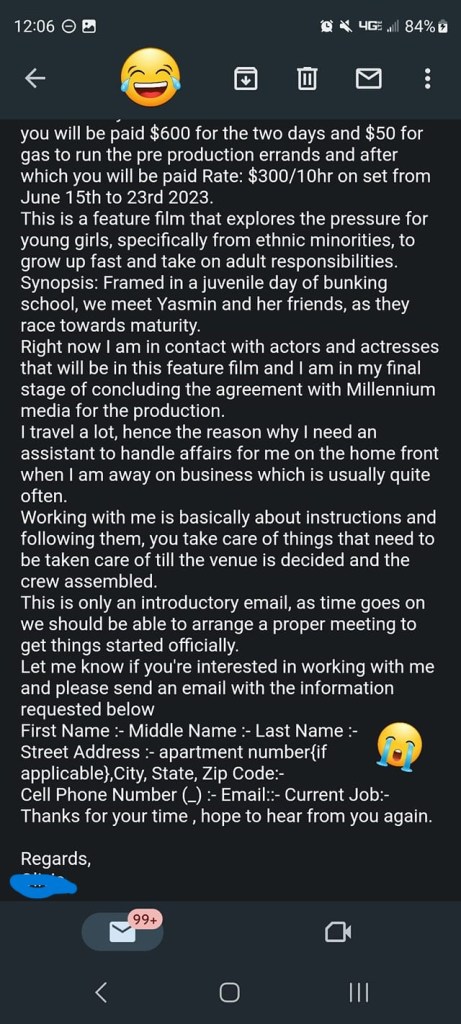
Yet another community member contacted me about a scam she came across from someone we’ll call O. I blocked out the name because I can’t be sure if this name was also stolen.

This is an example I’ve covered before — the word vomit job offer. Honestly, just the giant block of text in enough to provide you pause before you give any info.

The TLDR version of our analysis is this:

  • over explanation of what a PA does
  • Duties that a PA doesn’t do, like check processing and booking travel.
  • “I travel a lot…so I need an assistant there.” That’s a common scam tactic.
  • Requesting a ton of personal info right away. This exact same block of text appears in a number of scams I’ve covered before.
  • overall weird formatting

Most of my job e-mails are this:

“Hi, This is Insert-Name-Here from This Show. Got your name from So-and-So. Are you available to camera operate on a 6 week reality show starting May 7th?”

That’s it. Maybe even less. Producers know you know what a production assistant is. They aren’t interested in giving you a show synopsis. They’ll get your info when you’re officially hired and you sign a Deal Memo.

After this person posted her experience with the suspicious job poster, the job poster O, started sending threatening texts and promised to “destroy you …mess up your F-ing life.” I mean, seems legit, right?

RED FLAGS TO LOOK OUT FOR:

  • Name of famous producer or production company (for instance, just got one from “LucasFilmsLTD” recently.
  • Very short notice request for work.
  • Strangely high rate or strangely worded rate (“weekly pay” “1800 flat” “you get $600 for 2 days”)
  • Job poster doesn’t answer simple questions.
  • They want you to use your money to purchase something for the production.
  • They immediately ask for your banking info.
  • The Facebook account of the poster is new, and/or seems like it’s never used (no friends, no pics, etc).
  • The job poster meets any of these red flags and also just joined the Facebook group you saw the post in.

Where on Facebook did I see these posts?

The Facebook groups I saw these scams in were:

  • Film Production in GA
  • Georgia Film Production
  • Georgia Film Community
  • Atlanta Film Production Group
  • Atlanta Film & TV Casting & Jobs Board (CS)
  • Women in Film & Television Atlanta (WIFTA)
  • Acting and Filmmaking Atlanta

Some groups are less moderated and more prone to scam posts than others (lookin’ at you Film Production in GA). It doesn’t mean you can’t join any and all film related Facebook groups, but it does mean more of the work of identifying scams and bad jobs will fall on your shoulders.

What Can You Do To Avoid Scams?

Ah, that’s easy. Delete Facebook, unplug your internet, and throw your phone into the sea. Not an option?

Then you’re going to have to do more research than you want, but trust me, it’s worth it.

If something seems off about a job, start looking into it. Is the pay rate for the job too high? Are they asking for the wrong job duties for the job title, such as a PA operating a camera? Is the spelling and grammar all wonky?

Google can tell you a lot. Google the name of the employer, the production company they are associated with, or the email. If someone else has run into a scam, they might have shared that info online. Ask your fellow film professionals, “Hey, does this job look scammy to you?”

Look at the Facebook profile of the person posting the job. Is it a new Facebook account? That alone is a warning sign. Doubly so if they just joined the group they posted in. Even more so if they turn off comments on their posts in order to avoid people warning each other.

Be cautious if anyone is trying to pressure you into taking a job without getting all the details straight.

Sources

Layoffs begin in the film industry, as Hollywood strikes continue

Philadelphia film office warns filmmakers against scammers

Why Residuals Are a Big Factor in the SAG-AFTRA and WGA Strikes

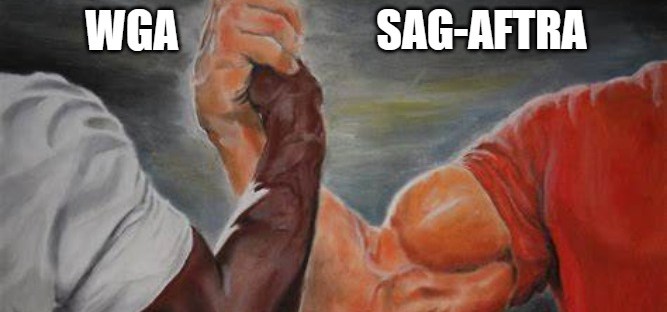
The WGA and SAG-AFTRA are both on strike against the Alliance of Motion Picture and Television Producers (AMPTP) halting TV and film productions and leading to a very sparse year financially for many film workers. They’re just asking for more money, right? Yes and no. This is certainly not a case of greed from the average film worker, but from corporate CEOs who make hundreds of millions of dollars a year while balking at a small percentage that writers are asking for. To put it in perspective, since 2018 writers have seen an inflation-adjusted fall in revenue of 14%. For writer-producers it’s worse at 23%. In recent years, the numbers of writers working at a WGA minimum went from a third to half of all writers. Meanwhile SAG-AFTRA actors report paltry residuals and popular TV shows that didn’t properly compensate them either, and a big culprit is streaming.

The WGA Strike Began May 2, 2023

The WGA went on strike in May when negotiations broke down. How far apart was the WGA’s proposal from the AMPTP counter offer? The WGA asked for a pay increase for members totaling $429 million per year (that’s only about 5% on WGA minimums). The AMPTP countered at $86 million per year, an amount they called “generous.”

You can consult this page to see the WGA’s terms and the AMPTP counter offers.

The WGA has gone on strike for several reasons, one of them being paltry residuals for streaming shows. Residuals are compensation for a performer when their work is re-run, syndicated to another network, or sold as a physical media such as a DVD box set to name a few. Streaming obviously complicates this because programs are not broadcast in the same fashion as on traditional TV.

“Over the past decade, while our employers have increased their profits by tens of billions, they have embraced business practices that have slashed our compensation and residuals and undermined our working conditions,” said the WGA Negotiation committee to its members prior to the strike beginning.

Surprisingly, WGA West’s fiscal report in March 31, 2022 reported an “all time high” in guild collected residuals. How does that make sense when writers claim they’re making less?

Because they are making less!

The total residuals may appear higher, but that is due to the volume of extra projects being made. It’s no longer just theatrical releases and network TV. There is a cornucopia of different streaming platforms all vying for a catalogue of material to get you to sign up for another subscription service.

Charles Slocum, assistant executive director at the WGA West, indicated that residuals slashing was taking place on a per-program basis, and the major culprit was streaming services.

And so, when WGA contracts were coming to an end this year, residuals were one of the main points they would negotiate for — as well as not having writers replaced by the likes of ChatGPT.

Slocum also made the point that companies have not agreed to pay residuals at broadcast levels for streaming programs. “If you write for a streamer, you get two residuals payments – one for domestic streaming and one for foreign streaming. It’s a set amount of money. If it’s a big hit, you do not get paid more residuals in streaming, whereas in the broadcast model, you do because of its success. That’s the sense that residuals were slashed – they have not agreed to a success factor when a program is made for streaming.”

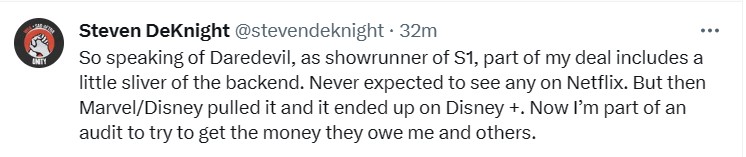
Many writers, actors, and other film industry professionals have taken to social media to explain what position they are in. Screenwriter Daniel Kwan, Oscar-winner for Everything Everywhere All at Once, said on Twitter, “It’s about maintaining a healthy middle/working class of writers in our industry. It’s about showing our collective strength as new tech threatens to take away our leverage.”

The average person may assume that screenwriters (and actors!) are making so much money already that this argument is unnecessary. But the truth is, the majority fall into middle class status or lower. Only a small percentage make the insane bucks that make headlines.

Shrinking writer’s rooms has also been a factor that has plagued modern writers. In traditional TV, you’d have a group of people hammering out episode ideas, sharing script writing duties for 20+ episode seasons. Now, with streaming’s angle towards shorter seasons (8 episodes seems the norm these days) and fewer writers, the entire process has shifted. Shorter seasons and smaller rooms equals fewers weeks of pay and more gaps in work for writers and actors alike

SAG-AFTRA Strike Began July 14, 2023

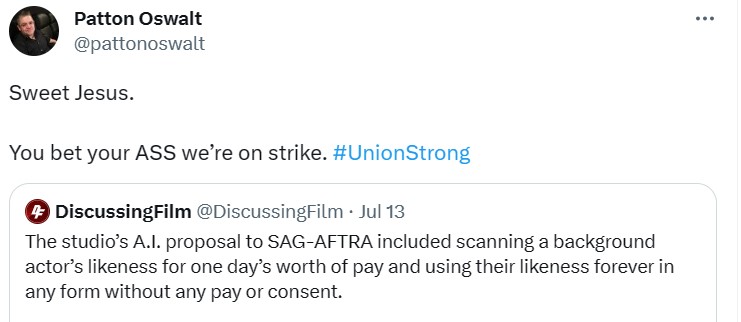
Actors too, are striking for better conditions. They decry similar concerns such as waning residuals from streaming to A.I. creating virtual versions of actors and replacing them, the actors were ready to put their foot down and join the WGA on the picket line.

“There has been a sea change in the entertainment industry, from the proliferation of streaming platforms to the recent explosion of generative AI, and at stake is the ability of our members to make a living,” said SAG-AFTRA Chief Negotiator Duncan Crabtree-Ireland. “We must ensure that new developments in the entertainment industry are not used to devalue or disrespect the performers who bring productions to life.”

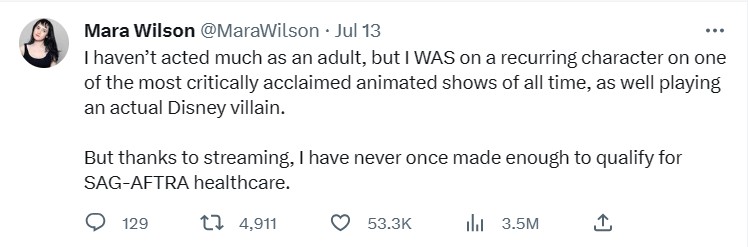
The culture’s shift to streaming has led to shorter season runs, and therefore fewer episodes and less work for recurring performers on shows.

Most actors, like the writers, do not make the big bucks that make readers of Variety blush. Many are considered middle class or even struggling to get by. As the strike was authorized, numerous actors took to Twitter to provide anecdotes on why the strike was necessary.

The popularization of A.I. tech has made both writers and actors nervous about the reality of losing their jobs. This is a huge topic, and difficult for me to cover without this post ballooning into a novel’s length, but suffice to say that AMPTP has unironically looked at A.I. as a cost-cutting maneuver to replace people.

This post went around recently by Justine Bateman, A.I. consultant to SAG-AFTRA during the negotiations.:

All indicators are showing that we’re going to be in this for the long haul.

Sources:

Deadline: Are Streaming Residuals Being Slashed? As WGA’s Own Data Shows, It’s Complicated

YouTube Video: Steve Schmidt explains how the SAG-AFTRA & WGA strike impacts the American middle class |The Warning

Tensions from the last writers’ strike cast a shadow over current labor fight

Why Actors Are Going on Strike

Mini Rooms Drive Major Controversy as Creative Community Feels Strain of TV’s Vast Expansion

SAG actors strike, joining Hollywood writers. What are we supposed to do now? Read?

Spider-man: Across the Spider-verse is Breaking its Artists

Spider-man: Across the Spider-verse is still doing gangbusters at the box office 3 weeks after its release. It’s a stunning display of cinematic art, and immediately blew away all high expectations that existed after Into the Spider-verse inspired us all to be our own hero. Too bad the artists who made the film truly had to suffer for that art.

The second Spider-verse movie did some really amazing things, including having the story grow darker and more mature as Miles himself grows into being his own hero. One very notable, and highly anticipated part of the film was how each universe would be rendered in its own unique art style. Gwen’s universe is awash in melty watercolor tones, Pavitr’s universe is Bollywood and boisterous, Miguel’s features some neon colors and sketchy lines.

It’s a beautiful movie. Really.

But 100 artists had to leave the project due to unfair working conditions.

Long hours and rough days are no strangers to those of us who work in film. A 12 hour day is standard for us. Many who work on bigger productions find themselves working way over that time, with a consolation of overtime and learning techniques on how to not fall asleep while driving home. Throw in the mix a Fraturday (day starts on Friday, ends on Saturday) that severely cuts into the weekend and then you do it all again on Monday. And these are actually better conditions than where it all originally started.

The artists on Spider-verse reportedly were hired on during the layout process, then had to wait months to get started, and then were shunted into immediate crunch time with 11 hour days 7 days a week. These conditions lasted for more than a year.

Some were afraid to leave, reticent to allow their work to go to the wayside if they weren’t there to see it through.

Fix it in Post!

Part of the issue was Phil Lord’s angle on editing material after a 3D render had already been produced. That’s pretty late in the pipeline for animation. That’s like an actor getting the director’s notes after you’ve already shot the scene. Those changes should take place during the storyboard stage, a handy pre visualization that filmmakers use to block out their entire movie before it is filmed or animated.

Animators allegedly had to go “back to the drawing board” five times, which had to be incredibly frustrating. After working so many hours on a scene, now you want it done a different way? Sure I don’t need to see my family any time soon.

One artist, pseudonym Stephen in this Vulture article, said:

For animated movies, the majority of the trial-and-error process happens during writing and storyboarding. Not with fully completed animation. Phil’s mentality was, This change makes for a better movie, so why aren’t we doing it? It’s obviously been very expensive having to redo the same shot several times over and have every department touch it so many times. The changes in the writing would go through storyboarding. Then it gets to layout, then animation, then final layout, which is adjusting cameras and placements of things in the environment. Then there’s cloth and hair effects, which have to repeatedly be redone anytime there’s an animation change. The effects department also passes over the characters with ink lines and does all the crazy stuff like explosions, smoke, and water. And they work closely with lighting and compositing on all the color and visual treatments in this movie. Every pass is plugged into editing. Smaller changes tend to start with animation, and big story changes can involve more departments like visual development, modeling, rigging, and texture painting. These are a lot of artists affected by one change. Imagine an endless stream of them.

Of course Sony execs rushed to backpedal on these claims. Amy Pascal, for one, didn’t exactly help things with this statement:

“One of the things about animation that makes it such a wonderful thing to work on is that you get to keep going until the story is right,” adds Pascal. “If the story isn’t right, you have to keep going until it is.” To the workers who felt demoralized by having to revise final renders five times in a row, the Spider-Verse producer says, “I guess, Welcome to making a movie.”

Amy Pascal, from the Vulture article.

A Lesson We Seem to Keep Learning

I don’t think the guy on the left would have gotten a sequel

Back in 2019 I did a post on the Sonic live action movie that dropped a trailer so jaw droppingly terrible that they literally had to rework the Sonic CGI in record time. I ended up watching both Sonic movies later on and they were both delightful family romps — and the correct choice was made to fix the Sonic character to be more like the source material.

My blog focused on the inherent problem with wanting to fix something fast. CGI, animation, and any kind of VFX takes an astonishing amount of hard work and time. It’s not just hitting a button that says render and walking away to watch a season of Black Mirror.

Crunch has been a negative word circulating through VFX houses and video game companies for some time now. I learned a lot about the term when it came to the videogame industry, actually, in Jason Schreier’s nonfiction book Blood, Sweat and Pixels. It’s a pretty insightful read. Animators, VFX artists, and video game designers are pushed into crunch mode to meet imminent and obscenely short deadlines and fix the inevitable problems that comes with that rushed work. It leads to an unhealthy work environment and depressed, overworked artists. Who wants that?

Across the Spider-verse came to a pulse pounding close. M friends and I sat at the edge of our seats in shock when we saw that the next installment would be in theaters March 29, 2024. We’d just been ripped in two by a cliffhanger, and before we could wonder how long it would take a sequel to come out, we were delivered an unfathomable promise.

According to additional reports coming out now, that’s not likely. And you know what?

That’s. Okay.

If we can give these hard working artists some breathing room and some better conditions, I can wait longer to see the conclusion of Miles Morales’s story.

I’d like to imagine an alternate universe in which we respect our artists, give them reasonable time and work conditions, and continue to appreciate their work.

If that means I don’t get Spider-verse 3 next March, I humbly accept that.

Sources:

Damning Across the Spider-Verse Report Reveals 100 Artists Quit Amid Brutal Working Conditions

Spider-Verse Artists Say Working on the Sequel Was ‘Death by a Thousand Paper Cuts’

The Problem with Sonic’s “Fix it Fast”

“Blood Sweat and Pixels: The Triumphant, Turbulent Stories Behind How Video Games Are Made” by Jason Schreier

National Cinema Day is September 3rd!

Tomorrow, Saturday September 3rd has been declared National Cinema Day. Theater chains across the nation are offering all film showings at $3 each — and that includes premium formats like 3D, 4DX, ScreenX and RPX. Now’s the time to try something in a crazy format if you haven’t already, especially since those premium tickets can run up to $23 a pop other times.

This event was announced by the nonprofit arm of the National Association of Theater Owners. 3,000 locations (over 30,0000 screens) are participating, and that includes chains like Regal and AMC as well as participating art house theaters.

The purpose of this is two-fold — get people out to see movies on the weekend before Labor Day, a statistically low attendance weekend, but also to bring people back to the movies in general.

In 2019, 1.2 billion movie tickets were sold. $11.4 billion was made off ticket sales. And then, of course, 2020 — that number slumped to $2.2 billion or 224 million tickets. In 2021, the numbers were at around 500 million tickets sold.

July of 2022 marked an improvement in these numbers. People came out in huge crowds for tentpole movies like Doctor Strange in the Multiverse of Madness, Top Gun: Maverick and Minions: The Rise of Gru to name a few. It injected a surge of hope in an activity that had been hit hard by the pandemic and perhaps a bit of hope to those who make movies… that there’s still a place for films in a theater setting, and not just in the average American living room via a streaming service.

So yes, this is a bit of an unsolicited ad from me to go attend a film in honor of National Cinema Day. I find this idea exciting. After all, the majesty of seeing films on a huge screen, popcorn in hand, was one of the things that lead me to this business to begin with.

Sources:

https://www.cnbc.com/2020/12/29/box-office-2020-sales-plummeted-80percent-the-lowest-haul-in-decades.html

https://www.statista.com/statistics/187076/tickets-sold-at-the-north-american-box-office-since-2001/

https://variety.com/2022/film/news/box-office-top-gun-elvis-pandemic-return-1235303574/

Cables, Adapters and Converters Oh My!

Quite some time ago, I published a post on what basic items you should have in your camera assistant kit. You can find that post here. A number of folks just getting into the camera department found the post useful, so I thought I’d build on that.

Do you know how many times I need just the right connector or cable to make a camera or monitor build work? Many times. All the times. Some of the times.

The fact is, sometimes when you’re working with someone else’s gear or renting a kit from someone, you might be surprised when one or more cables is missing, or you need a special connector to make something work.

I’m going to introduce you to my tackle box of connectors and useful screws and well as the common cables I keep in my kit.

One of the great things about working with other AC’s, camera operators and DP’s is I can see what they have in their kits and ask them what works best for them. Shop talk like that helps everyone build on their knowledge and slowly add in new pieces to their kit that will help them on future gigs.

The Tackle BoxScrews and Adapters

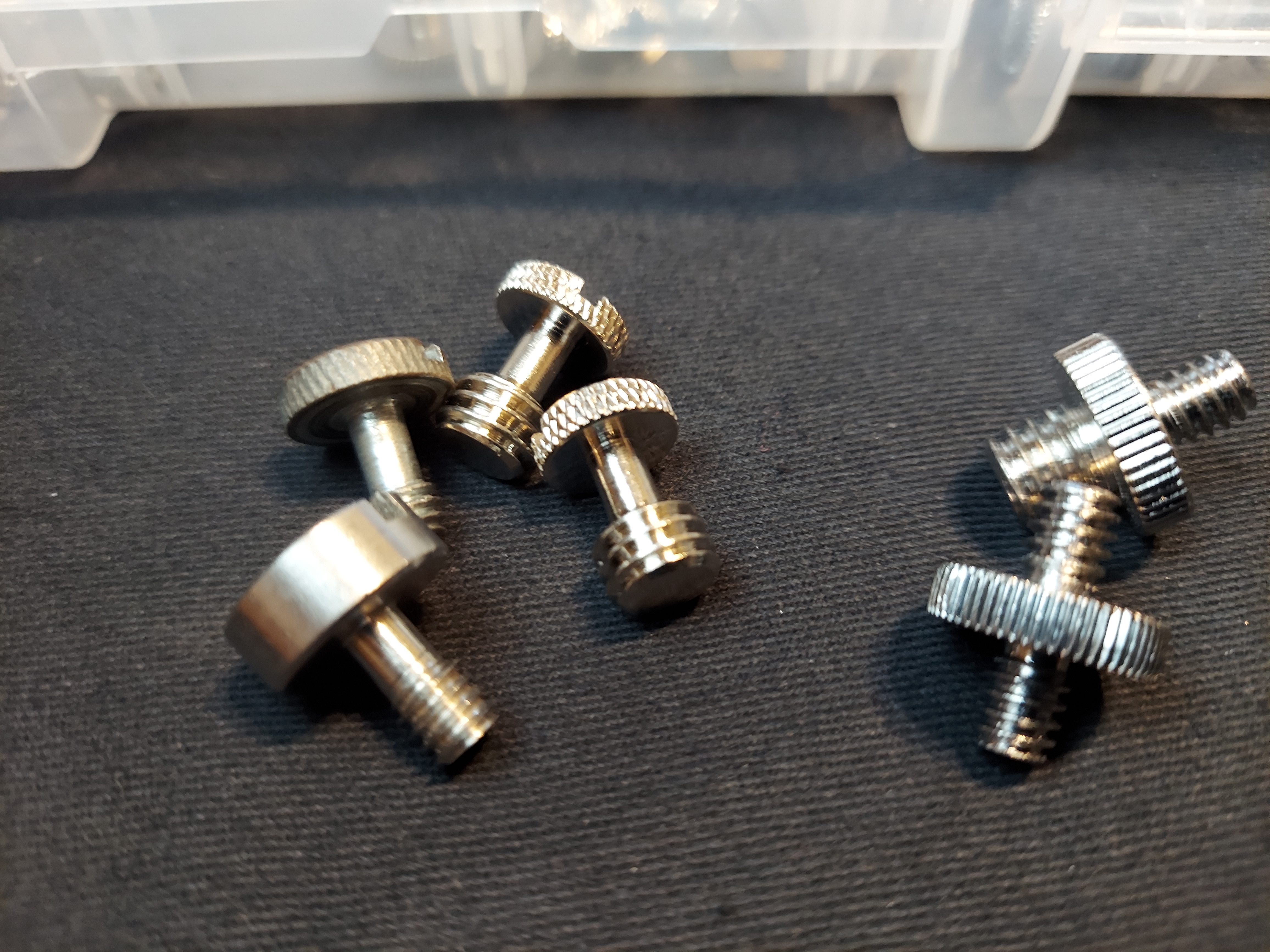
Many, many times I need a specific size screw in order to mount the camera on a pair of sticks or a Steadicam. I’ve slowly been adding to my pile of screws, but the basics will always be 1/4″ 20s and 3/8″. Having a couple short and long ones, as well as a washer for that rare occasion when there’s a gap between the screw and the mounting plate is crucial.

I got this little box at a craft store, but you can find a similar one in the fishing section of Walmart, so I call it my tackle box. It helps keeps things organized and neat, and when I need to send a 2nd AC to grab something, I only need to say “find the clear tackle box” and they find it right away.

Some items I have in the tackle box:

  • SDI Splitter
  • barrel connectors
  • Screws of various sizes
  • washers
  • HDMI to micro HDMI adapter
  • Double ended screws, different sizes

Cables

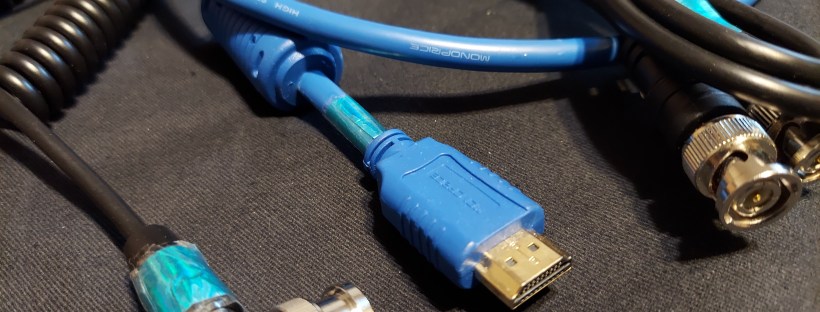
Wires are essential to get a video signal from Point A to Point B. There are many ways to keep and organize your wires. For now I’ve settled on different colored pencil cases. I usually have three cases with me: 1 for SDI cables, 1 for HDMI (on Blackmagic shoots) and 1 for “Other” – for me it’s Steadicam related wires.

My commonly used wires include:

  • SDI cables – coiled and regular, several sizes
  • PTAP splitter
  • HDMI

I recommend not buying the thin “spaghetti strand” SDI cables. I’ve had them several times and they always fail. A thicker gauge wire is a safer bet.

Also good additions to this are:

  • HDMI to SDI converter. I use the Blackmagic HDMI to SDI Microconverter. I’ve seen a larger version used on bigger shoots to provide a signal to off-site directors. Keep in mind this needs power. A cell phone power cable to USB can work on a camera with a USB power input. Another option is mounting a portable cell phone battery charger.

  • Arms for mounting – Noga arm or Smallrig or similar. All useful for mounting a Teredek, monitor or whatever else you need.


  • There’s no shortage of things you could add to your kit to make your life easier, but this list should get you off to a good start.

    A Film Is Born Three Times Pt. 1: Re: Writing

    “A film is born three times. First in the writing of the script, once again in the shooting, and finally in the editing.” — Robert Bresson, French film maker.

    I think folks at first take for granted that a film is a thing born of an idea, written, produced, and edited and then it just exists… but there’s so many changes along the way. Your first draft is almost never, ever going to be what appears on screen. And it probably shouldn’t. Some first drafts are better left being forgotten, but you can’t make a final draft without suffering through the whole writing and re-writing process.

    The Road Less Traveled

    I talked a bit about my short horror film The Road Less Traveled in my how-to post here: Making the No Budget Horror Film – Bridget LaMonica

    The very first very rough draft was written in 2014 while I was at SCAD. Cassie is abandoned at a bar by her friends and captured by two bad men named Miles and Dawson in a cool car.

    While in their nefarious clutches, Cassie calls her mother, who races to try to find her. Cassie gets her revenge, only to have her mother finally arrive in time to bury a couple bodies. I called the story Werewolf because that was the monster at the end of the story.

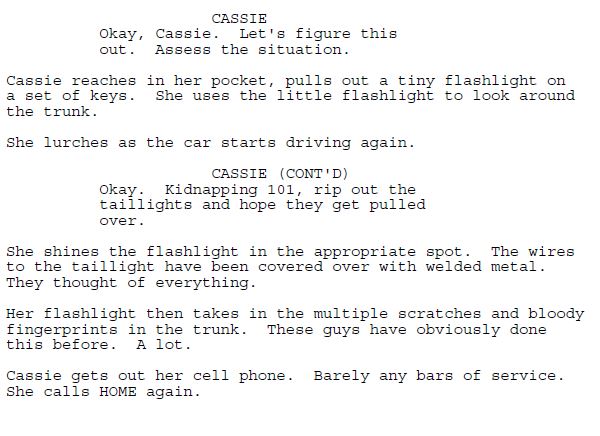
    Hunted, an early draft of The Road Less Traveled:

    Cassie talks too much. There’s a lot of her talking on the phone, to a friend at a bar, to the kidnappers. Blegh.

    She has a cell phone and is able to call for help (kind of a horror movie no-no).

    Cassie is resourceful. She knows ways out of her situation but finds her methods were anticipated.

    I sent the draft to my friend Masha, who gave me a great critique. Eventually I created the story that was much more interesting to me: Mia (formerly Cassie, now with a more appropriate name – Missing In Action) kidnapped by a lone serial killer named Clyde (the name is never said out loud) who brings her to an abandoned slaughter house to do his evil work. Jokes on him, because Mia fights back. This was called Hunted.

    The script was presented to director Lindsay Barrasse. With Lindsay’s attachment to the script and her love of classic horror, we leaned further into classic horror tropes and set the story in the 1970s instead of modern day. No more convenient cell phone.

    Draft 9:

    Cassie is now Mia and she has no spoken dialogue (only a few lines of voice over).

    This version mentions a “90’s style watch” but later we changed the date to the 70s.

    Mia is adept at survival — she knows some skills but is unable to escape until later.

    I wanted a horror story that played on the classic tropes while delivering some surprises. I had a not-so-subtle reference to a favorite TV show, Supernatural.

    Hunted became The Road Less Traveled, inspired by the Robert Frost poem “The Road Not Taken”, Supernatural‘s “The Road So Far” and the fact that we had a female victim who would prove herself capable. The film became more and more about female empowerment, especially since most of our production team was female.

    A note: I almost never find my title until a few drafts later. Same with a theme or tone — sometimes it just takes that long to finally whittle down to what I want to say.

    Routine Procedures

    Before The Road Less Traveled was produced, I had a thesis film at SCAD called Routine Procedures.

    This script began in a short script writing class. The basic premise being a group of soldiers discovering an alien box in the woods that could spell doom for all mankind.

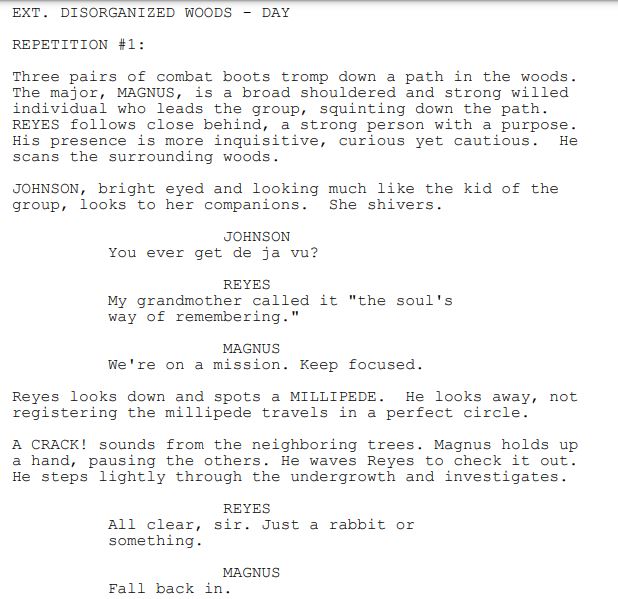
    The very first (equally very bad) draft saw Johnson, your average Gary Stu with his boss Magnus and a feisty Latina soldier Reyes (inspired by Private Vasquez in Alien). Reyes ends up being an alien. There might have been some idea about aliens enslaving humanity or something? I dunno. This draft doesn’t exist anymore and nor should it.

    This script went through several drafts in the class, becoming a time travel story in which these soldiers discover this alien artifact that forces them to relive the same day over and over as they deteriorate. Only one soldier notices, and he is freaking out, man.

    Draft 3, Page 1:

    In this version we have about 5 characters: Johnson, Sterling, Reyes, Magnus and Hopkins.

    This draft was way too talky with too many characters. Still I can see all the major things I kept from this draft forward: Johnson as our lead who figures things out, Magnus as the hard-as-nails superior who is afraid of change, the story starting by mentioning de ja vu.

    I condensed the best parts of Hopkins into Reyes and deleted Sterling entirely. He was a useless jerk.

    I worked with director Nick Bow to make the film. He suggested Johnson should be a woman. I stopped. I was about to argue. And then I realized, yeah, why didn’t I think about that? The genders of Johnson and Reyes were flipped and we put out a casting call. We got some excellent people to fill out these roles and it wasn’t who we originally expected.

    Draft 9, page 1:

    The characters were reduced to 3.

    We wanted to be clear what happened where (time travel stories get complicated). We labeled the repetitions and the different sections of landscape we were shooting in.

    In Draft 3 Reyes saw a snail stuck in a loop. Here it’s a millipede.

    Less dialogue and more focused.

    As I recall, the title Routine Procedures was there for most of the drafts. I think the first one or two were called Maneuvers or something vaguely military-esque. When I settled on Routine Procedures, it helped sell the fact that this was a time travel story.

    Let’s Wrap This Up

    Drafts are called such because they are a continuously changing process. The first draft is often called a vomit draft (ew) because you might need to get your initial idea out fast. You bring it to a critique group or a trusted friend who can give you notes, and then you incorporate that into a rewrite. The script is never actually done until it is filmed, and even then it’s open for interpretation.

    Next up, Part 2: Production.

    Feast or Famine in the Freelance Film World

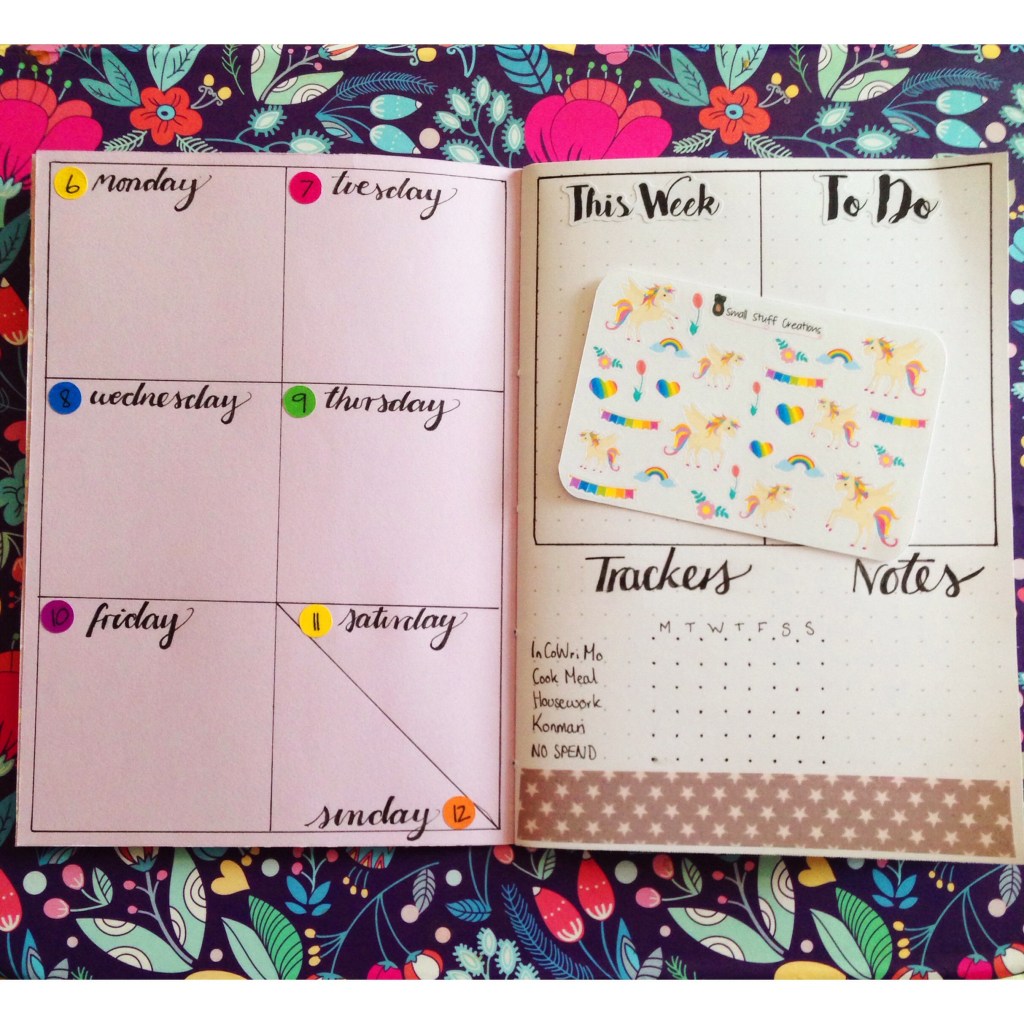
    I’m the type who keeps an up-to-date Google Calendar and a physical planner. I keep track of special events, due dates for film festivals, writing deadlines and yes — many random film gigs that come up.

    I was particular when purchasing my 2020 planner. It was gonna be a big year. I settled on this hardcover sparkly planner, being picky to choose one that I liked the layout of best.

    Coming out of a pretty slow winter (I only had a couple gigs, the longest of which was a short film that ended early March) I was happy to start booking gigs for the next couple months. Things were looking good. At first.

    “This was the year I was going to –” starts literally everyone I talk to. Major life events. Decisions to make a big gear purchase or invest in a new skill. Joining a union. All of that changed in March, when it became clear that things were not going as planned.

    The calls, emails, and texts started coming in. “We’re holding for now.” “The shoot is canceled.” Job after job disappeared, some of them going the “ghosting” route. At least three different productions just stopped communicating midway after heading full speed into production. It’s hard enough being a freelancer, but things had been dialed up to 11.

    If you looked at my planner, flipping month by month, you’d see vast columns devoid of any work. The only notations being the occasional webinar or Zoom call or writing sprint hosted by an author on Twitter. I was doing what I could to keep busy, but as each month passed and the potential “end date” for coronavirus kept being pushed back, all of us in the entertainment industry were sweating.

    Just since this August have I seen a reversal here in Georgia. Suddenly, I’m getting calls and gigs are holding fast, following recommended CDC guidelines and — for the most part — keeping crews small.

    I’ve personally been COVID tested four times now. It’s unpleasant, sure (they don’t call it the “brain tickler” for nothing) but it’s a necessary precaution and I have no problem with it.

    Every time I see one of those “I just moved here who wants to hire me” posts, inevitably someone will comment “Have you not heard of the pandemic?” Hold in there. We’re just starting to recover.

    We’ve just started December, and that could mean things will go right back into the normal winter holdup. Gig’s usually dry up from about December 15th to around the first week of January because of the holidays, so there’s typically not a lot going on during that time. Again, freelancers in the film industry who’ve only gotten to work for a few weeks or months for this whole year will have to tighten their belts and ride it out again.

    If you’re navigating your own joblessness and having trouble finding your path — give yourself time. Polish up that resume, tweak your reel if you have one, put your best foot forward (digitally) but don’t be too forward demanding work. Keep your eyes peeled as a number of short films and non-union productions are starting up all over, and will certainly need your help. Your job, if you choose to accept it, is to comb these job boards and find those gigs asking for someone with your skills. Bring your best attitude, mask up, and wash your hands.

    Networking in the Digital Age

    Earlier this year I borrowed a book on networking from the local library. Build Your Dream Network by J. Kelly Hoey was not likely to help me much in my business, and I knew this going in. The film industry is less about LinkedIn and corporate ladders as it is about building a reel and meeting people who want to hire you again. Reading this book was slow going–

    –and then the pandemic hit. Suddenly a book on networking just seemed ironic when everyone was stuck at home and every gig and job for the year was cancelled.

    Thanks to a very generous library return policy, I finally finished this book and wanted to share some insights on networking as it applies to working in film.

    I’m also keeping in mind the quarantine aspect of our current situation. Going to any sort of networking or meet-and-greet event is currently out. Stay socially responsible and do make your connections from home while things are still slow and social gatherings are not possible.

    Networking in General

    Networking is defined as “the action or process of interacting with others to exchange information and develop professional or social contacts.”

    Making connections is how you get jobs. Sure, you can get gigs by applying to online job postings, but if you’re a freelancer, much of your work will be through repeat hiring by people who like you and projects that received your name as a recommendation. Expanding your network is a way to get some sense of job security. The stronger your network, the more likely you will work. See what I did there?

    Also, networking should be considered an ongoing process. It’s not just something you do until you get the first job, or for the first year of your career — it’s continuous. Contacts come and go and production companies can move. You don’t want all your eggs in one basket.

    I also highly recommend having some sort of network in place before you move to a new place. Reach out to some folks in the area you want to live, ask questions, put examples of your work out there. You’ll be more established than if you go in blind.

    My Networking Experience

    When I first moved to Georgia, I spent the first few months living off my savings and reaching out to as many people as I could. I also went to some networking events with varying degrees of success.

    Most of my connections were made through Facebook groups. Thanks to Atlanta Film Community’s bi-weekly “Self Promotion Posts,” I was noticed by a local DP and director, both of whom have continued to hire me on their projects.

    Networking is connecting through shared stories and experiences. Its building a human connection, not simply stating a need to be filled (or, in the case of startups, a check to be written).” – J. Kelly Hoey

    I’ve connected with other people by seeing their online presence on social media, reaching out and having a chat, exchanging resumes and reels.

    One sound designer I networked with put up a self promotion post on a general film page. I saw it, looked at his work and contacted him. After seeing his quality of work and interacting online, I knew he’d be a talent to have on set. After our first film together, I continued to recommend him for numerous jobs, and he’s done the same for me.

    A fellow camera assistant posted about wanting to connect with like-minds in Atlanta. I reached out, and we’ve both recommended each other for jobs. She even had me over at a dinner party (ahem, in January, pre-COVID) where I was able to connect with even more people.

    You should be getting the sense that networking is not about saying “hire me,” it’s about developing a relationship and mutual respect with another person. This should be done delicately. Don’t spam post anywhere, don’t eek out desperation, and know the right time to send an unsolicited message to someone you don’t yet know. You should know when the time is right.

    Reach out to people you admire, whose work you appreciate. Check out someone’s work on Instagram, Twitter feed or their website and demo reel. Send them a quick message if you like their work. It means a lot. That might even open up a dialogue, but you shouldn’t try to force someone to hire you.

    Thanks to these weird times we live in, the latest film festival to show my short The Road Less Traveled — Cat Fly Film Festival of Asheville, NC — held an online streamed event. I reached out to two people — one in Atlanta who I hadn’t met before, and the director of the film I liked the most in the festival By Sunrise, a superbly done short horror film. Thanks to interacting at this streamed film festival, I made excellent connections I may be working with in the future.

    Networking fails

    Build Your Dream Network also had some great pointers on how not to network.

    One such piece of advice is very sound: don’t just reach out to someone when they’ve landed a big job or coveted position.

    “But,” you argue, “Didn’t you just say to reach out to people whose work you admire?”

    Sure! But did you establish a relationship with someone, only to ghost them until that success and it looked like you could get something out of it? Don’t be selfish. Keep up on your contacts, check in with the people you like and recommend people for jobs. It’s all good relationship fodder.

    Now, you can say “congrats!” to them if you feel necessary, but if that’s the only time you’ve contacted the person, the contact might be too little too late — at least according to J. Kelly Hoey’s book.

    I’m proud of my friends and colleagues when they post their successes, and I try to do my part by sharing what they want shared, supporting a fundraising campaign or posting when they’re going to do a livestream or a radio interview. It means a lot to have that kind of support.

    Conclusion

    If you have a garden, do you only water it when the tomatoes are ripe? Think of that daily watering and maintenance as a way you should approach building your network. In the film industry we meet scores of new people at every job — you don’t want your name to disappear in a thrown away call sheet.

    So, while things are still slow, this is your time to reach out to people, make those connections, and maybe polish all your public profiles and make sure things are up to date. You’ll want to hit the ground running when production starts back up.

    Reading List: Screenwriting

    Malcolm Gladwell wrote in his book Outliers: Secrets of Success that in order to become an expert in anything, you need 10,000 hours of practice. That is also true for screenwriters and film makers.

    I am of the belief that if you want to be good at something, you’re constantly working to enhance your knowledge, hone your craft and try new things.

    When I interact with young screenwriters, I find myself recommending the same reading material over and over again, so my next logical step was to list them here.

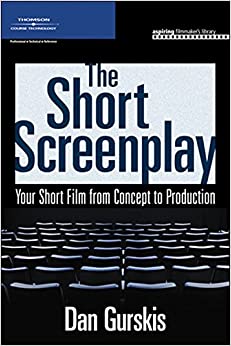
    The Short Screenplay: Your Short Film from Concept to Production

    Before you run, you must walk.

    Before you write a feature, I highly recommend you write a short film.

    A short film can range anywhere from 1 min to 45 or so, but usually around 5-10 mins is the common format that can find itself programmed into film festivals. That’s the sweet spot, so you might want to look in that range specifically.

    Find it here.

    Save the Cat! The Last Book on Screenwriting You’ll Ever Need

    Often touted as the “Bible of Screenwriting,” Save the Cat! is a famous book on the craft. This book takes a more Hollywood approach to screenwriting that’s beneficial for those wanting to understand the formula of most popular films.

    From the initial idea, to creating a beat sheet to marketing your script, Save the Cat! is a great resource to dive into.

    the book’s strength lies in its foundation of the formula of story arcs and organizational tools such as the beat sheet, so this is definitely a book you should check out.

    Find the book here.

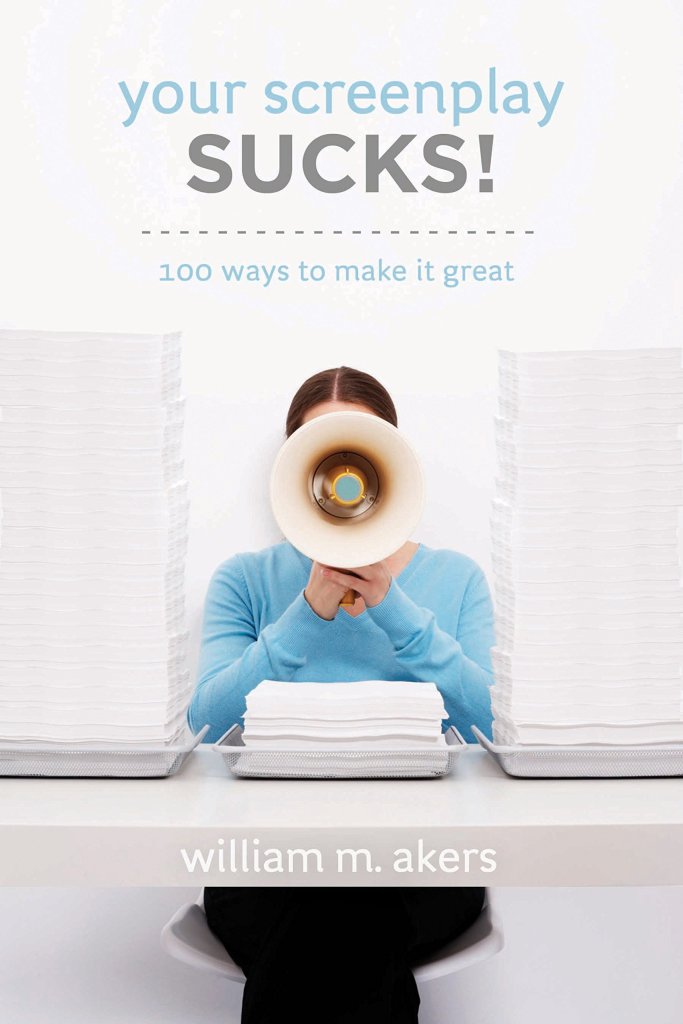
    Your Screenplay Sucks! 100 Ways to Make it Great

    I always send this book recommendation with the disclaimer “This is by no means a commentary on your script!”

    This book is broken up into digestible chunks that go into details on common problems and how to fix them. This book explores structure, the nitty gritty of story and other details that might have been missed during your first draft, such as a deep B story or multi-faceted characters.

    Find the book here.

    Crafty TV Writing: Thinking Inside the Box

    This is the book for any sort of TV writing. Here you learn about the particular format of broadcast television writing. TV writing is a different game than writing a feature by a long shot, as it pertains to act breaks, teasers, tags, and how to best tell a joke (the funny word comes last!).

    This book also has a meaty section on agents, navigating the world of spec script writing and pitching.

    Find it here.

    Honorable Mentions:

    The Coffee Break Screenwriter: Writing Your Script 10 Minutes at a Time. Find it here.

    Secrets of Film Writing. Find it here.