How to Avoid Film Job Scams – Take Five

It would be a full time job for me to update this blog everytime I find a scam posted or someone I know shares a scam they found with me. There’s no way to keep up. My overall goal is to equip you with the know-how to see the red flags and avoid being scammed at all costs.

Sometimes I can’t name names. There’s a few reasons for this:

  • scammers can also be identity thieves who stole someone’s picture and name. You don’t want the real person to get in trouble.
  • It’s just a fake made-up name that will evaporate anyway. Like one I covered, Jake Smith became Jeffery Cooper became Ethan Snith.
  • Maybe I’m wrong. Or maybe the poster is just inexperienced and went about things the wrong way.

I do however want to bring the following items to light, and also reinforce the red flags you should look out for when vetting a scam job post.

Red flags to look out for when vetting a scam:

  • bad grammar/spelling
  • incorrect film terminology. (I.E. Production Assistance instead of Assistant.)
  • unusually high rate or weird weekly rates/hourly rates for usually a day rate job
  • Job poster turned off commenting on the post. That’s usually because people started getting suspicious and asking the right questions.
  • large blocks of text that ramble on about the proposed job.

You can also do your due diligence by briefly looking into the job poster. Do they have no Facebook friends? Did they recently make an account, or change their name and profile pic? Did they post a very similar job in multiple groups with different dates?

Now these things don’t guarantee a scammer, but if you checked a few of them off a list, that’s a real good indicator.

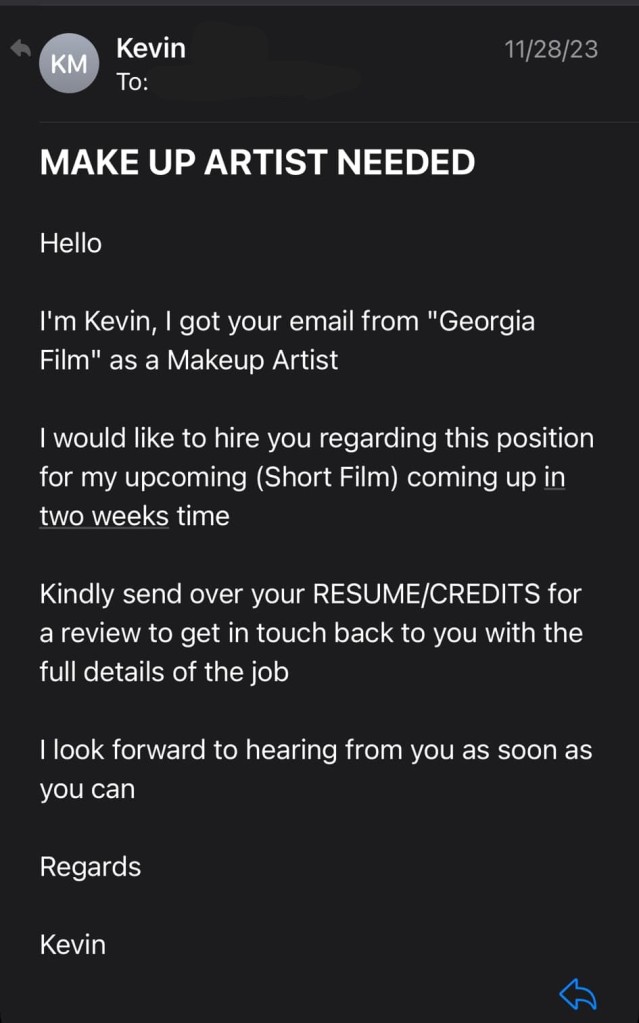
Kevin – But Not Really

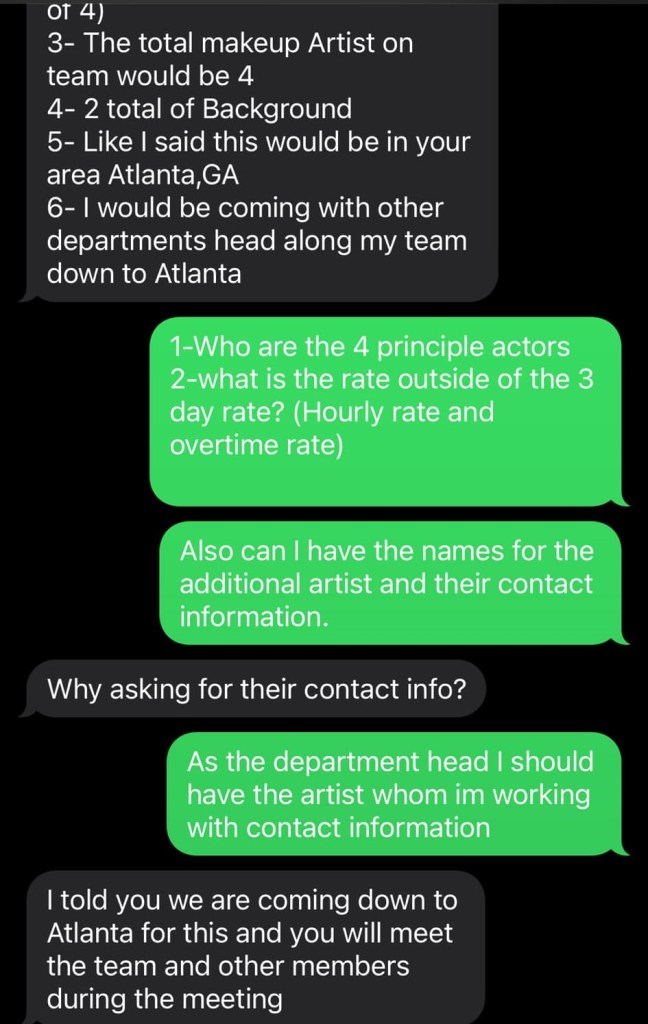
An Atlanta makeup artist was contact by a legit enough sounding job poster. They used a real person’s name who is in no way connected to the resulting attempted scam, so I deleted the last name.

It uses a familiar format: Fake Kev contacted the makeup artist saying they found their info on “Georgia Production website.” Sometimes it’s called a film directory or similar, but a lot of scams used this “I found you on (something that doesn’t exist).”

They also said “Kindly,” “regards,” and “send over your resume/credits.” which are all things I’ve seen a hundred times in these scam emails.

Although our makeup artist was excited at the opportunity to department head on a project, they kept a cool head and did their due diligence. They asked for a deal memo, tax docs and contact info for the additional makeup artist. This is all normal, good stuff to check on if you’re offered a job.

Then this mystery job poster sent a $3000 check to the makeup artist’s home….from an electrical company.

Folks, never, ever receive payment before a job. It is a check phishing scam. After that check goes in your bank and you immediately withdraw the funds for some equipment they ask you to pay for or, in this case, hiring an additional makeup artist, the bank finds out a day or two later that the check is fake and now you’ve sent your own money right back to the scammer.

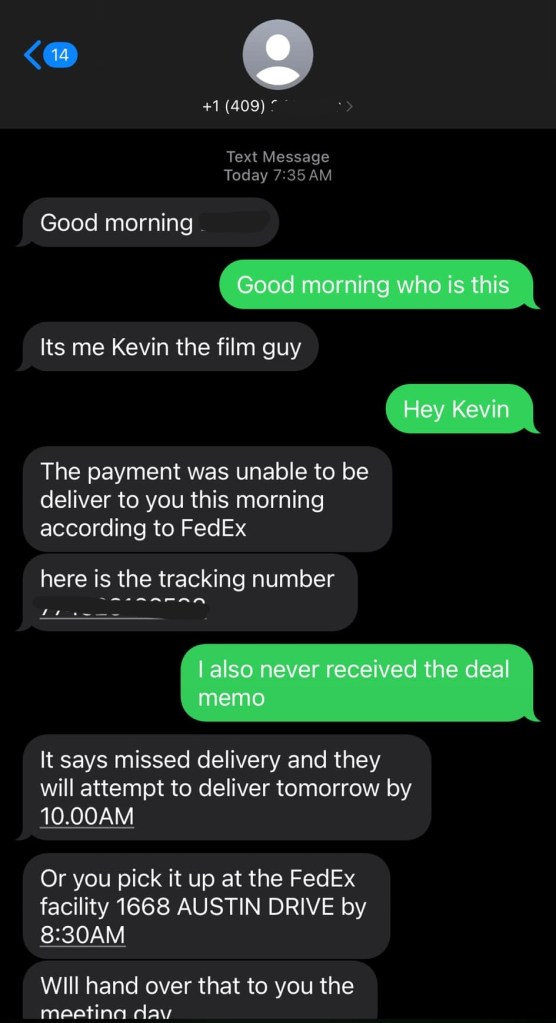
“It’s me Kevin the film guy” said the scammer

Our makeup artist did not get scammed because they knew when things weren’t adding up.

The scammer tries to guilt the makeup artist by saying they already confirmed (they didn’t) and trying to place blame on them for not stipulating a lack of deal memo was a deal breaker. And the scammer clearly didn’t know what a deal memo was because they proceed to call it a “demo” a couple times.

Sometimes these scammers know just enough about film to get by, but their story falls apart very quickly when a professional digs in.

Also note the poor grammar that indicates a non-native English speaker. “The payment was unable to be deliver,” “I will hand over to you meeting,” “You should have tell me this.” Look, I get it scammer, using past tense is hard. But if you want to make the Duolingo owl happy, you have to at least try.

Cinebyte

This one is posting a lot so I wanted to bring it to everyone’s attention.

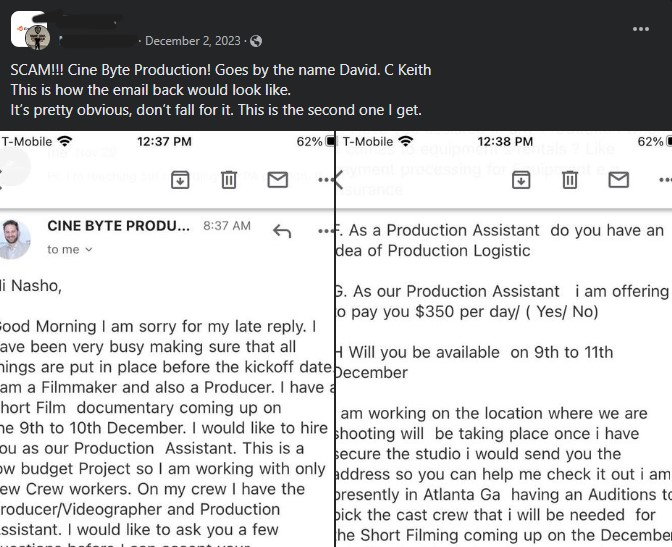
Another crew member in a Facebook group called out Cinebyte Productions as a scam, even posting the highly suspect email he received from the company.

The email is full of bad grammar and is just a huge block of text. I’ll reiterate what I’ve said in the past. When you are a professional in the film industry and someone offers you a job, it usually starts. “Hey, so-and-so recommended you. Are you available to cam op a scripted series in May?” And then you proceed to get more details on further communication.

The Cinebyte job postings are posted by several different people (or the same person using different names, isn’t this fun?). They also use multiple emails. So far I’ve seen: cbytefilm@gmail, lanawilson496@gmail, cinebyteproduction3, etc.

The postings are fake but the company is real. Someone stole David’s name and pic and the company name to seem legit.

I wanted this entry to end here. Guys, I’m tired of chasing these scams. I just want to catch non-Pokemon branded creatures in Palworld and relax for once. But there’s one more I’ve got to cover.

The Music Video Scammer

I’ve covered another shapeshifter before. He went by Jake Smith, Ethan Smith, Jeffery Cooper and every version of those names. Now we’ve got this guy.

Someone named “Eric” (but not really, follow along) posted this job for a PA on a music video. Responsibilities included driving talent and “on-set assistance” (groan).

A number of PA’s hungry for work fell into this supposed job. I learned they did do some driving around, but it became apparent that things were not on the up-and-up. PA’s were expected to pay for lunch, pay for an iPhone SE and headphones. They picked up Ken, a man who was supposedly in a car accident and couldn’t drive himself around. I suppose Ken, who claimed to be the rapper’s manager, the contact they were driving around, hair/makeup artist who, on closer inspection, might not have been an actual HMU. The driver/PA did three days of pickups/drop off’s to such places as a park in a seedy neighborhood, Cookout and, amazingly, Dave n Busters.

Every PA who responded to and did this job (it must have been more than the 3 days, as multiple people were scammed), did not get paid and were ghosted by Ken/Eric.

So Ken/Eric got called out on Facebook, and not long after he changed his name and profile picture to Chris, copying another real filmmaker’s profile pic and image, and posted this job:

I wasn’t ready to post the blog when this went up, so I immediately posted right after this that “Chris” was the same guy who scammed the music video PA’s. Within minutes, “Chris” deleted or changed his Facebook again. Whatever identity he picks next, I’m sure he and many others are out there ready to scam again.

A lot of our scammers are overseas, trying to steal your account information or get you to send them equipment and you’re out the money. But some scammers do this up close and personal. Let’s keep our community safe and keep each other informed.

Previous posts on this topic:

New Year, Same Old Film Job Scams

How to Avoid Film Job Scams – Take Four

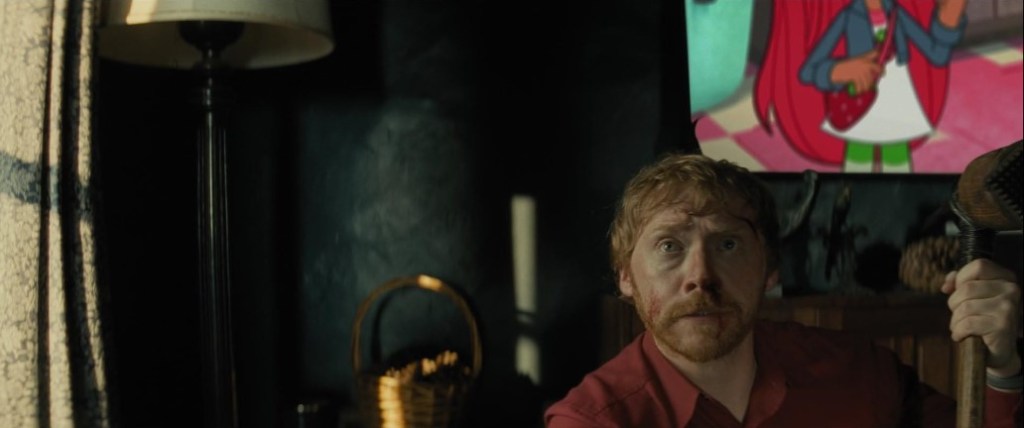
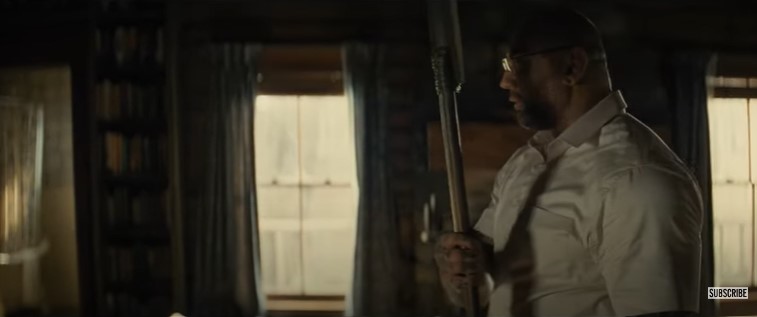
Unusual Shot Design to Evoke a Tone: Knock at the Cabin

My film professor Bear Brown would always say “Never stop learning.” We do this by practicing the craft of cinematography, reading about it, learning new technologies, and dissecting movies and TV to understand what was achieved.

Let’s look at the shot design of M Night Shyamalan’s Knock at the Cabin together!

While vacationing at a remote cabin, a young girl and her parents are taken hostage by four armed strangers who demand that the family make an unthinkable choice to avert the apocalypse. With limited access to the outside world, the family must decide what they believe before all is lost.

Anamorphic Lenses

Let’s dig into how I knew this film was shot on anamorphic lenses even though I can’t find any solid info on which camera or lenses were used.

All I could find was that Shyamalan wanted a 90s horror-thriller vibe and filmed with lenses from the 90s. These were used in flashbacks primarily. We could have had a mix of lenses and cameras for different scenes. That’s something the Directors of Photography (2 in this case) and the director would hash out. Ultimately it boils down to what the right tool is to tell your story. Given the unsettling feeling of the narrative, using anamorphics does make sense.

Anamorphic lenses capture twice the amount of horizontal image as a traditional spherical lens. that image is then de-squeezed in post production editing to get the final image. I’ve done a couple Steadicam gigs on anamorphic lenses now and it’s always a weird feeling seeing that strangely square image squished onto your monitor. (You then of course go through the monitor settings and get it de-squeezed so you can see what the final image would be).

Anamorphic lenses have unique properties. You can get fun J. J. Abrams style lens flare, oval-shaped bokeh (instead of the usual circular bokeh). They also feature reduced sharpness (focus is not always perfect!) and increased distortion of the image around the edges.

I mention all this not just because of the beautiful bokeh I witness in the background of certain shots….

look at those pretty bokeh ovals

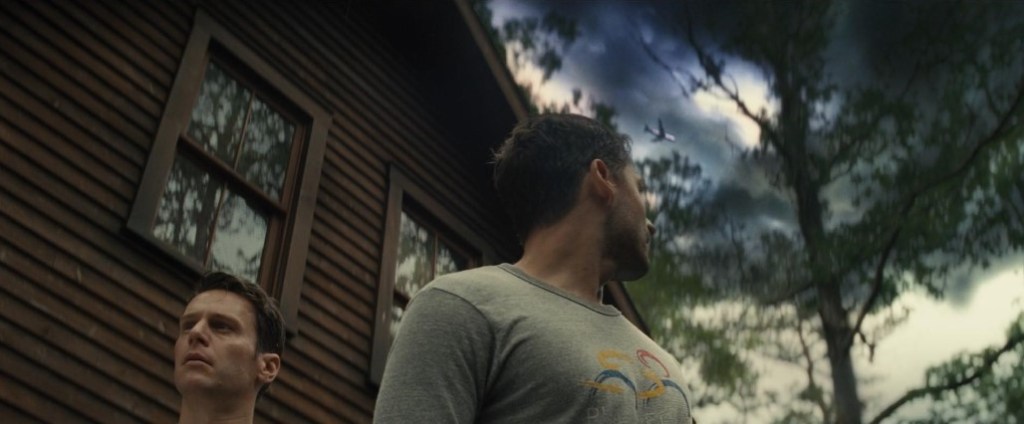
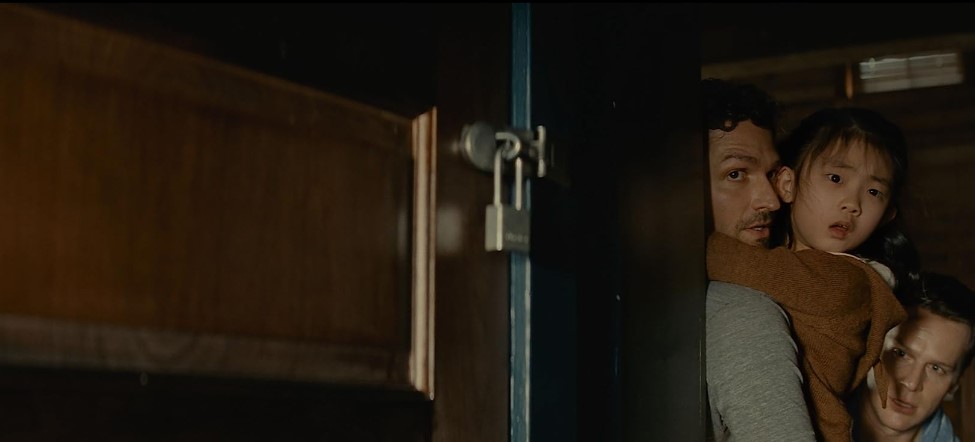
… I also say that because it motivates the characters to be up front and center-framed more often than on the sides. There are a lot of shots where characters are center framed. The viewer’s focus goes to the center and everything else is set dressing for whatever the center of attention is.

You also notice distortion if you look at any straight lines, such as doorways, bookshelves, etc. The lenses make them bend away at an unnatural angle. As you’re watching a film with this lens, you don’t typically notice this if you’re not looking for it. Your mind is focused on the story and characters and subtly translating this background information to be a little unsettling or off-putting.

A lot of other shots, however, were framed predominantly on the right. This is interesting because assuming you read left to right, you would look at the image from left to right, even if it happens in an instant. Often times, an important character will be on the left of the screen. Or you may have an equal distribution of shots that are framed left, right, and center. What made these right framed shots stand out was the sheer number of them. When things weren’t centered, they were right of frame.

I believe this was to keep things off-balance and to give the viewer time to scan the image before settling on the subject in frame.

Camera Movement

The use of camera movement was very intentional in this film. Most of the time, it felt like the camera was attached to whatever it was following, like Leonard’s low shot of his feet walking in the woods.

You can see that walking shot in the beginning of this clip: https://www.youtube.com/watch?v=Pgk1VGlWiDI

Another great shot, which I can’t find a clip of, is when the parents are confronting the people who invaded the cabin. the camera is basically stuck to a close-up on the parent’s face as he circles in the cabin. It was probably accomplished using a snorricam technique. A snorricam is a device that mounts a camera directly to an actor. Think “way too much effort for a selfie.”

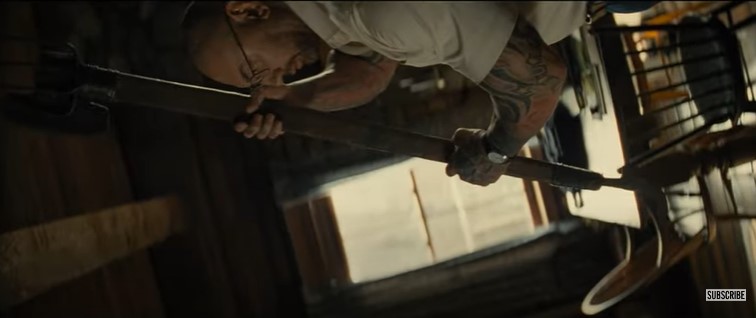
Even better was this really cool shot of Leonard swinging his weapon. The camera movement is perfectly timed and matching the angle of the axe coming down.

Big spoiler if you see the video of this scene, but here’s Leonard swinging that axe: https://youtu.be/p3Zth0YEn5A?si=07_S3tmxakWRlmrF&t=147

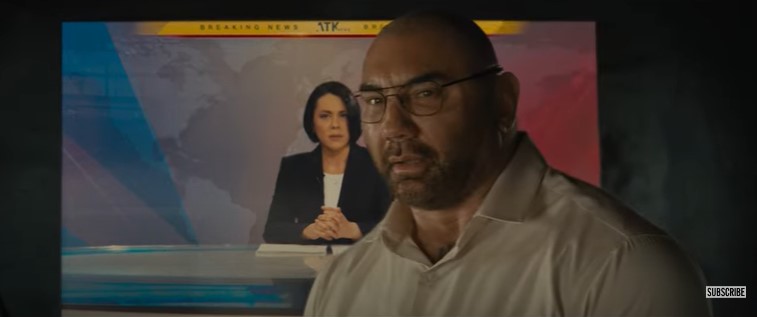
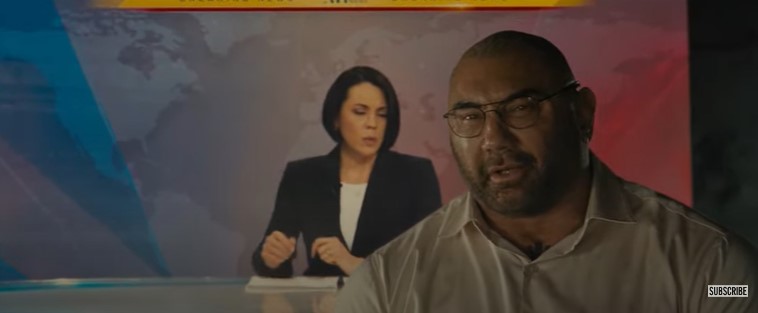
The DP’s also used a famous technique of a zoom-dolly (ala the famous beach scene in Jaws) to underscore when Leonard is proving that his doomsday story is real. The technique is achieved by utilizing a zoom and pushing in or away from an actor at the same time. The resulting distortion creates an uncomfortable feel that warps reality around the character. Pretty cool!

Look at how the perspective of the TV behind him changes over the course of this shot.

See that zoom-dolly in action here: https://youtu.be/xf8ILZnoSr4?si=wDYOefTrl0ymYX_n&t=74

Details hidden in the background

There’s a flashback to when Andrew and Eric adopt Wen from China. I used Google Lens to translate this text: “Children, when we love others, we should not only love them with words and tongues, but also show them in actions and sincerity.” It directly ties into what Leonard says about this couple having to choose who should die in order to save the world.

The blackboard in the cabin had a few questions on it. I started looking at it but didn’t really think about them until I came across this screenshot.

The questions are:

  1. Who invented chess?
  2. The first color named?
  3. Why school buses don’t have seatbelts?

The answers to those questions, when searched are:

  1. Uncertain. The origin is unknown though it likely originated from the Indian game of chaturanga.
  2. Light and Dark (White and Black). In almost all languages this is the case.
  3. They are bigger, heavier, and sit off the ground. Buses protect kids through compartmentalization.

In this small detail, we see nods to our Indian director (Shyamalan), the concept of light and dark (good and evil) and the safety of many. It directly speaks to the film’s themes and it’s just a thing in the background you might miss as you’re watching the action of the film take place.

Credit to the DP’s Jarin Blaschke and Lowell A Meyer for some really interesting work.

So is the movie worth watching?

Eh, well that’s up to you. For the purpose of seeing these shots in action? Sure. I like the unique way this film was shot, obviously enough to write about. But upon finishing the movie with a friend, we were both left with a bunch of questions and a puzzling sense of “was this movie good or not?” The movie both under- and over-explains the premise. I don’t get answers I want. I’m left wondering if certain actions were necessary. I think the bones of a good story are there, probably present from its beginning as the 2018 novel Cabin at the End of the World by Paul G. Tremblay. Shyamalan’s script version is reminiscent of the awkward dialogue I don’t like in his other movies. Maybe I’m biased. I’m still mad about The Last Airbender and annoyed that I wasted time watching trees blow gently in the breeze in The Happening.

Sources:

Knock at the Cabin – Prime

What are Anamorphic Lenses? – PhotographyLife.com

Anamorphic Lenses: The Key to Widescreen Cinematic Imagery – BHPhoto

Small Details You Missed in Knock at the Cabin – Looper

SAG-AFTRA just threw their Voice Actors under the A.I. bus

2023, the year of the strikes.

The combined writer’s and actors strikes, WGA and SAG-AFTRA respectively, won workers more residuals and consulted the affected workers on issues of A.I. usage.

Then, yesterday, SAG-AFTRA dropped this bomb and acted like it was a good thing:

SAG-AFTRA and Replica Studios Introduce Groundbreaking AI Voice Agreement at CES

Replica Studios (Replica), an artificial intelligence (AI) voice technology company, and The Screen Actors Guild – American Federation of Television and Radio Artists (SAG-AFTRA) announced today the introduction of a groundbreaking AI voice agreement during an event at CES….

This new agreement paves the way for professional voice over artists to safely explore new employment opportunities for their digital voice replicas…

The agreement between the leading AI voice company and the world’s largest performers’ union will enable Replica to engage SAG-AFTRA members under a fair, ethical agreement to safely create and license a digital replica of their voice. Licensed voices can be used in video game development and other interactive media projects from pre-production to final release.

http://www.sagaftra.org

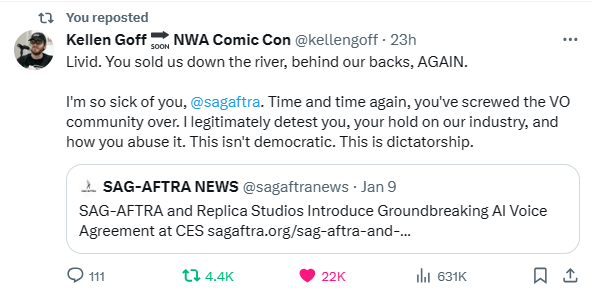
I like that they used the words “fair, ethical, safe” to describe how they were stabbing their membership in the back.

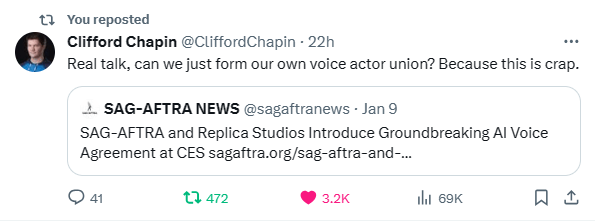
Why do I think that this went behind SAG-AFTRA membership’s backs? Simply because I found out about this because of how many voice over artists called it out, saying, “We didn’t vote OR hear about this. What the hell.” (paraphrasing)

Kellen Goff: Voice actor Five Night’s at Freddy’s (videogame), My Hero Academia, Attack on Titan, Black Clover

Elias Toufexis: Voice actor Starfield (videogame), Deus Ex: Mankind Divided (videogame), Blood of Zeus

Clifford Chapin: Voice actor in My Hero Academia, Attack on Titan, Spider-man 2 (videogame)

The technology already exists to sample someone’s voice and create a pretty convincing, if not soul-less replica of their voice. This isn’t only un-creative, it’s also completely un-ethical. This argument has also come up with the advent of deep fakes.

“Typically used maliciously or to spread false information.” Such as when someone made a deep fake of House Speaker Nancy Pelosi to act like she was impaired. Deep fakes can make it seem like anyone said anything, and that’s very damaging. And do I need to remind you how wrong it is?

Circling back to voice actors, what does this entail? Doesn’t the deal with Replica Studios just give voice actors the ability to sell a digital imprint of their voice? This could be interpreted as the actor’s choice.

This issue was also brought up by SAG-AFTRA membership last year, when it became clear that production companies wanted to pay background actors a one time fee to digitally scan them, and then use that image in perpetuity. That’s forever, babe. That’s multiple thousands of dollars that person will never be able to make. That’s a likeness of them out there that could be made to do anything.

“But, I can’t afford to pay an artist/actor/voice actor/graphic artist for their work! I have to use A.I.!”

What did you do before the days of this technology? Several options: 1. Save up the money or fundraise so you could do your project. 2. Take the time to learn the skills yourself. 3. Reach some kind of deal with the artist you need, like bartering services in kind or deferred payment.

“But Bridget, you say. You don’t work in voice over or animation or videogames.”

I know, anonymous person in my head, but here’s the thing. When you attack one artist, one creative profession like this, you attack us all. And I like videogames and animation and artwork and writing, so I’m going to support the people affected and continue to fight for them.

Hey it’s not all bleak. Recently Wacom (a well known drawing tablet manufacturer) had to apologize for accidentally using AI imagery in their ad campaigns. This cute dragon image falls apart when you really look at it. A tail sprouts from the wrong direction, fur mushes into scales and other weird artifacts are present.

I’m just including the above example, not all 4 that artists uncovered because this post is already bloated.

Artists immediately threw backlash at Wacom. Simply, a company for artists should support them. They had to apologize.

“We want to assure you that using AI generated images in these assets was not our intent.

Here is what happened: Wacom purchased these images through a third-party vendor where it was indicated that they were not AI generated. We vetted the images through a few popular online tools that also indicated that they were not AI generated. However, given the community’s feedback, we are now not sure how the images were created. For this reason, we immediately discontinued their use.”

Wacom’s statement

This $750 Million dollar company can’t claim poverty. They could have commissioned a legion of artists for their marketing campaign.

If you’re like me, you’re going to continue to fight against companies replacing artists with soulless computer interpretations. The next job they take could be yours.

Sources:

SAG-AFTRA and Replica Studios Introduce Groundbreaking AI Voice Agreement at CES

The deal that ended the writers strike: A look at what the 3-year agreement says

Movie extras worry they’ll be replaced by AI. Hollywood is already doing body scans

Doctored Nancy Pelosi video highlights threat of “deepfake” tech

Artists are making creative companies apologize for using AI

A response to community questions concerning Wacom using AI-generated art in US marketing assets

New Year, Same Old Film Job Scams

I use the blog on my website to teach what I know about the film industry. But one topic keeps coming up: Scams. It’s gotten so common that now people just associate my blog as “the scam blog.” My last scam related post was in August, but I’d have enough fodder to update the post weekly.

Here’s an example:

Love that comment.

I highlighted the red flags that should stand out for you:

  • Generally poor grammar: “The dates for a documentary-style TV show for Veles Productions (extra space added) this month are August 21-25.” Also the weirdness of hiring a Production Assistant/Personal assistant, two completely separate jobs.
  • Astronomically high rate for a PA $1500 for 12 hours (and weird added “4 hours per day.”) Day rates for PA’s range around $175-250ish per day (12 hours) depending on the market and type of gig.
  • Must have “terminology knowledge.” What!?
  • Using the word “staff” instead of “crew.”
  • The PA is helping set up “lights, props and tools.” PA is an entry level job and typically shouldn’t be doing any of these things, but as budgets get tight (read: stingy) a lot of places are making PA’s take on extra responsibilities. It’s not great but… I’ve seen it done.

That’s your typical example of a film job scam that’s posted to social media. It could be Facebook, Instagram…heck I’ve even seen scams posted to StaffMeUp and LinkedIn. Nowhere is safe, so always keep your guard up.

I wanted to shift gears for the new year and arm you with two other types of scammy jobs to look out for: Illegal internships and opportunity scams.

Illegal Internships

I’ve worked on a number of movies, tv shows and other projects where we’ve got some newbies working as PA’s who are billed as interns.

Internships have been under fire before in the entertainment industry. A famous case occurred during the production of Darren Aronofsky’s Black Swan. Two interns sued on behalf of 100 Fox Searchlight interns for backpay as they did work as employees, not interns. The class action lawsuit was resolved in the interns’ favor.

But I’ve also run into it on several low budget features and other projects where someone eager to enter the film industry comes in as an intern. Read between the lines — unpaid labor.

Sometimes I make a point to ask the intern “Are you in college right now? Are you getting college credit?” If not, then it gets sketchy. A legal internship benefits the intern alone, through work experience and/or college credit. Typically an employer is helping the intern but not benefitting themselves — well, in theory. But if that intern is doing the work that a full time employee would do? That’s a problem.

If you want to volunteer on someone’s project, that’s up to you. But I wouldn’t ask you to take the title of intern if you’re doing an actual job for someone. I even wrote about deciding whether or not to volunteer on a film set before:

“This is your opportunity!”

The real reason I was inspired to do an update on scams is because I came across this on Eventbrite.

This “event” someone posting that you could work on a faith based film — for the low, low price of $199! That you pay them.

Oh jeez, where do I start with this one?

You should never pay to work on a movie.

I’ve seen this scam before in another form, someone advertising they needed crew for a movie and asking the crew to pay to work on the film. The audacity of this.

Oh also, “star” in a movie? With no acting experience? That’s fishy enough. At best you’d be an extra. Someone sitting on a park bench in the background or filling tables in a restaurant. Not a main character with lines.

Sign up from our website and receive a 25% discount!

Star in a Faith-Based Christmas Movie! No Acting Experience Required. Now available in over 50 major US cities. Bring the whole family!

If it wasn’t clear this was a scam before, I clicked on the website link and saw that the “admission fee” was now $50 (how generous! And also not the definition of 24% off from the original $199) and now the location was listed as another state. Not Atlanta but Venice Beach California, Detroit, Los Angeles, etc. It’s a “pop up filming event” (the heck is that!?) in over 50 major US cities!

Using the word “local.” So many of the Facebook-posted job scams I’ve covered have used terms like “local” or “in your area” so they can scam far and wide. Or there’ll be a weird space before the location or date because it’s clear they copy and paste and change a couple details.

There are plenty of other scammy looking opportunities, classes, events that try to sell the dream of a career in film to new people. If something seems too good to be true or glamorizes the whole prospect of joining a film production, think twice before you submit or pay for anything.

Stay safe in 2024.

Sources:

Fox Settles ‘Black Swan’ Interns Lawsuit After Five Years

More than 40% of interns are still unpaid—here’s the history of why that’s legal

How to Avoid Film Job Scams – Take Four (blog)

5 Reasons for and Against Volunteering on a Film (blog)

The Case for Physical Media in an Increasingly Online World

Many PlayStation users were greeted with this legal notice recently:

PlayStation, due to “licensing changes” is deleting 1200 titles, including those that were purchased by users already, and not offering refunds.

The concept of ownership these days is tenuous. In the before-times, it was pretty clear. If you owned a record, a CD, a DVD…. that’s yours for however long you want it. You could sell it at a yard sale. You could Frisbee it at a neighbor you don’t like. That’s yours for all purposes with certain exceptions for illegal copying or pretending you’re a theater chain and trying to profit off the film yourself.

But as our technology changed, so did the way we consumed our media. Movie rental places were replaced by streaming services. Music aficionados actually pay for Spotify. You no longer have to go to a physical store and find the music you want. You could just yell in your house, “Alexa, play Running up that Hill by Kate Bush.”

Just yesterday I was reminded how things have changed. I was in a Discord with some friends. We were all playing separate games because the Eminem takeover killed Fortnite (don’t judge me) but meanwhile, we were using a bot called Jockie Music to play music for us while we talked. We went through some early 2000s emo, some pop 80s tracks, and on a whim one member played a soundtrack title from Final Fantasy. 800 miles apart, and we were all able to listen to the same music and request what we wanted from a personal digital DJ.

This topic also came to mind recently because I heard Best Buy was phasing out their DVD sales. Then I was in Target for Black Friday and their DVD section was one shelf. In Walmart the same, with the Entertainment section being taken over by tech.

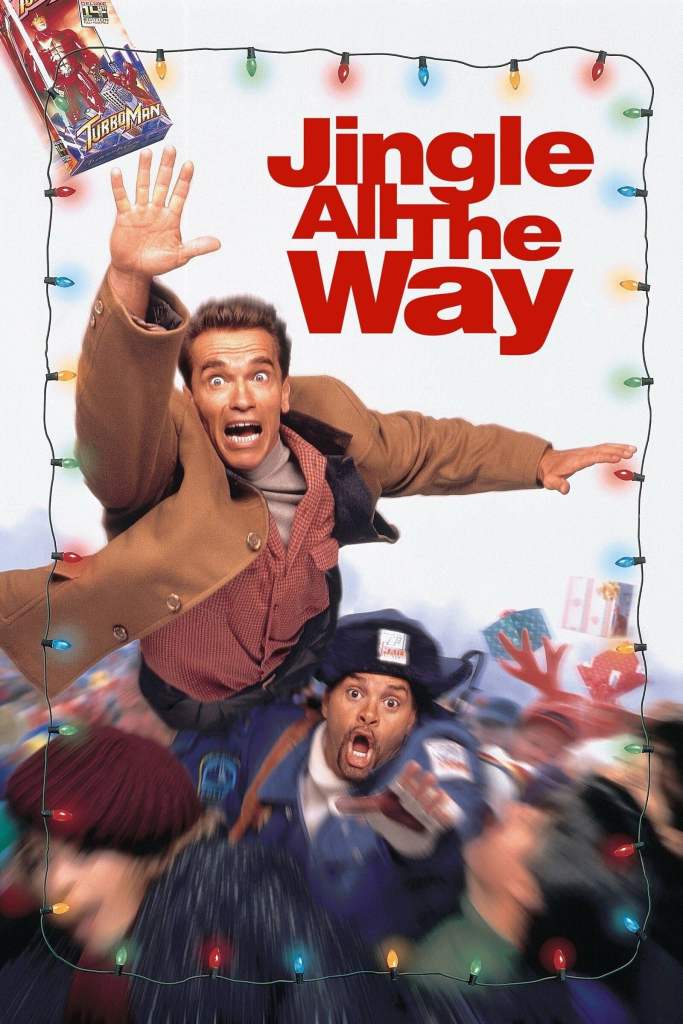
Have you ever tried to look up a movie that is 10, 20, 30 years old and can’t find it? Or better yet, you find it, but it’s not free. You have to rent a movie that’s been playing on regular TV for free for decades. Last year I had a hankering for a bumbling, heavily accented father trying to get his little Anakin Skywalker the hottest toy of the season. I speak of course of the 1996 classic Jingle All the Way.

Pictured here: Me, looking for outdated movies in bargain bins.

I. Couldn’t. Find. It.

I had 4 streaming services to choose from. It was nowhere without having to rent a nearly 30-year-old movie. This year Disney+ has custody, so…cool I guess.

That’s the thing. These streaming services all buy and essentially “borrow” a lot of their content through licensing. They compete against each other. You want to watch all the Spider-mans? And I mean all of them? Good luck finding them all on one service. You can’t even watch the Andrew Garfield movies (all 2 of them) on one service.

Besides the streamers flipping through content like cards in a deck of Uno, you also have the very real possibility that a company will just arbitrarily decide “You know what? We need a tax break.” And they delete their own movie off their service with no physical media to back it up. Gone. That content that cost hundreds of thousands of dollars, and so many people’s time and energy to create… is gone forever.

HBO Max reportedly cut costs last year by deleting 20 shows and movies including those that belonged just to them. That’s content that exists nowhere else.

Surely you’ve also booted up a service like Netflix and started the endless scroll to find something to watch. That’s apparently something these companies are very concerned about. From the previously linked MSNBC article:

“With the coming addition of Discovery+ content, Warner Bros. Discovery executives are concerned HBO Max may get bogged down with little-watched films and shows. That could cause viewers to associate the service with having a lot of stuff they don’t want to watch — the “Netflix problem,” said one HBO Max executive, who asked not to be named because the decision was private.”

Digital content isn’t, necessarily, forever. I feel like the NFT bros have also come to this conclusion.

The case could be made for physical media to experience a resurgence. Heck, record sales are doing well. Yes, vinyl! Vinyl sales were up for the 17th year in a row, though the article I reference did mark a slow in growth, probably due to price increases.

I get it. The way movies have been marketed has been diluted by so many avenues, and folks don’t necessarily have $22 to lay down on a movie to add to their collection. But your favorite movies, the ones you want to go back to time and again? They’re worth it.

Maybe I’ll end this by proposing this ridiculous idea: Physical media on demand. Sure, the vast rows of TV season box sets and various editions of Blu-Ray and DVDs might have to be phased out, but perhaps there should be a way to custom order the physical media you want so it’s only produced when someone orders a copy. Less waste is created. But at least there has to be a way to keep digital copies of movies that were acquired legally. Otherwise, I think the pirates will probably win, and that’ll be yet another struggle in the film industry to fight.

Sources:

PlayStation Store To Lose More Than 1,200 Purchasable Titles – With No Refunds

Where to Watch Every Spider-Man Movie Online in 2023

Streaming services are removing tons of movies and shows — it’s not personal, it’s strictly business

Here’s why HBO Max is pulling dozens of films and TV series from the streaming platform

U.S. Vinyl Album Sales Rise for 17th Straight Year — But Growth Is Slowing

Header image: Photo 26195729 | Dvd © Tonny Anwar | Dreamstime.com

Podcasts that put the strike in perspective

One way I’ve stayed in tune with the impact of the WGA and SAG-AFTRA strikes is through podcasts.

I wanted to share several selections from podcasts I’ve listened to recently that stress the necessity for the strikes in the spotlight. I’m on the crew side, so hearing from writers and actors helps put things in perspective.

I listen through Audible, but I imagine you can find most if not all of these on Apple Podcasts and Spotify.

Scam Goddess -“The Film that Hid Fraud”

Laci Mosley (Lopez vs Lopez) and her guests started this episode talking about the insanity of the markup on wedding things – also known as the wedding tax — and it ended up making commentary on film worker’s lives.

Naomi Ekperigin (actor Mythic Quest  and writer Mrs. Fletcher): “Someone’s like ‘Oh yeah, I’ve seen you on TV.’ Just because I’m on TV… doesn’t mean I want to spend all the money I have on this. You don’t know my life. You don’t know my circumstance. We work in a business too where — okay yeah, it was a good year but we don’t know if it will be next year.”

Mosley: “We up on a whole strike right now! It’s up and down. You never know how long you’re gonna need to save your money.”

The episode then covered an interesting story about the fraudulent film production of A Landscape of Lies, so check out that episode. Laci and her guests are very entertaining.

Listen here.

Deadline Strike Talk – Week Sixteen with guests Gale Anne Hurd and Glen Basner

On this episode, host Billy Ray talked with producer Gale Anne Hurd (Terminator) and Glen Basner (FilmNation CEO), and the talk inevitably turned to the problem of AI.

Gale Anne Hurd pointed out that the concept of AI (like ChatGPT) writing scripts would be just a rehashing of what’s been done before. AI can “theoretically formulate box office successes” that are just copies of what was popular before. “The great age of cinema and television series,” Hurd stated, “was always when there was innovation.”

Basner: “If you look at a distributor like A24, Neon, Bleeker Street — they may be great theatrical distributors and there may be an audience at the theatrical level for those movies, but if they can’t sell their movies to paid TV or streamers, at the levels that they currently are, then the whole economic model upends itself and we have to readjust to say well creatively these may make sense but we may need to make them for 60% of the cost that we have been beforehand and that’s not sustainable in the long term to keep reducing the cost structure of each film.”

Hurd: “There’s gonna be continued consolidation.”

Billy: “If streamers add ads, wouldn’t they have to be transparent about their numbers with their advertisers?”

Hurd: “There have been lawsuits about fake data. About just how many people are actually seeing ads on those platforms. I’m always concerned that metrics will not be reliable. I can’t tell you the number of times I’ve had to sue for profits on my films. Some of my most successful films are still not profitable. If they’re not sharing that data with us accurately, I think they will share unreliable data with advertisers.”

Listen here.

Scam Goddess – The Fake Film for… Feminism?

Laci Mosley’s podcast gets a second mention because of her episode with Abbott Elementary writer Brittani Nichols.

Mosley: “I think that regular everyday people look at the strike and think ‘Oh these are Hollywood writers who live in Hollywood mansions and then have millions of dollars and they want even more?! They’re so greedy!’ Where in truth most writers aren’t super duper rich.”

Nichols: “Correct. Our guild is largely working class.”

Mosley: “And the middle class has been shrinking all our guilds because in SAG you used to make residuals and now streaming’s like ‘We’re not going to tell you how many people watched it.’ “

Nichols: “The entire industry has shifted. Streaming has put a squeeze on the middle class writer and made it harder to move up the ranks. Made it harder for people to have a sustainable career.”

Mosley made the example of an actor who did a voiceover line for Friends and still gets a $300 check each month as it re-airs. with streaming, it’s $0.

Their talk then shifted to AI, another major sticking point for both actors and writers during strike negotiations.

Mosley: “We get paid for ADR [sessions] but with AI, they could do it without us.”

Nichols also countered that the AMPTP (or at least streamers like Netflix) doesn’t want a traditional writer’s room. They want to pay the bare minimum and make it a freelance, gig based environment.

The pay for writers and actors may look high at first glance, but it also takes into account the fact that they might not work again for a very long time. It’s the nature of the business, so if a line isn’t drawn in the sand now, it’ll only get harder for that shrinking middle class actor/writer to survive.

Listen here.

Movies in Focus – $34. Filmmaker Joe Russo Gives Insight Into the WGA Strike

Podcast host Niall Browne invited writer/director Joe Russo (Au Pair Nightmare, Nightmare Cinema) onto the podcast to talk about how streamers treat their libraries, and therefore impact the discussion of residuals. Have you ever wondered why a show just up and disappears? Why a show gets canceled for seemingly no reason?

Russo: “What’s happening with streamers is they’ll run a show for one, two, three seasons maybe and as soon as they decide, as soon as that algorithm decides that show is not bringing in new subscribers, they cancel it. And so the chance to make those residual payments over dozens and dozens of episodes, that’s gone away. They’ll replace it with a new show, a new shiny bauble, to try to bring in new subscriber growth.”

Joe Russo went on to describe that the idea of any long term success is fleeting when streamers can just delete a show off their platform like this. Sometimes they barely get a release.

Russo: “They’ve been pulling things off the platform. There was a Disney movie that was released on Disney+ in May and it came down June 30th. It was on the platform 6 weeks. That’s hundreds of people’s labor, time, 1-2 years of their life invested into this thing for 6 whole weeks. And who knows if it’ll ever be seen again.”

Listen here.

Feel free to check out these podcasts and others to learn more about the strike from the perspective of those walking the picket line.

Networking for Film Makers

I read a book on networking once and realized it didn’t have exactly the information I needed for my own career. But there was some sage advice that could be adapted.

Let’s look at several options for networking in the film industry.

Networking Events

Might seem obvious.

It does make a difference on which networking event you attend.

When I first moved to Georgia, I jumped at the chance to go to meet folks in the industry. I literally went to the first one I saw. It was at some studio and sounded legit. People were encouraged to go up to this microphone, introduce themselves, and mingle afterward. It was so awkward. Everyone there was someone who wanted a job, not anyone who could actually offer one. I ended up making one connection, who ended up humble bragging into making me believe he knew what he was doing. I wasted time prepping a film that fell apart the day before the shoot and I found out they lied and misled about everything. I had to block this person on every form of social media as they got a bit stalkery.

Lesson learned.

So choose accordingly. As a general rule, networking events shouldn’t charge much if anything to its participants. I was at an event that charged $10 to attendees which wasn’t bad. Look at the event, where it is held, and what exactly they’re offering. It may also be helpful to go to more specific events that cater to more narrow criteria, like one specifically for women film makers.

Here are a few upcoming networking events you may want to check out:

April 1 – Class In Session: Creative Industry Mixer & Panel – Free

March 23 – Atlanta Film Production Group – Film Mixer – $10

Other events to look out for in the future:

WIFTA open networking events (open to members and non-members)

Atlanta Film Society‘s Eat Drink and B- Indie Networking events.

Casual Meetups

It’s not all about networking, sometimes it’s just about making a connection.

Film Bar Mondays – Set at a different bar each week, Film Bar is an informal meetup.

Film Brunch Sundays – Another super informal meetup.

Atlanta Script Reading Club – A group of people get together to read and discuss scripts. It’s a new group but I like their chutzpah. They cover screenplays and plays.

Maybe check out some groups on something like Meetup.com as well!

Education

I know I’m not the only one who attended SCAD or a similar film school and referred to it as “Networking School” It really was a trial by fire situation. You quickly built your favored group of film people and made films together. Some of those connections would go on to last into your professional career.

But this isn’t a post about film school. You can see that post here.

Let’s talk about other educational opportunities. A simple Google search or Facebook event search will show you courses and panels you can attend either virtually or in person.

For an entry level course, I’ve heard really good things about both the PA Academy and the Georgia Film Academy, plus I’ve run into graduates on films I’ve worked. Clearly something is working.

Atlanta Film Society hosts a number of great events you can learn from, such as their writing classes, panel discussions and film screenings.

Film Festivals

https://www.filmimpactgeorgia.org/georgiafilmfestivals

Another great way to meet people is at film festivals or screenings! Talk to panelists after a discussion, research filmmakers and talk to them about their work, meet your fellow audience members, go to a social event connected to the film festival. Come equipped with business cards (yes I’m old school) or an easy to share Instagram or Facebook handle so you can connect with people after the event.

I got to DP The Night Courier because the director and I met at a film festival. We contacted each other outside the film festival and said, almost simultaneously, “Hey I liked your film!” and a connection was made. That led to another successful film for both of us.

Working on set

“But I’m trying to network in order to get on set!” You say. I know, it’s a real chicken-and-egg situation.

One great way to meet and network with people in the industry is to actually work on sets, big or small. I’m hard pressed to find a gig I did where I didn’t end up with a phone number, email or Instagram of someone who wanted to work together or connect again in the future.

“Wouldn’t it be cool if we worked together again? What’s your Instagram?”
“Quiet on set. And stand over there.”
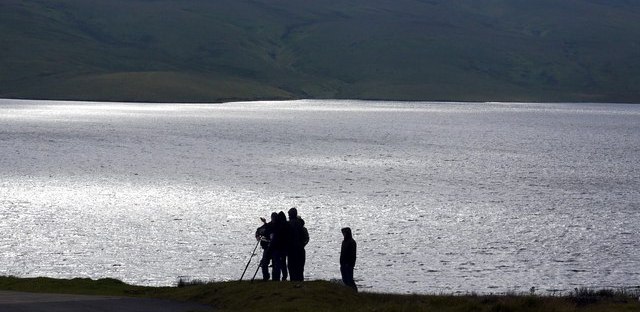
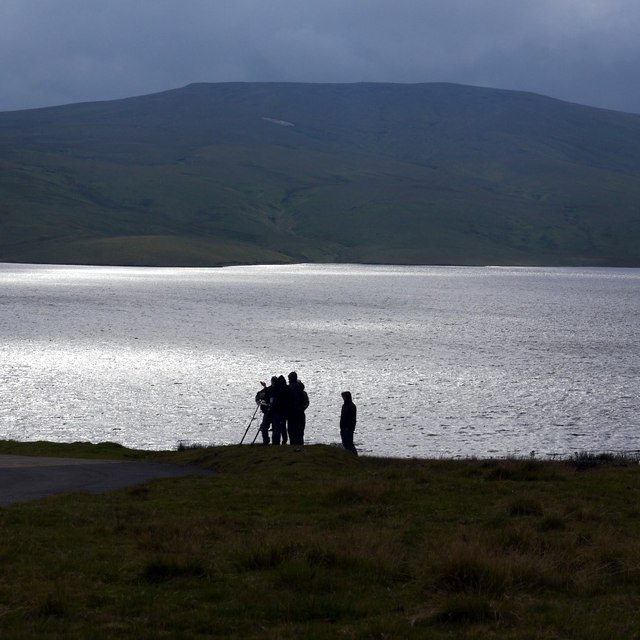
Film crew on location above Cow Green Reservoir by Andrew Curtis is licensed under CC-BY-SA 2.0

I did a lot of the work for you here. Now it’s your turn. Go out and make those connections!

Feast or Famine: Looking at the Stats

It’s the end of February, and all I’ve heard from various film friends is “I’m not working right now, are you?” A winter slump is normal, especially December into January. I just go into these months expecting the slowdown, and for things to pick up in March.

But another kind of work anxiety hits. How much do I need to reach out to jobs before I work regularly? It’s not an easy answer, but looking at my own data, I can see some patterns.

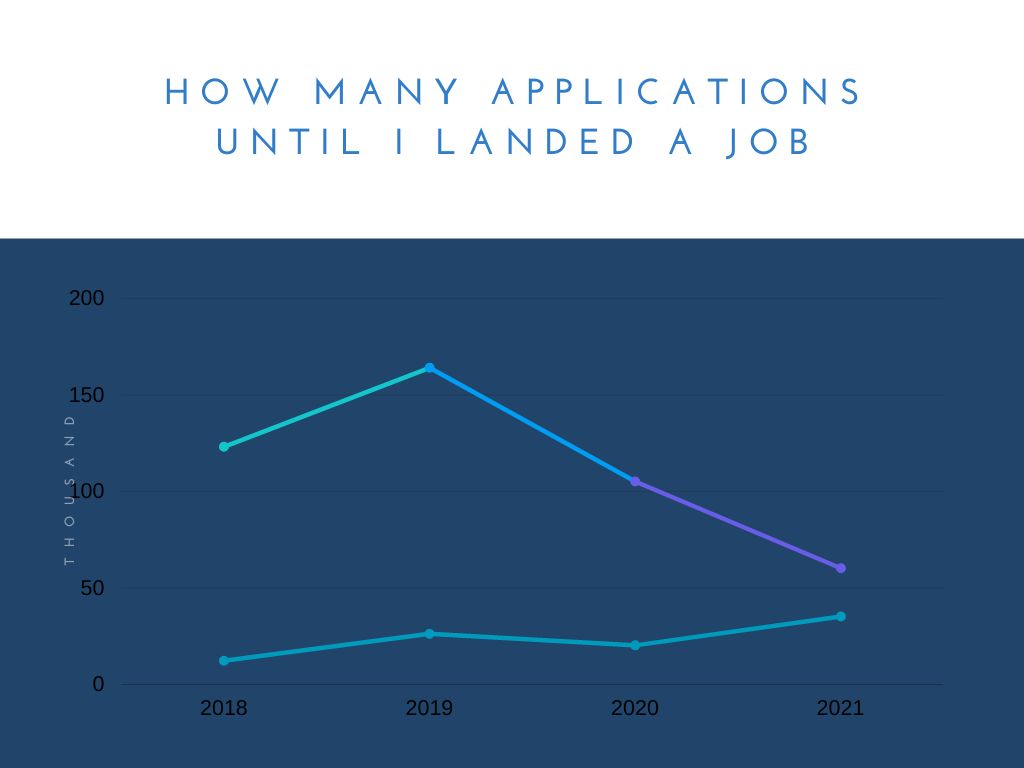
Since 2018 I’ve been keeping track of how many jobs I’ve applied to or been recommended for, and how many jobs I actually got. I meant well, but as times got busy, I eventually lost track or didn’t keep the best data. But I decided, you know what? There’s still something here to see. At least from 2018-2021.

I’m looking at two main things. Gigs applied to, referred to, or inquired about vs Gigs actually worked.

A Handy Dandy Chart

YearGigs AppliedGigs WorkedHow many applications until a job
20181231210
2019164266.3
2020105205.25
202160351.7

Within 4 years, you can see that I went from sending out 10 applications to get to one job, to sending out about 2. Now, I went to art school so I can’t Math all that well, but that looks like a good trend to me.

If I just don’t think too hard about it, the math checks out

I didn’t bother showing info from 2022 because I had several long running gigs and decided not to be Type A about showing what jobs I applied to anymore.

Represented as a hastily thrown together graph on Canva, that looks like:

Top line = Number of applications

Bottom line = Number of jobs landed

Closing the gap is a good thing.

There’s a few things I want you to know about this data.

  1. It takes a lot of effort to establish yourself in a new market. When I arrived in Georgia, I had to do a lot of legwork to start getting jobs.
  2. As time went on, a lot of my applications were actually just recommendations — people recommending me for gigs. When you become known, the work starts coming to you.
  3. I didn’t bother keeping track in 2022 because I was almost 100% working based off recommendations and had several longer runs on shows, whereas previous years I had more day-play opportunities.

If I look at my Google calendar from those years, I see wide swathes of nothing going on for days or weeks during the same slow months. Film is a marathon, not a sprint, and you’ve got to plan accordingly for the slow times. And those slow times can make you feel like you’re beating your head against the wall.

And it’s not just as simple as applying to jobs you see posted on job boards or Facebook groups or throwing your name in the ring for open crew calls.

A lot of the work I did alongside all this was networking, meeting people for coffee, doing casual fun things with fellow filmmakers, helping out on friend’s sets, speaking to students and film clubs, and even writing this blog. Self-promotion is a big deal in addition to applying for jobs. Networking is the glue that holds it all together.

I also applied to a lot of jobs in the slow months of January and February each year. There’s a lot more competition then, because less people are actively working.

This is my way of saying, if it’s slow right now, it’s not just you. It’s a lot of us, and there’s a lot of folks scrambling for the next job.

Keep in mind we’re also on the brink of a possible union strike down the line, and theories have been floating around about productions holding back from starting. I don’t know for sure. All I can say is to hold tight and know that you’re not the only one not actively working right now, and if you’re new — it’s going to take a lot to get yourself established.

This is not an easy industry to get into, but those who have the fortitude to stick through the hard times end up successful.

Sources:

Hollywood Braces for a Possible Writers Strike: Why the WGA and Studios Are on a Collision Course

Someone asked me to give an inspirational speech…

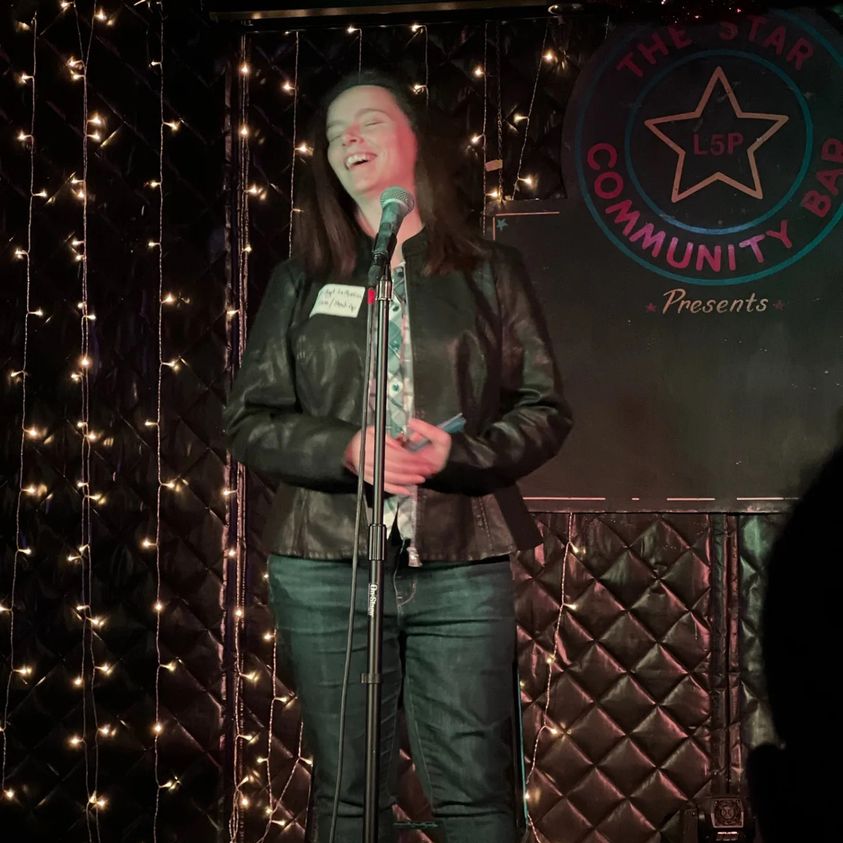
Recently I was asked to speak at the Atlanta Film Production Mixer on Feb 17. It was held at the Star Community Bar in Atlanta.

Organizer Edward Reid told me to prepare 5-10 minutes of “something inspirational, talk about your specialty.”

Never one to underdo something, I wrote a whole speech. I thought it was pretty good, so I’m sharing it here too.

The awkward timing on this photo provided by Marco Gutiérrez.

My name is Bridget LaMonica. I’m a cinematographer and Steadicam operator. 

I graduated from the Savannah College of Art & Design and immediately started working in film, right? Great success. Roll credits. We’re done here.

SCAD – The University for Creative Careers and Existential Breakdowns. Had fun though!

No, not really. 

It took a couple years. Thank God I moved here with a savings because it was months before I started getting paid work, and even longer still before film was truly paying my bills. 

What got me here was not just what I knew, but my personality and work ethic. Yeah yeah, – but hear me out.

If you’re a pleasure to be around and you’re willing to learn on the fly, you’ll go far. My first full run on a show, I was hired as a production assistant. By the end of the first week, I was upgraded to camera PA and stills. And a producer was genuinely shocked I wasn’t a camera assistant already. 

I got my first camera operating job on a feature because I had worked with the DP on several short films. She liked working with me, and trusted me to shoot that feature alongside her. 

90% of the work I get is through recommendation. Your biggest goal is being the one that people like being around. Let’s face it, when you work a standard 12 hour day, the last thing you want to be is the grumpy one everyone avoids. We call those people… oh wait, we don’t call those people. Because they don’t get hired again.

You have to overcome the crushing disappointment of rejection and applying to promising jobs that then ghost you like a bad first date. 

There’s also something else you have to deal with.

You see, after that big step of camera operating on that first feature, I was visiting family for Thanksgiving that I hadn’t seen for a few years. I thought maybe, this was one of those humble brags that would earn me sick thanksgiving family street cred. After I told this family member that I had camera operated on a movie, he winced at me – winced! – and said “Are you happy with where you are in your career right now?”

I didn’t know how to respond. The turkey hadn’t even come out yet.

I’m a camera operator on a movie! How is that not a good thing?

I’ve seen worse.

For every person who claims you can’t have a creative career, who says you shouldn’t bother writing that movie or working on some set… For every person who says “Get a real job” – remember they’re also the ones gushing over the most recent episode of The Last of Us, or listening to music on the way to their boring office cubicles.

Film and television productions spent 4.4 billion dollars in GA alone last 2022. All that content had to be made by someone. By someone like you….

If I couldn’t get past rejection and disappointment, I never would have taken that Steadicam class. I remember putting on the heavy rig we had at school, feeling overwhelmed, and thinking – for a minute there – maybe I can’t do this. But I’m no quitter, and this was just another goal to tackle.

I’m one of the few female Steadicam operators. I know, I know, you figured me for a professional wrestler. I’ve put on Steadicam rigs that made muscle-bound key grips go “Whoa. This is heavy.” I’ve also operated hour long segments on reality TV wearing an EZ rig and ye olde Sony F55 – about yay big of your best friend including the lens. (Imagine hand gesture here).

Eh this is the best photo I got after 2 seasons on the show.

Getting started is the hardest part. You’re here. This is a start. Networking is a big deal in this business. Picking the right projects will set you on your path. Go into each job with the knowledge that your presence could make the entire production better. 

There will be hard days and crazy directors and hilariously bad crafty and moments where you may legitimately question your sanity – but if you keep going, you’ll find yourself saying, “I make movies for a living.” What’s not a little cool about that?

Even if that requires being the old cam op who can fit into tight spaces.

And if it’s a crappy movie you’re embarrassed you worked on? Well, did the check clear? 

I’m not just in the film industry to make films. I’m also here learning, pushing boundaries and helping those who need it, because I was once the one who didn’t know what a c-stand was. Now I hope I inspire the next person.    

One of the ways I do this is through the blog on my website (Holy crap, you’re here already?!). Thanks to my set experience, I write on my website about equipment you should know, how to write a screenplay, and even how to avoid scams targeting film people. That’s a big one for me. I don’t want those who chase their dreams taken advantage of by some jerk. Some jerk in a cubicle.

I’ve had people reach out and thank me for the information on my blog. I’ve had PA’s on set appreciate that I took the time to teach them a skill. It’s that passing of knowledge that makes me realize that I do make a difference, and it feels good.

How to Avoid Film Job Scams – Take Three

This is a perennial post on my blog now.

There are a lot of scammers out there who want to take advantage of you.

This is especially so in a freelance gig worker job where jobs can sometimes be few and far between. Slow times of the year (December into January definitely comes to mind) mean film workers can get desperate for that next job, especially if they’re entry level like a production assistant, and living on a paycheck by paycheck basis. It’s possible these scammers are aware of the slow times for work and we’re going to tap into that later.

These scams can target a person in many different ways. I’ve received e-mails from either very fake sounding names (Vincent TONG) or very famous sounding names (Steven Spielberg, scammers? Really?). I’ve received text messages that claim I was discovered on some film directory and my “skills” are perfect for this job, and I just need to contact them to learn more.

Here’s a common copy-pasted scam I’ve seen under a bunch of names. I’ve actually posted one such version below here so you can compare.

Red Flags? We have many:

  • awkward grammar (non-native English speaker)
  • imaginary profile on “film production directory.”
  • Weird punctuation – “Titled” is capitalized, but the actual film title is inexplicably in parentheses and lowercase.
  • $1800 for a production assistant. Also what’s the rate of pay? Is that supposed to be a day rate?
  • “Stay Blessed” – common in scam e-mails. See also: Kind Regards.

The scammer can also create a fake social media profile, often spoofing a real person’s name and information, and contact you directly or make job posts online to lure in as many unsuspecting victims as possible.

So what is the scammer’s goal? Easy. To steal your money or even your identity.

One of the most common scams targeting film workers is the check cashing scam. Someone asks you to cash a check, saying you’ll get part of it and someone else gets the rest. The check is fake and you’re out thousands of dollars.

Here’s an example of a word-vomit e-mail that is likely the lead-up to a check cashing scam. I blanked out the name of the sender because they were impersonating a real person.

The red flags in this email:

  • It’s too long! My legitimate job emails usually are: “Hi, you were recommended by So-and-So. We have a feature coming up in March and we’re looking for a camera operator. Are you available? What are your rates?”
  • bad spelling/grammar
  • Asking for way too much personal information.
  • $1800 – they like this number, don’t they?
  • Pre-production pay? What?
  • Kind Regards AND Stay Blessed
  • More information section*

*This section is where we have the lead up to the check cashing scam. they’ll likely send a check, it will look real, prior to the job start date. They expect you to put that in your bank account. They either expect you to send money elsewhere at that point, or they’ll get your bank info and clean out your account.

The Federal Trade Commission has an article about fake checks that you should peruse, especially as it explains how scammers get away with these fake checks:

By law, banks have to make deposited funds available quickly, usually within two days. When the funds are made available in your account, the bank may say the check has “cleared,” but that doesn’t mean it’s a good check. Fake checks can take weeks to be discovered and untangled. By that time, the scammer has any money you sent, and you’re stuck paying the money back to the bank.

Federal Trade Commission

Sometimes the scam isn’t even offering you a job, it’s saying you owe someone money. Recently, this message was sent out to union members:

this is where I was going to leave this installment of “Bridget takes on the scammers” but then something happened.

Remember when I said they prey on people who are eager to work or during a slow time of the year?

The following scam is one I received four days after applying for unemployment. This scammer somehow found my email during that process. I spoke with a friend who had applied for disability, and she got the same email.

They prey on the desperate. They prey on the uninformed. Don’t take the bait, be savvy, and stay safe out there.

Have you come across a job scam and want to share? Fill out the form below.

Go back

Your message has been sent

Warning
Warning
Warning
Warning.

Previous posts on this topic:

Common Film Job Scams and How to Avoid Them

Film Job Scams and How to Avoid Them – Take Two