How to Avoid Film Job Scams – Take Nine

On the Facebook film page I help manage, we’ve been getting flooded with scam posts again. They sneak into the group answering the group rules and questions, pretending to be real people, and then they post something like this garbage:
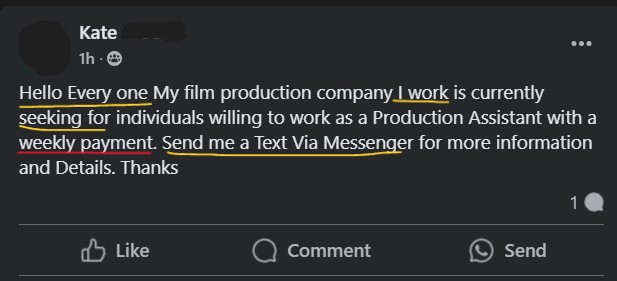
In my annotations, I marked in yellow the bad English grammar usage. In Red we see where it is obviously a scam.

For some reason, the scammers love to advertise a weekly payment.

As I see them, or as they are reported by community members, these scammer posts are deleted and the user is banned. Sometimes I’ll post about it on the page immediately after and hopefully catch whoever might have already emailed the scammer. But since it is nearly impossible to keep up with scam posts (I just can’t be on the page 24/7 people. I know.) my main goal is to educate our populace so that we all know what signs to look for.

Check out this similar scam job posted on a Florida film group:

I’ve redacted some identifying info like the full email and the name of the poster for two reasons. 1: the name might belong to a real person who was hacked or is being impersonated. 2. I don’t want someone mistakenly reaching out to this person.

To be fair, there’s not a lot in this particular scam job post to clue you in, but we will note a few things here before we dig deeper:

In Yellow: Things that are suspicious. One, “we are seeking” has been in a lot of scam job posts, but it is not necessarily only used by scammers. Two, the weird email they are using. Doesn’t look professional at all. But a scammer might use gmail or something that looks like a company email and a real person may be using a weird email. So it’s not a huge red flag.

In Blue: Some misunderstanding of how professional film people work. We see them stating their budget – not necessary for a PA or a Set Medic to know. But some folks might post this (see how this gets difficult to tell a scam job post?). We also have them clarifying that Production Assistants are also “PAs.” It’s nitpicky but you shouldn’t see that kind of explanation of film terms in a job post.

In Purple: I redacted part of the name but I’ll tell you that a lot of these scammers have been using weird, backwards names. Like Smith John instead of John Smith. I think it’s because they’re stealing the real John Smith’s info but reversing the name. I’ve seen this before with Jeffery Cooper/Cooper Jeffery, though the jury is still out if there was a real guy being personified or if this was just a fella using every random name he could think of.

Luckily, we can see what happens after you contact this potential job. I’m redacting their info as well, but we will call them Lily.

Lily applied to the job after seeing it on the Florida film group. Lily then received texts very soon after applying:

In Yellow: Bad grammar.

In Blue: This scammer clearly posted this scam elsewhere, because they mistook Lily as being in Pennsylvania, instead of Georgia or Florida (the group where it was posted). The scammer then immediately disregards Lily asking if the production is in Pennsylvania because they are just responding with a copy/pasted response.

In Red: Here’s the hallmarks of the scam. They try to lure you in with a flexible working situation that “won’t interfere with your current job.” That’s not how productions work! At all! They also talk about the weekly rate here, which I’ve pointed out countless times is a scammer tactic.

In Blue: Here we have a weird misunderstanding about how production works. This is continued in the next screenshot below. This person is telling a PA about a meeting and discussing the synopsis of the movie and all that. A PA would not need to be at that meeting or need that information. I don’t know why they think including this makes it seem more legit. It just makes it clear they don’t understand the film industry.
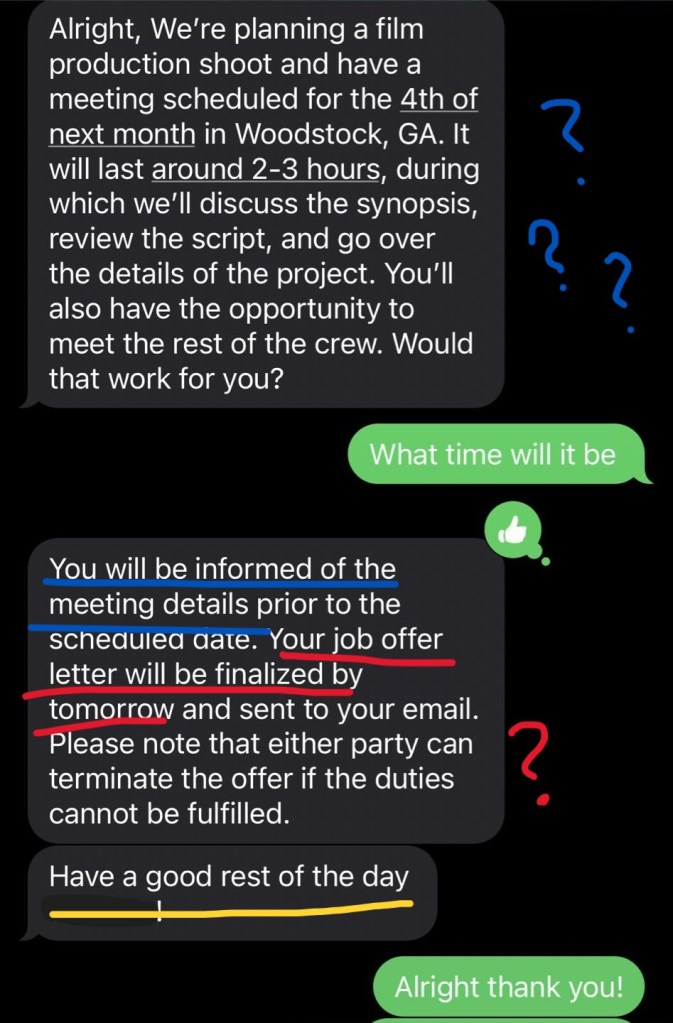
In Blue: Continuation of the weird meeting mumbo jumbo. “You’ll also have the opportunity to meet the crew!” Oh how cute. Typically that’s done on … day one of the production. Like everywhere else.

In Red: More scam red flags. A job offer letter is something a traditional job may give you, but productions are short term. If anything, you should be receiving a deal memo.

If you see a suspicious job post in a Facebook group, make sure you report it to the group admins. And if you start getting suspicious texts like these, check it against the red flags we’ve gone over here and in other installments of “How to Avoid Film Job Scams” in order to best arm yourself against a scam.

Sources:

Federal Trade Commission – Consumer Advice: How To Spot, Avoid, and Report Fake Check Scams

How to Avoid Film Job Scams – Take Eight

Since I began this blog series on scams in the film industry, I started a folder on my desktop whenever I found a questionable job so I could put it in the next entry on the topic.

But… I couldn’t keep up. There’s too many. And the same names will pop up again and again, but new ones do too. There’s no way to truly catalogue them, so the best I can do is show you some examples from time to time, list the red flags, and hope to keep you from being taken advantage of in the future.

Google the E-mail

Scammers are a bit lazy too sometimes. You’ll see the same e-mail used by many different screennames. I’ve been chasing this mikebeebee email since at least July this year, having saved examples of this scam from different Facebook groups. I’m mentioning it now because it’s one of the recent ones to plague a group I manage.

This scam email was also used in July, when I saved these screenshots:

As you can see, it’s multiple names and “jobs” but the same scam email. I did blank out most of the names that posted because it’s likely they are hacked accounts and innocent of this posting. Or they could be completely fake profiles. Either way the most important thing is understanding the details of the scam.

Most recently, this one was posted:

Now, what happens if you apply to the fake job? You’ll likely get this email, with the name changed depending on the fake person you’re communicating with. Email screenshot attached with annotations explained below:

In Yellow: Generally bad grammar and grasp of the English language, so it’s likely an overseas scammer.

In Blue: If you are a professional, you do not need an explanation of how to do your job. This is a complete misunderstanding of how professionals are hired for a film set.

In Green: They use “kindly” which a lot of scammers use for some reason, and they’re also asking for all this identifying information. Probably for identity theft or to further sell your information to future scammers.

In Red: This part is where you know it’s a scam. The guy claims he will pay you $2000 before the job. Never, ever accept payment before a job is done. This is a check phishing scam. They are just trying to steal Your money, which they will do once you see the second part of the red section: “This covers your $1500 upfront payment and the talents'(sic) fee ($4,000) payable to their manager.

This is how the check phishing scam works. They issue you a fake check, and before your bank notices the check is fraudulent, you’ll be issuing a check from your own balance to pay the “talent” who is actually the scammer. You are out at least $4,000 at the end of this scam.

According to the FTC, “Fake checks can take weeks to be discovered and untangled. By that time, the scammer has any money you sent, and you’re stuck paying the money back to the bank.”

Production Assistant Scams

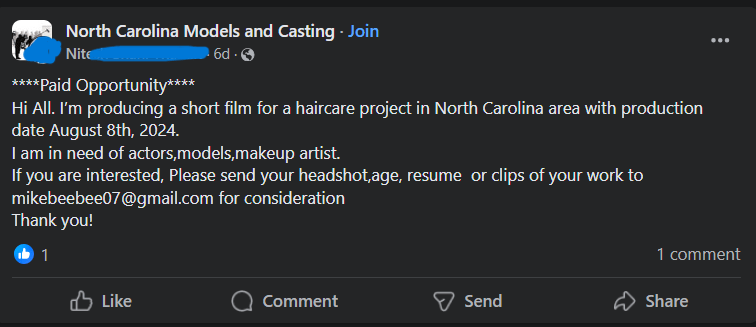
This latest one was brought to my attention by a community member on a page I moderate. I’d had my suspicions about the job when it was posted, but I didn’t have enough info to delete and ban the poster until I received further info.

Here’s why this job looks suspicious at first glance and why I didn’t delete it immediately.

  • Casting call – for a production assistant? You only do casting calls for actors. Crew calls for film crew. I chalked this up to someone green in the industry.
  • Grammar “Seeking for.”
  • 3 days, 4 hours of work for a lump sum payment of $700. Again, I thought this was an inexperienced person who doesn’t know how day rates work. But 4 hours a day is suspicious even for a short film.
  • The poster turned off comments. Scammers do this because they know people will start calling them out in the comments. But insecure people also do this.

I couldn’t annotate this one because as soon as I started, I realized I was underlining the entire thing in red. Let’s look at those emails!

Red Flags:

  • Giant block of text. Most gigs will email at best like two sentences to see if you’re available.
  • Atrocious grammar and spelling. They don’t even spell their email correctly.
  • Wishing you good health. This is America, we don’t have that.
  • Apologizing. For some reason a lot of scam communications start with apologizing for being so busy. Maybe the intent is to make them look like they are in high demand or something.
  • Audition – for a production assistant? Oh no honey. But this detail confirms my suspicion that this was also a copy & pasted scam for an actor as well. Remember how the job post was a “Casting Call”? I bet this same scam showed up elsewhere targeting actors or models.
  • I laughed at “Camera Man.” The term is camera operator. But they probably meant Director of Photography.

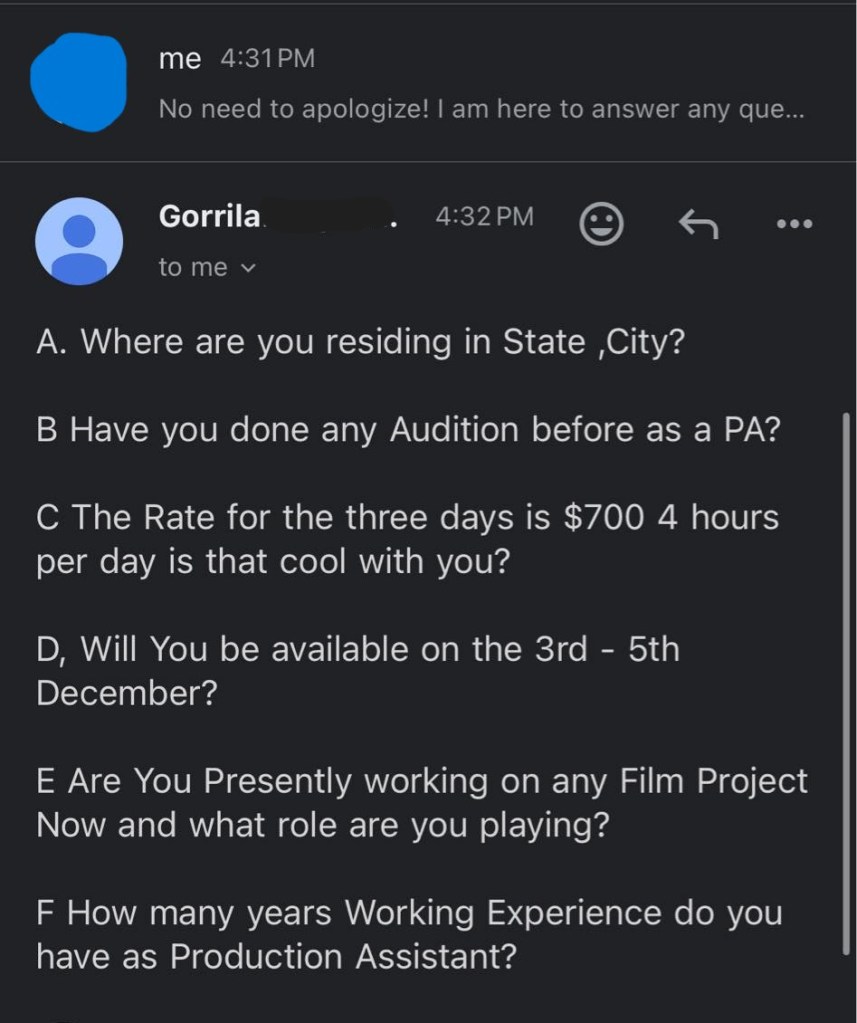
Let’s look at the next email!

Red flags:

  • Scammer asking where you live (including the state).
  • Audition and PA again.
  • “Is that rate cool with you?” No. Because it’s fake.
  • Are you available the dates we already established?
  • Why are they asking what you’re currently working on? This is none of their business.
  • Asking for years of experience for an entry level position.

And here is the grand finale:

Red flags:

  • Advance payment – It’s a check phishing scam!
  • Also… sponsors? Wth.

Thanks to the community member who sent the screenshots and reached out with questions about identifying scams.

Sources:

Federal Trade Commission – Consumer Advice: How To Spot, Avoid, and Report Fake Check Scams

The Evils of the Rolling Take and Reset

Let’s dig into a pet peeve of many on set: the rolling take.

A rolling take is when you keep shooting and keep repeating the action. Like an actor walking in to a room who flubs a line and goes back to start it over again. That can be a valid reason for a rolling take. No need to re-slate and re-call action. Just try it again.

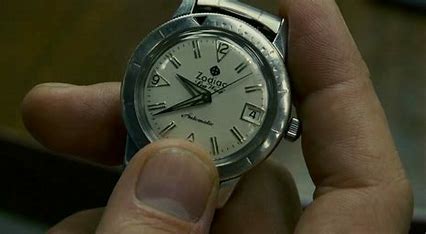
An Insert Shot: A watch being picked up and brought into the frame is a valid reason to do a series of the same action without cutting in between.

A rolling or series take might be done on a particular insert shot to get it right. Let’s say your actor needs to throw a letter to land on a desk just right. The director might ask for a series or rolling take in order to keep attempting that throw to get it the way they want. No fuss, no muss, and no wasting extra setup time to get that insert shot that you’ll see for two seconds on screen.

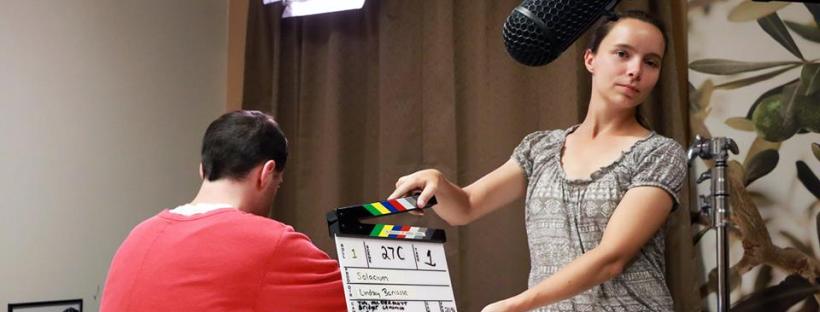
Directors don’t work the slate but I’ll allow this since it’s clipart.

Imagine this scenario: It’s after lunch. The Assistant Director is informing everyone for the third time that you are now an hour and a half behind on the schedule. You have several more scenes to light and shoot and somehow you have to make up a significant amount of time. Hence the anxiety that leads inexperienced directors to try shortcuts. One of those shortcuts is overusing a rolling take.

After experiencing this on a number of films, I’ve observed that green directors love to overuse the rolling take. They’re feeling the pressure and just trying to get footage in the can. The AD, meanwhile, is just trying to make their day. Now suddenly, you’re filming scene coverage as a rolling take, not cutting when you reach the end of the action, but waiting for the actor to reset and just going with it, maybe for multiple “takes.”

A rolling take going on and on is more trouble than it’s worth.

Time = Money

First, what should be obvious — you’re using up footage. This became less of a crisis when most of us went from actual film stock to digital, which is a much cheaper alternative, but digital does not mean free.

Film costs include the film stock, developing, processing, and digitizing so you can edit on a computer.

But just because you can hit “record” on a camera doesn’t mean that doesn’t cost money. Each card needs to be purchased, and you need to have enough available media to get through the day’s shooting without having to write over those cards with additional footage. Ideally, you want your DIT or media manager making backups throughout the day. That means the production also needs to purchase storage and backup storage for that media.

So let’s say you think you know the costs and you’re still cool with doing 40 minute takes instead of a few 5 minute takes. All that footage needs to be downloaded and viewed, meaning you’re paying for the media manager’s time to download that footage and make copies, as well as the editor down the line. A single 40 minute clip is just going to take longer to download and transfer. And you might be paying overtime to the media manager who is staying late dumping all that footage.

Wear and Tear on Cast/Crew

In the moment, if you abuse the rolling take, you’re quickly using up the energy reserves and physical strength of your cast and crew.

You’re also using up your camera operators and 1st ACs and boom ops and everyone doing something physical for that scene that no longer get that tiny bit of rest to reset themselves.

  • The cast has to stay in-the-moment and may get frustrated, flubbing lines more and more.
  • The boom op has to hold that boom pole and actively follow whoever is talking without getting that small break in between.
  • The camera operators might be doing handheld or Steadicam and are using up their muscles faster.
  • 1st ACs, staring at a screen for minute changes in focus, don’t get to rest their eyes.
  • Script supervisors’ notes get complicated as the same scene plays out multiple times in the same take.

When I’m doing Steadicam or handheld, my least favorite thing is a rolling take, especially if it’s long. I just need time to reset. Sometimes there’s an adjustment needed in a handgrip on a shoulder rig or I need to fix the balance on the Steadicam.

Other concerns? Using up batteries! You might be playing beat the clock with what battery you have left in the camera or on the mic packs.

Closing Thoughts

Using a series or a rolling take can be done with purpose. It’s just another tool in your kit. Abusing it can lead you to creating an uncomfortable work environment for your crew. So before you panic and decide to just “roll on everything” look at it critically and see if a rolling take is necessary or if you need to re-evaluate and be more concise with your time.