Unusual Shot Design to Evoke a Tone: Knock at the Cabin

My film professor Bear Brown would always say “Never stop learning.” We do this by practicing the craft of cinematography, reading about it, learning new technologies, and dissecting movies and TV to understand what was achieved.

Let’s look at the shot design of M Night Shyamalan’s Knock at the Cabin together!

While vacationing at a remote cabin, a young girl and her parents are taken hostage by four armed strangers who demand that the family make an unthinkable choice to avert the apocalypse. With limited access to the outside world, the family must decide what they believe before all is lost.

Anamorphic Lenses

Let’s dig into how I knew this film was shot on anamorphic lenses even though I can’t find any solid info on which camera or lenses were used.

All I could find was that Shyamalan wanted a 90s horror-thriller vibe and filmed with lenses from the 90s. These were used in flashbacks primarily. We could have had a mix of lenses and cameras for different scenes. That’s something the Directors of Photography (2 in this case) and the director would hash out. Ultimately it boils down to what the right tool is to tell your story. Given the unsettling feeling of the narrative, using anamorphics does make sense.

Anamorphic lenses capture twice the amount of horizontal image as a traditional spherical lens. that image is then de-squeezed in post production editing to get the final image. I’ve done a couple Steadicam gigs on anamorphic lenses now and it’s always a weird feeling seeing that strangely square image squished onto your monitor. (You then of course go through the monitor settings and get it de-squeezed so you can see what the final image would be).

Anamorphic lenses have unique properties. You can get fun J. J. Abrams style lens flare, oval-shaped bokeh (instead of the usual circular bokeh). They also feature reduced sharpness (focus is not always perfect!) and increased distortion of the image around the edges.

I mention all this not just because of the beautiful bokeh I witness in the background of certain shots….

look at those pretty bokeh ovals

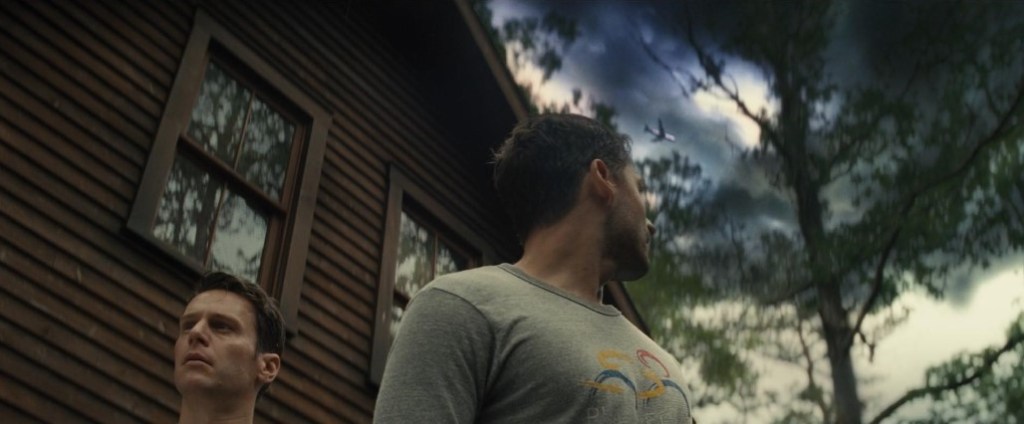
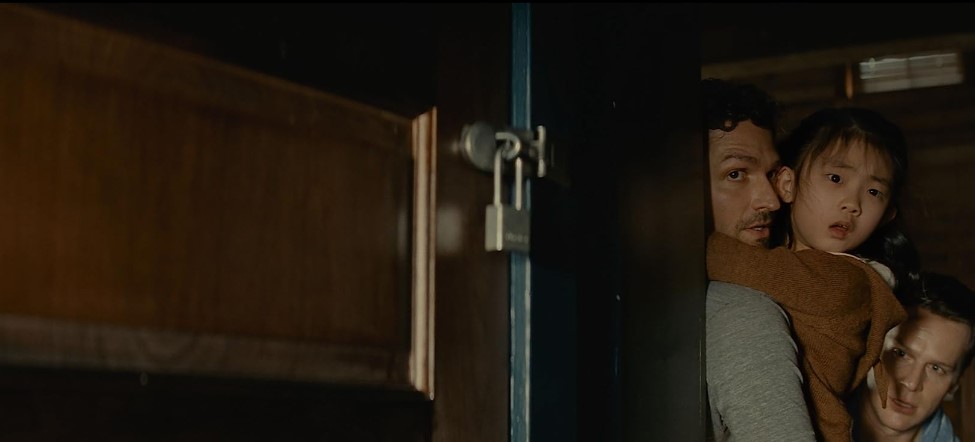
… I also say that because it motivates the characters to be up front and center-framed more often than on the sides. There are a lot of shots where characters are center framed. The viewer’s focus goes to the center and everything else is set dressing for whatever the center of attention is.

You also notice distortion if you look at any straight lines, such as doorways, bookshelves, etc. The lenses make them bend away at an unnatural angle. As you’re watching a film with this lens, you don’t typically notice this if you’re not looking for it. Your mind is focused on the story and characters and subtly translating this background information to be a little unsettling or off-putting.

A lot of other shots, however, were framed predominantly on the right. This is interesting because assuming you read left to right, you would look at the image from left to right, even if it happens in an instant. Often times, an important character will be on the left of the screen. Or you may have an equal distribution of shots that are framed left, right, and center. What made these right framed shots stand out was the sheer number of them. When things weren’t centered, they were right of frame.

I believe this was to keep things off-balance and to give the viewer time to scan the image before settling on the subject in frame.

Camera Movement

The use of camera movement was very intentional in this film. Most of the time, it felt like the camera was attached to whatever it was following, like Leonard’s low shot of his feet walking in the woods.

You can see that walking shot in the beginning of this clip: https://www.youtube.com/watch?v=Pgk1VGlWiDI

Another great shot, which I can’t find a clip of, is when the parents are confronting the people who invaded the cabin. the camera is basically stuck to a close-up on the parent’s face as he circles in the cabin. It was probably accomplished using a snorricam technique. A snorricam is a device that mounts a camera directly to an actor. Think “way too much effort for a selfie.”

Even better was this really cool shot of Leonard swinging his weapon. The camera movement is perfectly timed and matching the angle of the axe coming down.
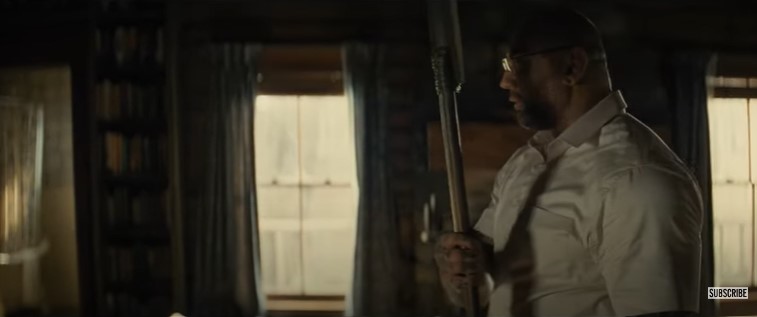
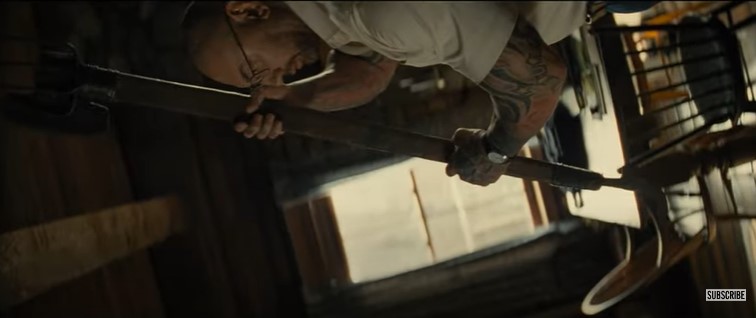
Big spoiler if you see the video of this scene, but here’s Leonard swinging that axe: https://youtu.be/p3Zth0YEn5A?si=07_S3tmxakWRlmrF&t=147

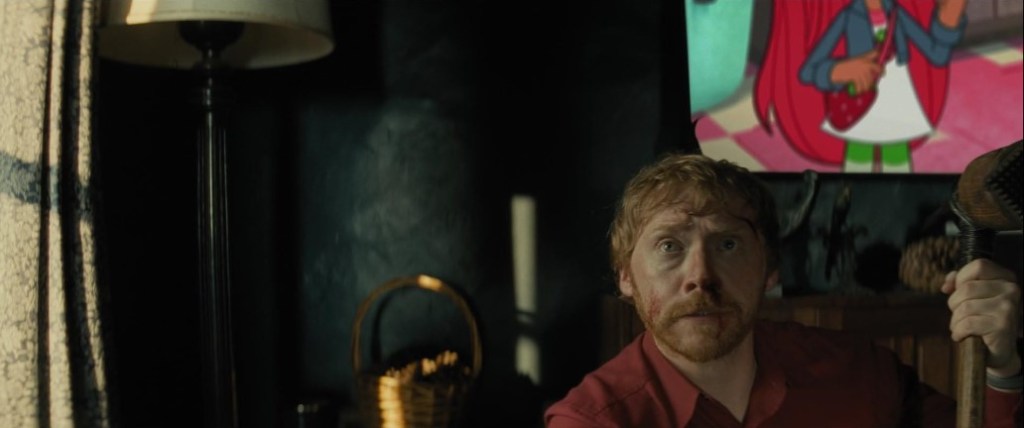
The DP’s also used a famous technique of a zoom-dolly (ala the famous beach scene in Jaws) to underscore when Leonard is proving that his doomsday story is real. The technique is achieved by utilizing a zoom and pushing in or away from an actor at the same time. The resulting distortion creates an uncomfortable feel that warps reality around the character. Pretty cool!
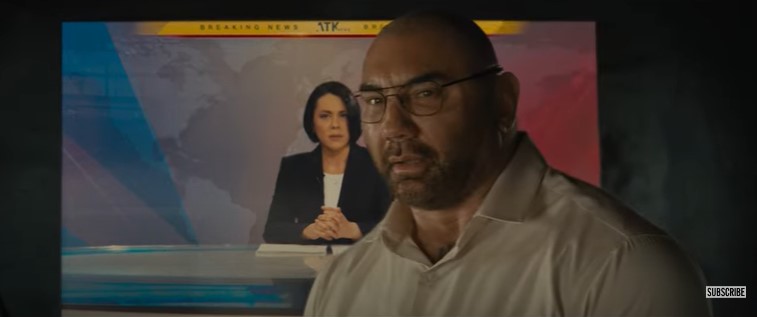
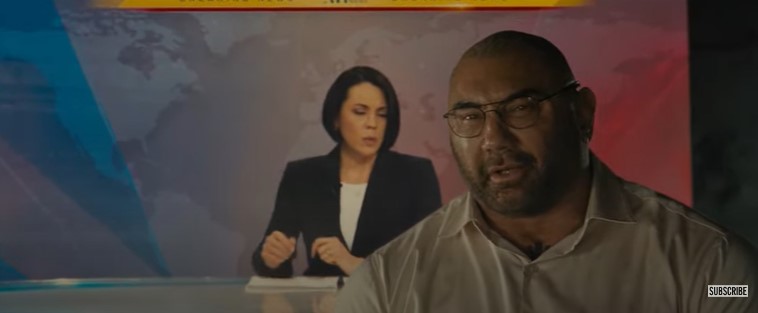
Look at how the perspective of the TV behind him changes over the course of this shot.

See that zoom-dolly in action here: https://youtu.be/xf8ILZnoSr4?si=wDYOefTrl0ymYX_n&t=74

Details hidden in the background

There’s a flashback to when Andrew and Eric adopt Wen from China. I used Google Lens to translate this text: “Children, when we love others, we should not only love them with words and tongues, but also show them in actions and sincerity.” It directly ties into what Leonard says about this couple having to choose who should die in order to save the world.

The blackboard in the cabin had a few questions on it. I started looking at it but didn’t really think about them until I came across this screenshot.

The questions are:

  1. Who invented chess?
  2. The first color named?
  3. Why school buses don’t have seatbelts?

The answers to those questions, when searched are:

  1. Uncertain. The origin is unknown though it likely originated from the Indian game of chaturanga.
  2. Light and Dark (White and Black). In almost all languages this is the case.
  3. They are bigger, heavier, and sit off the ground. Buses protect kids through compartmentalization.

In this small detail, we see nods to our Indian director (Shyamalan), the concept of light and dark (good and evil) and the safety of many. It directly speaks to the film’s themes and it’s just a thing in the background you might miss as you’re watching the action of the film take place.

Credit to the DP’s Jarin Blaschke and Lowell A Meyer for some really interesting work.

So is the movie worth watching?

Eh, well that’s up to you. For the purpose of seeing these shots in action? Sure. I like the unique way this film was shot, obviously enough to write about. But upon finishing the movie with a friend, we were both left with a bunch of questions and a puzzling sense of “was this movie good or not?” The movie both under- and over-explains the premise. I don’t get answers I want. I’m left wondering if certain actions were necessary. I think the bones of a good story are there, probably present from its beginning as the 2018 novel Cabin at the End of the World by Paul G. Tremblay. Shyamalan’s script version is reminiscent of the awkward dialogue I don’t like in his other movies. Maybe I’m biased. I’m still mad about The Last Airbender and annoyed that I wasted time watching trees blow gently in the breeze in The Happening.

Sources:

Knock at the Cabin – Prime

What are Anamorphic Lenses? – PhotographyLife.com

Anamorphic Lenses: The Key to Widescreen Cinematic Imagery – BHPhoto

Small Details You Missed in Knock at the Cabin – Looper

SAG-AFTRA just threw their Voice Actors under the A.I. bus

2023, the year of the strikes.

The combined writer’s and actors strikes, WGA and SAG-AFTRA respectively, won workers more residuals and consulted the affected workers on issues of A.I. usage.

Then, yesterday, SAG-AFTRA dropped this bomb and acted like it was a good thing:

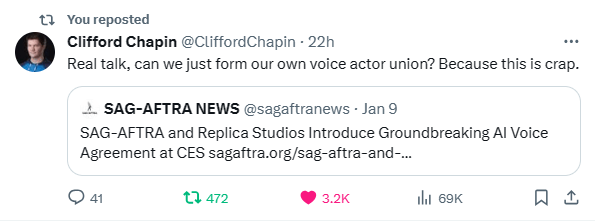
SAG-AFTRA and Replica Studios Introduce Groundbreaking AI Voice Agreement at CES

Replica Studios (Replica), an artificial intelligence (AI) voice technology company, and The Screen Actors Guild – American Federation of Television and Radio Artists (SAG-AFTRA) announced today the introduction of a groundbreaking AI voice agreement during an event at CES….

This new agreement paves the way for professional voice over artists to safely explore new employment opportunities for their digital voice replicas…

The agreement between the leading AI voice company and the world’s largest performers’ union will enable Replica to engage SAG-AFTRA members under a fair, ethical agreement to safely create and license a digital replica of their voice. Licensed voices can be used in video game development and other interactive media projects from pre-production to final release.

http://www.sagaftra.org

I like that they used the words “fair, ethical, safe” to describe how they were stabbing their membership in the back.

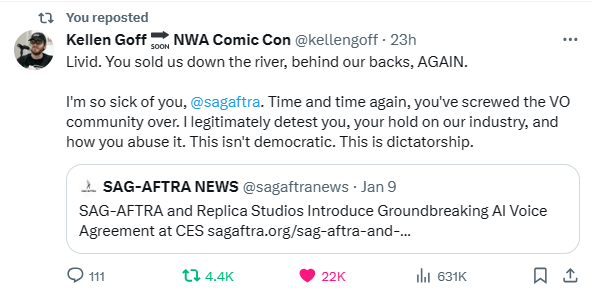
Why do I think that this went behind SAG-AFTRA membership’s backs? Simply because I found out about this because of how many voice over artists called it out, saying, “We didn’t vote OR hear about this. What the hell.” (paraphrasing)

Kellen Goff: Voice actor Five Night’s at Freddy’s (videogame), My Hero Academia, Attack on Titan, Black Clover

Elias Toufexis: Voice actor Starfield (videogame), Deus Ex: Mankind Divided (videogame), Blood of Zeus

Clifford Chapin: Voice actor in My Hero Academia, Attack on Titan, Spider-man 2 (videogame)

The technology already exists to sample someone’s voice and create a pretty convincing, if not soul-less replica of their voice. This isn’t only un-creative, it’s also completely un-ethical. This argument has also come up with the advent of deep fakes.

“Typically used maliciously or to spread false information.” Such as when someone made a deep fake of House Speaker Nancy Pelosi to act like she was impaired. Deep fakes can make it seem like anyone said anything, and that’s very damaging. And do I need to remind you how wrong it is?

Circling back to voice actors, what does this entail? Doesn’t the deal with Replica Studios just give voice actors the ability to sell a digital imprint of their voice? This could be interpreted as the actor’s choice.

This issue was also brought up by SAG-AFTRA membership last year, when it became clear that production companies wanted to pay background actors a one time fee to digitally scan them, and then use that image in perpetuity. That’s forever, babe. That’s multiple thousands of dollars that person will never be able to make. That’s a likeness of them out there that could be made to do anything.

“But, I can’t afford to pay an artist/actor/voice actor/graphic artist for their work! I have to use A.I.!”

What did you do before the days of this technology? Several options: 1. Save up the money or fundraise so you could do your project. 2. Take the time to learn the skills yourself. 3. Reach some kind of deal with the artist you need, like bartering services in kind or deferred payment.

“But Bridget, you say. You don’t work in voice over or animation or videogames.”

I know, anonymous person in my head, but here’s the thing. When you attack one artist, one creative profession like this, you attack us all. And I like videogames and animation and artwork and writing, so I’m going to support the people affected and continue to fight for them.

Hey it’s not all bleak. Recently Wacom (a well known drawing tablet manufacturer) had to apologize for accidentally using AI imagery in their ad campaigns. This cute dragon image falls apart when you really look at it. A tail sprouts from the wrong direction, fur mushes into scales and other weird artifacts are present.

I’m just including the above example, not all 4 that artists uncovered because this post is already bloated.

Artists immediately threw backlash at Wacom. Simply, a company for artists should support them. They had to apologize.

“We want to assure you that using AI generated images in these assets was not our intent.

Here is what happened: Wacom purchased these images through a third-party vendor where it was indicated that they were not AI generated. We vetted the images through a few popular online tools that also indicated that they were not AI generated. However, given the community’s feedback, we are now not sure how the images were created. For this reason, we immediately discontinued their use.”

Wacom’s statement

This $750 Million dollar company can’t claim poverty. They could have commissioned a legion of artists for their marketing campaign.

If you’re like me, you’re going to continue to fight against companies replacing artists with soulless computer interpretations. The next job they take could be yours.

Sources:

SAG-AFTRA and Replica Studios Introduce Groundbreaking AI Voice Agreement at CES

The deal that ended the writers strike: A look at what the 3-year agreement says

Movie extras worry they’ll be replaced by AI. Hollywood is already doing body scans

Doctored Nancy Pelosi video highlights threat of “deepfake” tech

Artists are making creative companies apologize for using AI

A response to community questions concerning Wacom using AI-generated art in US marketing assets

New Year, Same Old Film Job Scams

I use the blog on my website to teach what I know about the film industry. But one topic keeps coming up: Scams. It’s gotten so common that now people just associate my blog as “the scam blog.” My last scam related post was in August, but I’d have enough fodder to update the post weekly.

Here’s an example:

Love that comment.

I highlighted the red flags that should stand out for you:

  • Generally poor grammar: “The dates for a documentary-style TV show for Veles Productions (extra space added) this month are August 21-25.” Also the weirdness of hiring a Production Assistant/Personal assistant, two completely separate jobs.
  • Astronomically high rate for a PA $1500 for 12 hours (and weird added “4 hours per day.”) Day rates for PA’s range around $175-250ish per day (12 hours) depending on the market and type of gig.
  • Must have “terminology knowledge.” What!?
  • Using the word “staff” instead of “crew.”
  • The PA is helping set up “lights, props and tools.” PA is an entry level job and typically shouldn’t be doing any of these things, but as budgets get tight (read: stingy) a lot of places are making PA’s take on extra responsibilities. It’s not great but… I’ve seen it done.

That’s your typical example of a film job scam that’s posted to social media. It could be Facebook, Instagram…heck I’ve even seen scams posted to StaffMeUp and LinkedIn. Nowhere is safe, so always keep your guard up.

I wanted to shift gears for the new year and arm you with two other types of scammy jobs to look out for: Illegal internships and opportunity scams.

Illegal Internships

I’ve worked on a number of movies, tv shows and other projects where we’ve got some newbies working as PA’s who are billed as interns.

Internships have been under fire before in the entertainment industry. A famous case occurred during the production of Darren Aronofsky’s Black Swan. Two interns sued on behalf of 100 Fox Searchlight interns for backpay as they did work as employees, not interns. The class action lawsuit was resolved in the interns’ favor.

But I’ve also run into it on several low budget features and other projects where someone eager to enter the film industry comes in as an intern. Read between the lines — unpaid labor.

Sometimes I make a point to ask the intern “Are you in college right now? Are you getting college credit?” If not, then it gets sketchy. A legal internship benefits the intern alone, through work experience and/or college credit. Typically an employer is helping the intern but not benefitting themselves — well, in theory. But if that intern is doing the work that a full time employee would do? That’s a problem.

If you want to volunteer on someone’s project, that’s up to you. But I wouldn’t ask you to take the title of intern if you’re doing an actual job for someone. I even wrote about deciding whether or not to volunteer on a film set before:

“This is your opportunity!”

The real reason I was inspired to do an update on scams is because I came across this on Eventbrite.

This “event” someone posting that you could work on a faith based film — for the low, low price of $199! That you pay them.

Oh jeez, where do I start with this one?

You should never pay to work on a movie.

I’ve seen this scam before in another form, someone advertising they needed crew for a movie and asking the crew to pay to work on the film. The audacity of this.

Oh also, “star” in a movie? With no acting experience? That’s fishy enough. At best you’d be an extra. Someone sitting on a park bench in the background or filling tables in a restaurant. Not a main character with lines.

Sign up from our website and receive a 25% discount!

Star in a Faith-Based Christmas Movie! No Acting Experience Required. Now available in over 50 major US cities. Bring the whole family!

If it wasn’t clear this was a scam before, I clicked on the website link and saw that the “admission fee” was now $50 (how generous! And also not the definition of 24% off from the original $199) and now the location was listed as another state. Not Atlanta but Venice Beach California, Detroit, Los Angeles, etc. It’s a “pop up filming event” (the heck is that!?) in over 50 major US cities!

Using the word “local.” So many of the Facebook-posted job scams I’ve covered have used terms like “local” or “in your area” so they can scam far and wide. Or there’ll be a weird space before the location or date because it’s clear they copy and paste and change a couple details.

There are plenty of other scammy looking opportunities, classes, events that try to sell the dream of a career in film to new people. If something seems too good to be true or glamorizes the whole prospect of joining a film production, think twice before you submit or pay for anything.

Stay safe in 2024.

Sources:

Fox Settles ‘Black Swan’ Interns Lawsuit After Five Years

More than 40% of interns are still unpaid—here’s the history of why that’s legal

How to Avoid Film Job Scams – Take Four (blog)

5 Reasons for and Against Volunteering on a Film (blog)